Teachers / Lesson plans / Balancing Toys
Lesson plan · Grades 2-8How can a butterfly balance on the tip of your finger?
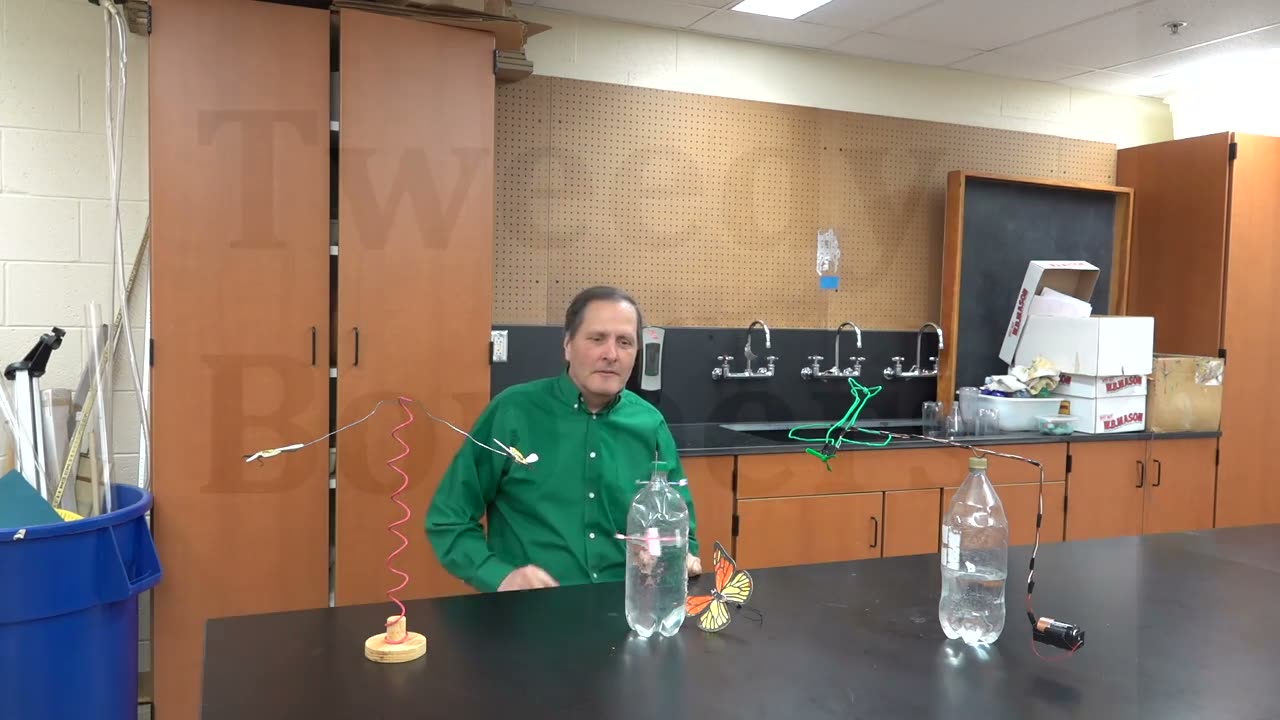
Each student builds a cardboard butterfly with a washer on each front wingtip and balances it by its head on a fingertip, then taps it, adds coins and tries new supports. Students learn that mass placed far out on the wings shifts the center of gravity to the support, and that a toy with its center of gravity at or below the support swings back instead of falling.
How can a cardboard butterfly sit on your fingertip by just its head, and why does it swing back instead of falling when you tap it?
Learning objectives
- Students will be able to build a balancing toy and locate its balance point.
- Students will be able to explain how adding mass at the wingtips moves the center of gravity.
- Students will be able to predict whether a toy will balance, tilt or fall when extra mass is added in different places.
- Students will be able to compare an object supported below its center of gravity with one supported above it.
Lesson flow (5E)
Balance the demo butterfly on your fingertip by its head and tap a wing so it rocks and settles. Then try to balance a plain cutout with no washers the same way and let it fall. Ask: what is different?
Students cut out and color their butterflies, attach one washer under each front wingtip at equal distances from the head, and gently bend the wingtips down. They balance it on a fingertip, then with a partner tap a wing, tape a coin on the tail, tape a coin on one wingtip, and try an eraser or bottle cap, recording each result.
Introduce center of gravity as the balance spot. Use Bruce's hammer demo: balance it on a bar with the support directly under its center of gravity, then hang it from a string with the support above. Connect the butterfly to the second case: the washers move the center of gravity forward to the head and hang slightly lower than the support, so any tilt raises them and gravity swings the butterfly back.
Show the two-pencil balancer and point out that its center of mass is in empty space below the support. Swap one pencil for a shorter one and have students predict how it will tilt before you set it back on the support.
Exit ticket: draw the butterfly from the side, mark the support and the approximate center of gravity, and explain in one sentence why it swings back when tapped.
Discussion questions
- Where does your butterfly balance, and where would a plain cardboard butterfly balance?
- What did the washers change?
- Look from the side: are the washers higher or lower than your fingertip? Why might that matter?
- Why did a coin on the tail make it tip off?
- How is the butterfly like the hammer hanging from the string, and unlike the hammer on the bar?
- Can an object's center of gravity be somewhere that is not part of the object? What is your evidence?
Common misconceptions
Assessment
- Exit ticket: a side-view drawing with the support and center of gravity marked, plus a one-sentence explanation.
- Use the age-matched worksheet (5-7 'My Balancing Butterfly', 8-10 'Balance Test' or 11-14 'Explaining Center of Gravity') and its answer key.
- Performance task: give students a coin and ask them to predict, then show, where to tape it to make the butterfly tilt toward one wing.
- Oral check during testing: ask each pair to explain why tapping does not knock it off.
Differentiation
Support: Provide pre-cut butterflies and attach washers with tape so younger students can test right away; focus on where it balances and what happens when it is tapped, and use the 5-7 worksheet.
Extend: Find the cardboard butterfly's center of gravity before and after adding washers with the plumb-line method, compare flat wingtips with bent-down wingtips for stability, or build a tweety bopper to investigate rotational inertia and harmonic motion.