Teachers / Lesson plans / Balloon in a Bottle
Lesson plan · Grades 2-6Can you blow up a balloon inside a bottle?
Students build a sealed two-straw balloon bottle and discover that the "empty" bottle is full of air that resists being compressed. They test what the open vent straw does, then solve Bruce's puzzle of inflating the balloon without blowing into it, which leads to the idea that outside air pressure does the pushing.
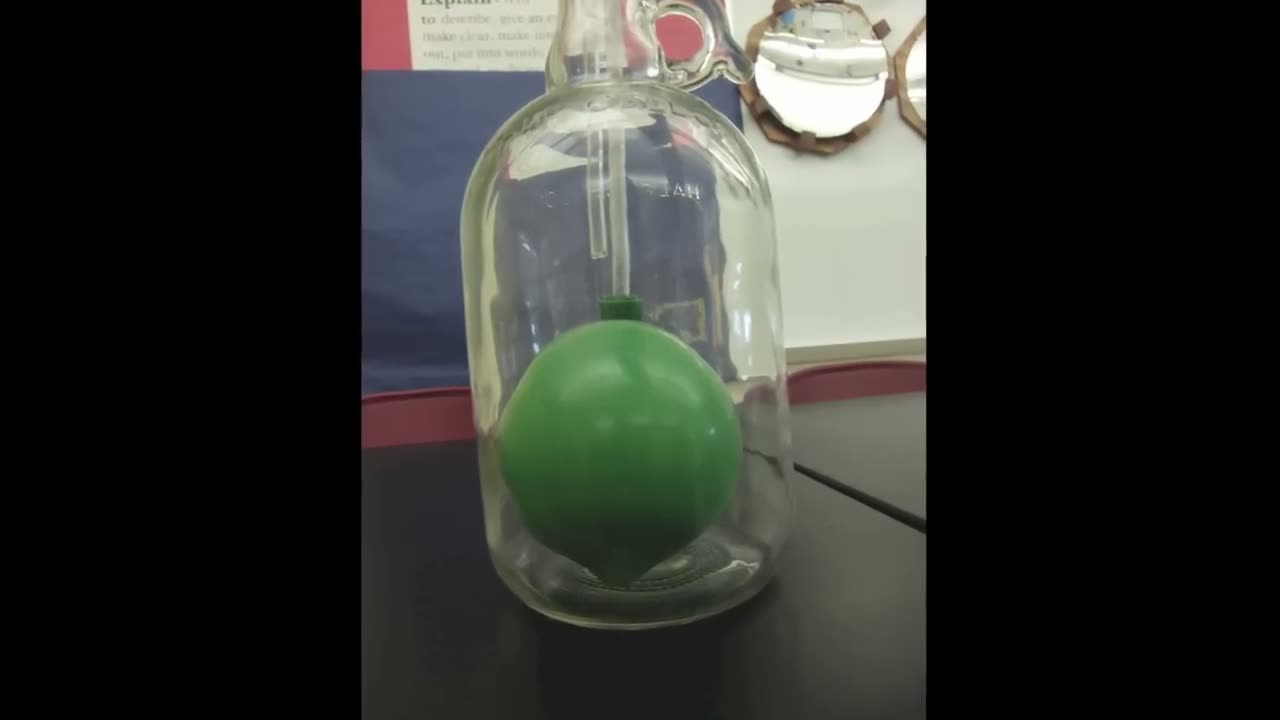
The teacher blows up a balloon inside a sealed bottle, then makes it inflate again while blowing (actually sucking) on a different straw. How did the balloon blow up both times?
Learning objectives
- Students will be able to explain that air is matter that takes up space, using evidence from the balloon bottle.
- Students will be able to predict and test how closing the vent straw changes whether the balloon inflates.
- Students will be able to explain that air pressure from outside, not suction, pushes air into the balloon.
- Students will be able to compare at least two solutions to the no-holes balloon challenge.
Lesson flow (5E)
Show the demo bottle. Inflate the balloon through its straw, let it deflate, then inflate it again by secretly sucking on the vent straw. Ask: how did the balloon blow up both times? Record student ideas.
Pairs build their bottles following the page steps, then run the tests: blow with the vent open, blow with the vent covered, cover the vent after inflating and release the balloon straw, and finally try sucking on the vent. Students record each result on the worksheet table.
Discuss results. Build the idea that the bottle is full of air, that air takes up space and pushes back when compressed, and that the vent lets it escape. Explain the sucking trick: removing air lowers the pressure inside, and outside air pressure pushes air into the balloon.
Pose Bruce's no-holes challenge with a plain bottle. Pairs brainstorm solutions, including ones they can't test, and try one (bypass straw, or straw and rubber band). Compare which methods work and why.
Exit ticket: draw the bottle with arrows showing where the air moves when the balloon grows, and write one sentence explaining what pushes air into the balloon during the sucking trick.
Discussion questions
- What was in the bottle before the balloon went in? How do you know?
- What job does the open straw do?
- Why does the balloon stay inflated when you cover the open straw, even though the balloon's own straw is open?
- When you sucked on the open straw, what actually pushed the air into the balloon?
- Which no-holes challenge solutions would work, and which wouldn't? Explain using air pressure.
- Why would chilling the air in the bottle help the balloon inflate?
Common misconceptions
Assessment
- Exit ticket drawing with air-flow arrows and a one-sentence explanation of the sucking trick.
- The age-appropriate worksheet, especially the prediction and results table.
- Performance task: without looking at the steps, a student shows how to make the balloon stay inflated with its straw open, and explains why it works.
Differentiation
Support: Pre-assemble the balloon on the straw with the rubber band for younger students, and have them focus on the vent open vs vent covered comparison with the draw-and-choose worksheet.
Extend: Older students use Boyle's law to estimate the pressure needed to fill half the bottle in a sealed system, and design a fair test comparing two no-holes challenge solutions.