Teachers / Lesson plans / Breaking Pole Paradox
Lesson plan · Grades 3-8How can you snap a stick that's resting on two cups of water without knocking them over?
Students watch a stick resting on two cups of water snap in half without the cups moving, then compare a slow push with a fast strike on a spaghetti version and rotate through hands-on inertia stations (coin on a card, coin stack). They explain the result with Newton's first law and, for older students, rotation around the pieces' new centers of mass.
A stick resting on two cups of water is struck so hard it snaps in half, yet neither cup tips or spills. How can a blow strong enough to break the stick not knock over its supports?
Learning objectives
- Students will be able to predict and compare how the supports respond to a slow push and a fast strike.
- Students will be able to explain, using inertia, why a fast strike breaks the stick before the supports are disturbed.
- Students will be able to describe how each broken piece rotates around its center of mass so its outer end lifts away.
- Students will be able to identify the variables in a fair test of the setup and design one.
Lesson flow (5E)
Show the spaghetti setup. Ask: if I break this stick, what happens to the cups? Students vote. Press slowly on the middle of one strand and let them watch the ends drag and the cups tip or slide.
Reset and do several fast strikes while students record results in a table (strike type, broke?, cups?). Film one in slow motion. Groups then rotate through the coin-on-a-card and coin-stack stations, predicting before each try.
Introduce inertia and Newton's first law. Play Bruce's board break and his center-of-mass diagram. Use the slow-motion clip to show the pieces' outer ends flipping up as each half rotates around its own center of mass.
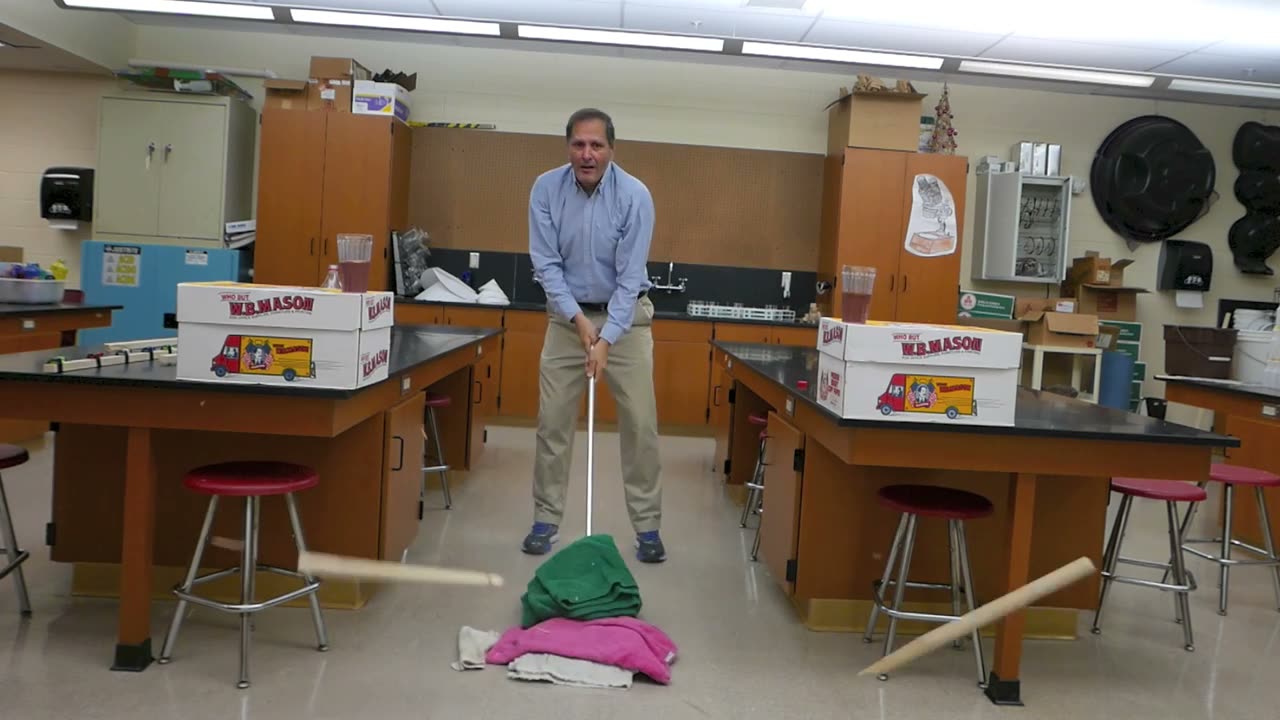
Show Bruce's failed take. Groups identify what went wrong (the pieces hit the box under a glass) and propose one change to the setup and how they would test it fairly.
Exit ticket: 'Why does a fast strike leave the cups standing but a slow push knocks them over? Use the word inertia.'
Discussion questions
- What did the cups do when the stick was pushed slowly? When it was struck fast?
- Which parts of the stick 'want' to stay still, and why?
- Why does it matter how quickly the stick breaks?
- Which way did the outer ends of the pieces move right after the break? Why?
- What could make the trick fail?
- How is this like the coin-on-a-card trick or a tablecloth pull?
Common misconceptions
Assessment
- Exit ticket using the word inertia.
- The 8-10 or 11-14 worksheet, especially the data table and the 'why' question.
- Quick performance task: a student predicts, then demonstrates, the coin-on-a-card trick and explains it in one sentence.
Differentiation
Support: Younger students focus on fast vs slow and the coin-on-a-card station, use the 5-7 draw-and-tell sheet, and describe inertia as 'things like to keep doing what they're doing'.
Extend: Older students analyze slow-motion frames to see the outer ends rise, compare stick thicknesses or rim overlap in a fair test, and look up the center of percussion of a uniform rod.