Experiments / Breaking Pole Paradox
Breaking Pole Paradox
How can you snap a stick that's resting on two cups of water without knocking them over?
Whack a stick balanced on two cups of water so hard it snaps in half, and the cups don't even wobble.
New home version. Bruce's original demonstration is in the video; these home instructions were adapted for this site and are still being test-built.
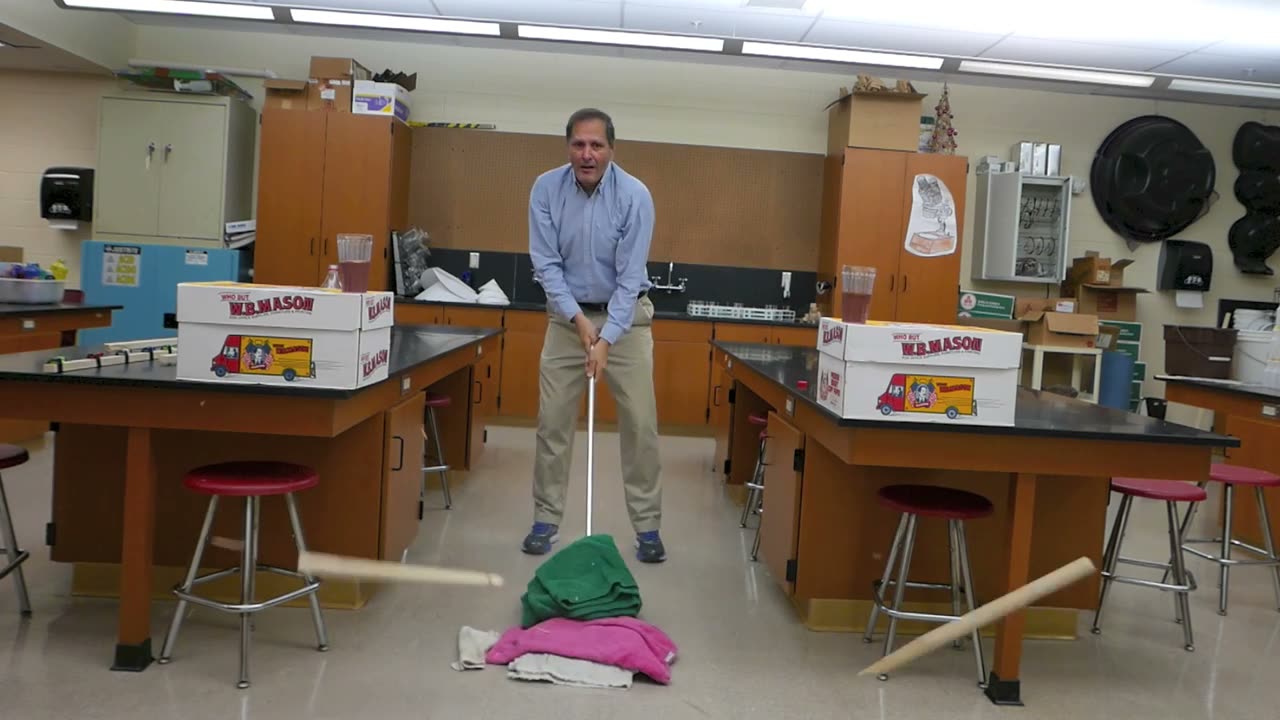
In the video, Bruce rests a 4-foot pine board on two glasses full of water, swings a metal bar down onto the middle, and snaps the board in two while the glasses stay standing. That full-size strike is a grown-up demonstration, not a home project. At home you'll do a small, safe version: a strand of uncooked spaghetti resting on two plastic cups of water, snapped by a grown-up with a quick chop of a ruler. Push slowly and the cups should topple; strike fast and they stay put. The secret is inertia.
“I put it on the cups, and when I hit it very quickly, it has enough inertia that I can break it in place.”
Build it
Build two equal stacks of books on a table, about 6 inches (15 cm) tall, with a gap about 7 inches (18 cm) wide between them.
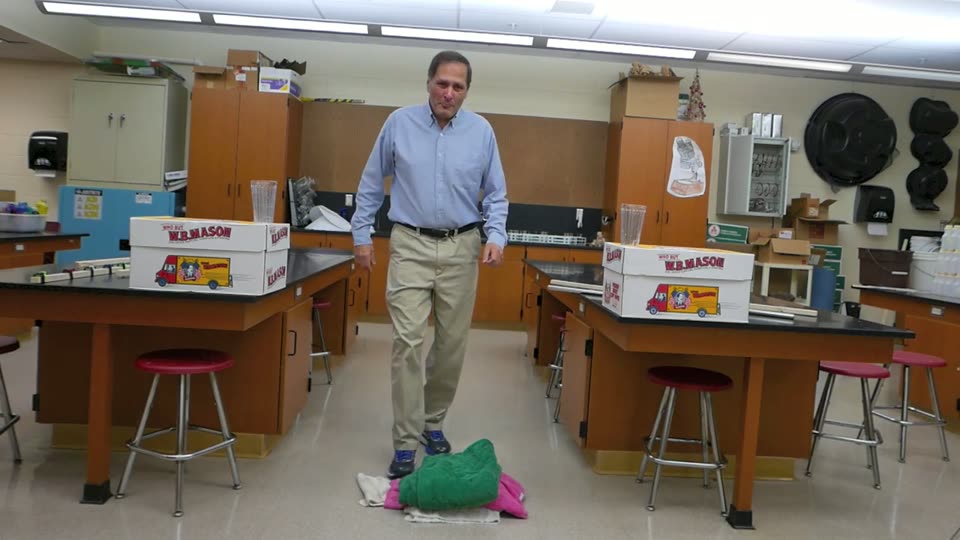
Fold the towel and lay it on the table in the gap. It catches the ruler, like the pile of towels on Bruce's floor catches his bar.
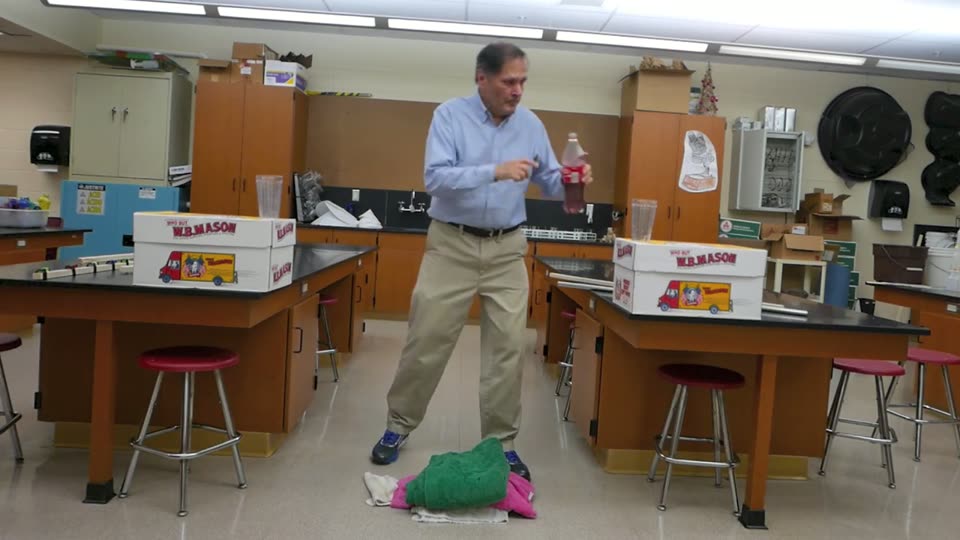
Fill both plastic cups about three-quarters full of water and add a drop of food coloring.
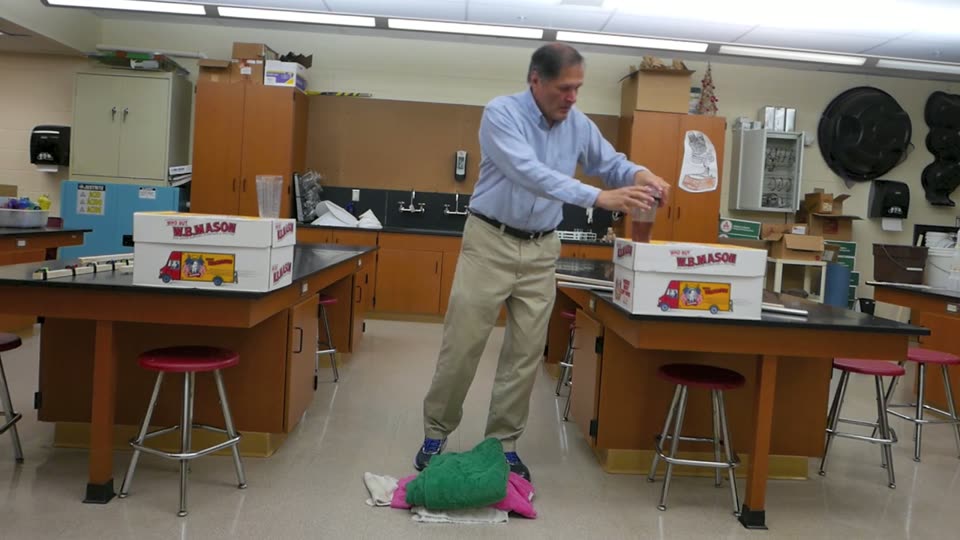
Stand one cup on each stack, right at the edge next to the gap.
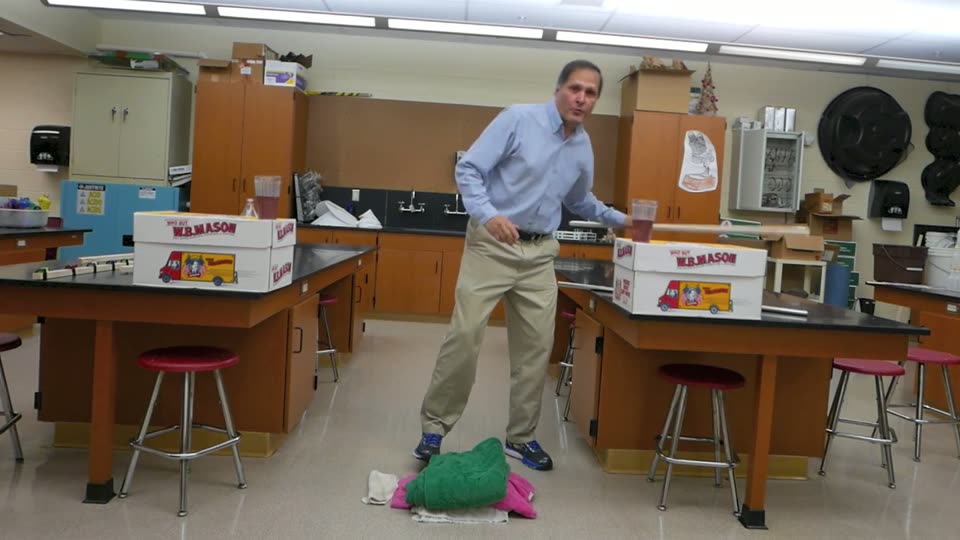
Lay one strand of spaghetti across the two cups so each end rests about half an inch (1 cm) onto a rim.
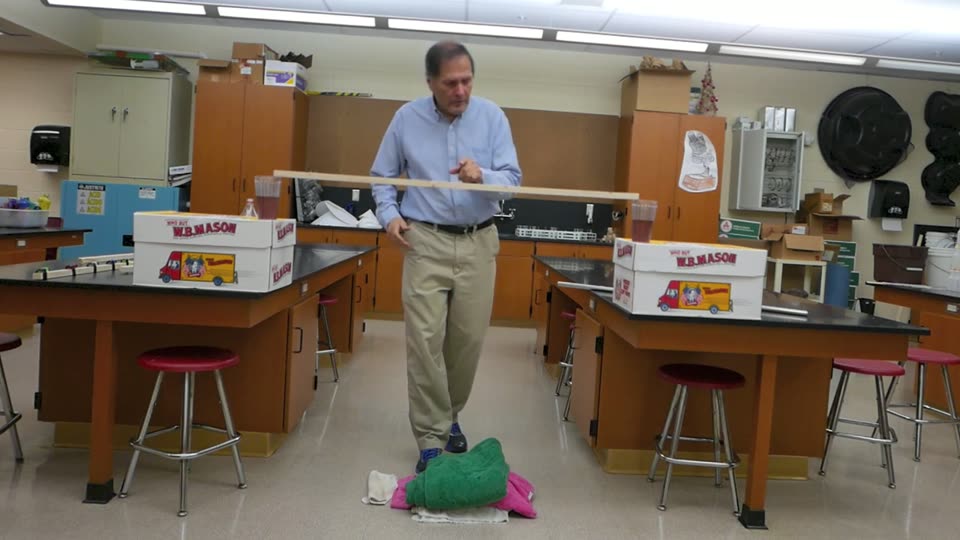
Put on safety glasses. Everyone else steps back about 6 feet (2 m).
Grown-up: Hold the ruler flat by one end and raise it about a foot (30 cm) above the exact middle of the spaghetti.
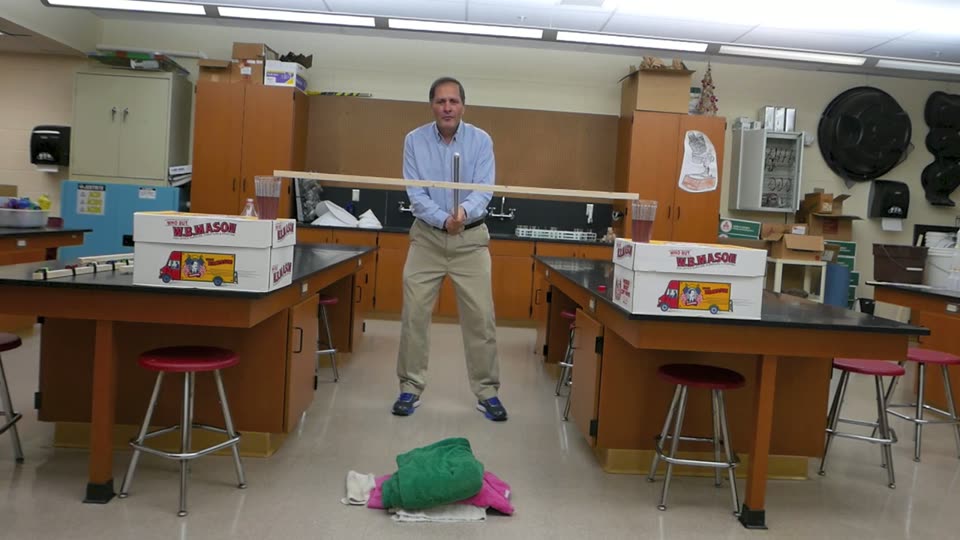
Grown-up: Chop straight down, fast and hard, and follow through into the towel.
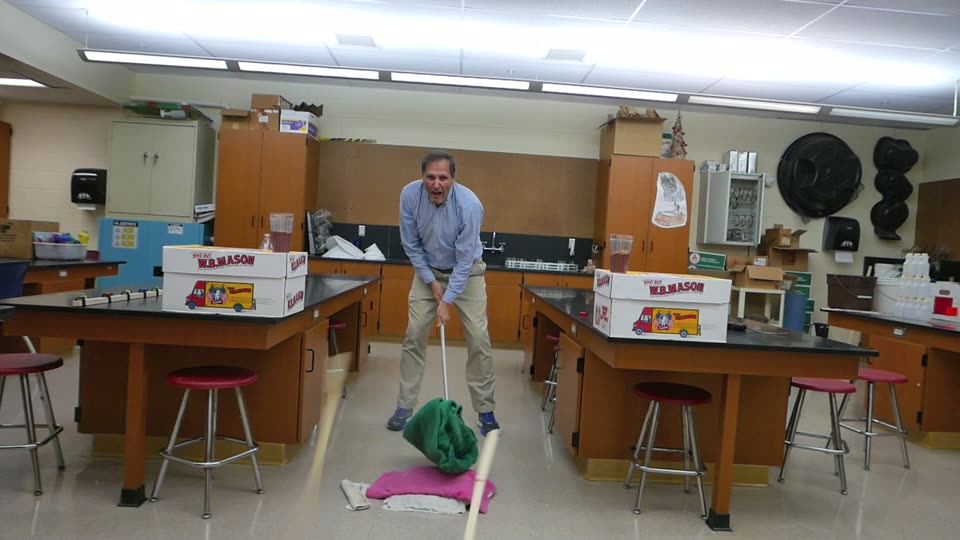
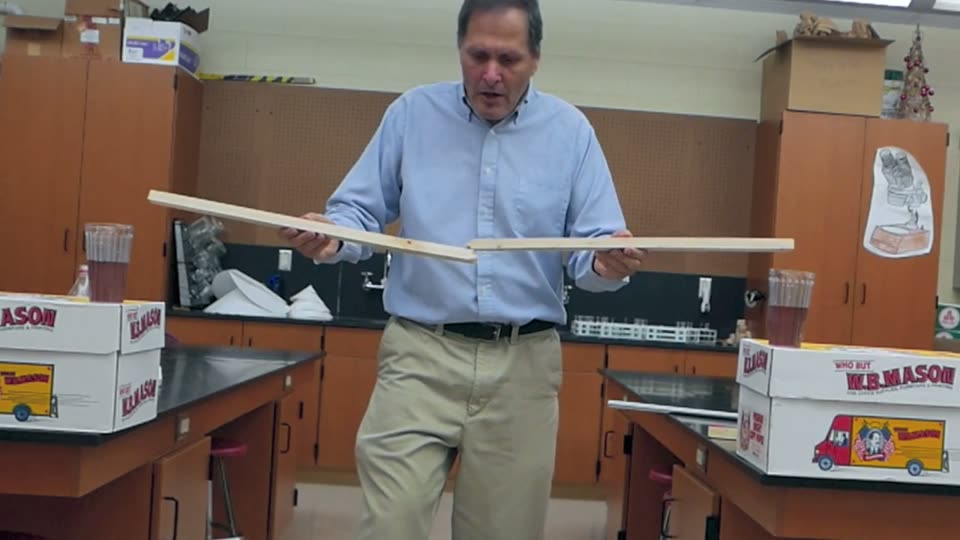
Look at the cups. Are they still standing, with the water inside? Find both pieces and see where each one landed.
Try it & notice
What's going on?
For young scientists
Inertia means things keep doing what they're already doing. Something sitting still stays still until a push gets it moving, and heavier things need a bigger push. The two ends of the spaghetti are sitting still on the cups, and they 'want' to stay that way.
When you press slowly, the push has plenty of time to travel along the spaghetti to the ends, so the ends get dragged and the cups get tugged and tipped. When a grown-up chops fast, the middle snaps in a tiny fraction of a second. The ends haven't had time to start moving before the spaghetti breaks, and once it's broken, the push can't reach the cups anymore.
Then each piece spins like a seesaw. Its broken end gets shoved down, so its outer end flips up, lifting off the cup instead of pushing on it. Bruce explains that each piece turns around its own middle, its center of mass, and its outer end 'simply misses the cup'.
For grown-ups & teachers
This is a classic inertia paradox (versions with a broomstick on wine glasses or paper loops are old parlor demonstrations). Newton's first law says the board's ends stay at rest unless a net force acts on them, and their mass resists being accelerated. A sharp blow at the center delivers a large force for a very short time. Wood (or spaghetti) can only carry so much bending force before it fractures, and the blow drives the center far past that limit within milliseconds, before the ends have picked up any significant motion. Once the board is in two pieces, no more force can be carried to the supports. A slow push does the opposite: the force builds gradually and is shared out along the whole board to the supports, so the glasses take the load and tip.
Bruce's own explanation is about rotation, and it's the second half of the story. After the break, each half gets a downward impulse at its inner (broken) end, off its center of mass. That impulse both moves the half downward and spins it around its center of mass. For a uniform rod struck at one end, the spin wins at the far end: right after the hit, the far end moves upward at about twice the speed the center of mass moves down (the struck end's 'center of percussion' sits two-thirds of the way along). So the outer ends lift off the rims instead of pressing on them. This is shown in Bruce's diagram at about 3:00 in the video.
Common misconceptions: that the glasses survive because they are strong (it's the board that limits the force, and the glasses barely feel it), or that the stick moves 'too fast for gravity' (gravity isn't the point; inertia and timing are). It also isn't magic every time. In Bruce's last take, frame-by-frame video showed the break was fine and the pieces were turning, but their outer ends hit the box holding a glass, knocking it enough to spill. Off-center or slow strikes, supports in the pieces' path, and ends resting too far onto the rims all make failures more likely.
Extensions: film strikes in slow motion and step through frame by frame, as Bruce does; compare spaghetti, a thicker bundle, and a wooden coffee stirrer; vary how far the ends rest on the rims; and pair it with Bruce's other at-rest inertia demos (coin on a card over a cup, a stack of coins, a tablecloth pull with unbreakable dishes).
NGSS performance expectations
- 3-PS2-1 Plan and conduct an investigation to provide evidence of the effects of balanced and unbalanced forces on the motion of an object.
- MS-PS2-2 Plan an investigation to provide evidence that the change in an object's motion depends on the sum of the forces on the object and the mass of the object.
Science words
Tips from 41 years of teaching it
Bruce taught inertia to his 7th graders as part of his first motion unit for years, with a run of quick demos. Here is what his lesson notes and parent letters add.
- Bruce defines inertia simply as 'resistance to change in an object's motion', and teaches that the amount of inertia depends on mass.
- To show mass matters, he ties a string to a 1 kg mass and another to a foam block, then yanks each quickly: the foam block comes along easily, and the heavy mass resists.
- His at-rest demos include a block sitting on a skateboard: push the board quickly and the block stays behind. A stack of coins works the same way.
- For the tablecloth trick at home, his advice is to use a cloth with no seam or hem along the edge you pull, and to pull fast and hard. Use unbreakable dishes.
- He follows straight-line inertia with rotational inertia: tops with and without pennies, full vs empty toilet paper rolls, and weights taped at the center vs the ends of a blade.
Bruce warned parents, in a note about trying the tablecloth trick at home, that science teachers would not be responsible for any broken glassware. In another note, he joked that his 7th graders seemed to prove the first law themselves: once in motion, they showed no sign of slowing down.
More to try
- Bruce's string-break demo: hang a heavy weight from a string, with a second string tied below it. Pull the bottom string slowly and the top string breaks; yank it quickly and the bottom string breaks. A grown-up does this one, with a weight that can't land on toes.
- Pull a sheet of paper quickly out from under a cup or a magnet, then slowly. Which way leaves the object behind?
Make it a challenge
Coin, card and cup
Lay an index card on a plastic cup and set a coin in the middle. Flick the card sideways, fast. The coin's inertia keeps it in place while the card shoots out, and the coin drops into the cup. Kids can do this one themselves.
Coin stack
Stack 6-8 coins. Slide a ruler flat along the table and smack the bottom coin out sharply. The rest of the stack drops straight down. Bruce uses a coin stack in his inertia lessons.
Thicker sticks
Grown-up only, with safety glasses: try two or three strands of spaghetti held together with a dot of tape at the middle, or a wooden coffee stirrer. Does it still work, and how much harder does the chop need to be?
Paper loop supports
Hang two paper rings made from strips of paper about 1 inch (2.5 cm) wide from pencils pinned under the top book of each stack, and thread the spaghetti through them. Can a fast chop snap the spaghetti without tearing the paper?
Watch Bruce's blooper
Watch the end of the video, where one try goes wrong. Pause it frame by frame and find the moment the pieces hit the box. Where would you move the box?