Teachers / Lesson plans / Cartesian Divers
Lesson plan · Grades 3-8Why does a diver sink when you squeeze the bottle?
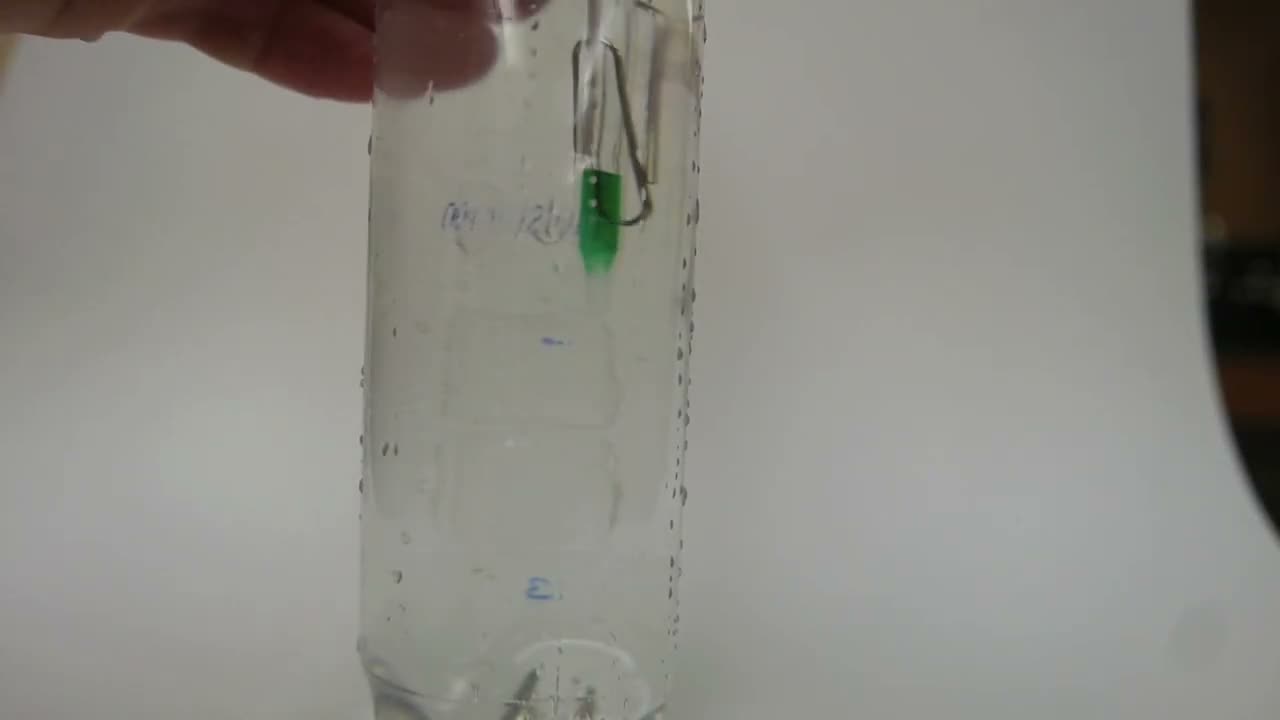
Students tune an eye-dropper diver so it barely floats, seal it in a full 2-liter bottle and make it sink and rise by squeezing. They use what they see inside the dropper to explain the diver with Pascal's principle, density and buoyancy.
Nothing touches the diver, so why does it sink when you squeeze the bottle and rise when you let go?
Learning objectives
- Students will be able to tune a diver to near-neutral buoyancy by adjusting the water inside it.
- Students will be able to describe how the air bubble changes when the bottle is squeezed and released.
- Students will be able to explain the sinking and rising using pressure, density and buoyant force.
- Students will be able to predict and test whether the squeeze location and the cap affect the diver.
Lesson flow (5E)
Show the demo bottle and make the diver sink and rise without saying how. Students predict: what is changing inside the bottle?
Pairs clip, fill and tune their dropper until it barely floats, load the bottle and test it. They watch the water level inside the dropper, try squeezing at the top, middle and bottom, and try it with the cap loose.
Pairs share what they saw in the dropper. Build the explanation together: the squeeze raises pressure everywhere in the sealed water (Pascal), air compresses but water doesn't, water enters, the diver's density rises past water's and the buoyant force no longer holds it up (Archimedes).
Early finishers tune a condiment-packet diver or try to make the diver hover. Demonstrate the remote-control pair and ask which bottle has more pressure when one is squeezed.
Exit ticket: draw the diver floating and sinking, show the air bubble in each, and explain in one or two sentences why it sinks.
Discussion questions
- What did you see happen inside the dropper when you squeezed?
- Why did the diver have to be tuned so it barely floats?
- Why doesn't it matter where you squeeze the bottle?
- Why doesn't the diver work as well with the cap loose?
- In the remote-control bottles, which bottle has the greater pressure when you squeeze one of them?
- How is a submarine like your diver?
Common misconceptions
Assessment
- Exit ticket drawing of the diver floating and sinking, with the bubble size shown and a one-sentence explanation.
- The age-band worksheet (8-10 or 11-14) completed during Explore and Explain.
- Performance task: tune a new diver from scratch so it sinks with a light squeeze.
- Quick check: 'If the diver hovers halfway down, how do its weight and the buoyant force compare?' (They are equal.)
Differentiation
Support: Hand younger students a pre-tuned diver and focus on predicting and observing the bubble; use the 5-7 worksheet and colored water in the dropper.
Extend: Have students compare an open dropper diver with a sealed pipette diver, build a reverse diver in an oblong soap bottle, or calculate the extra water pressure at the bottom of a 4-foot tube (about 1 psi per 2.3 feet).