Experiments / Cartesian Divers
Cartesian Divers
Why does a diver sink when you squeeze the bottle?
Squeeze a closed bottle of water and a tiny diver sinks to the bottom; let go and it floats back up.
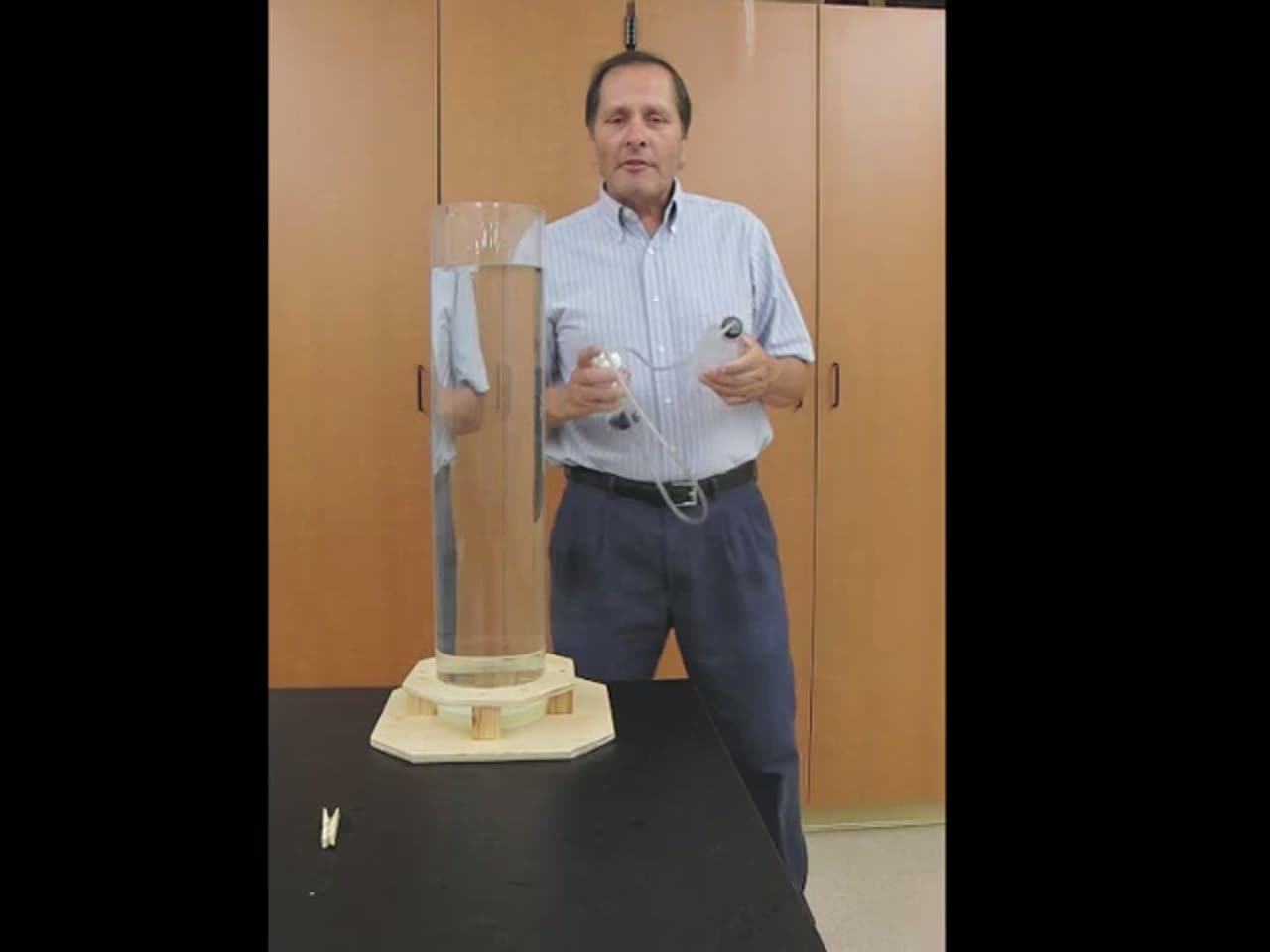
Based on Bruce's demonstration in the video below.
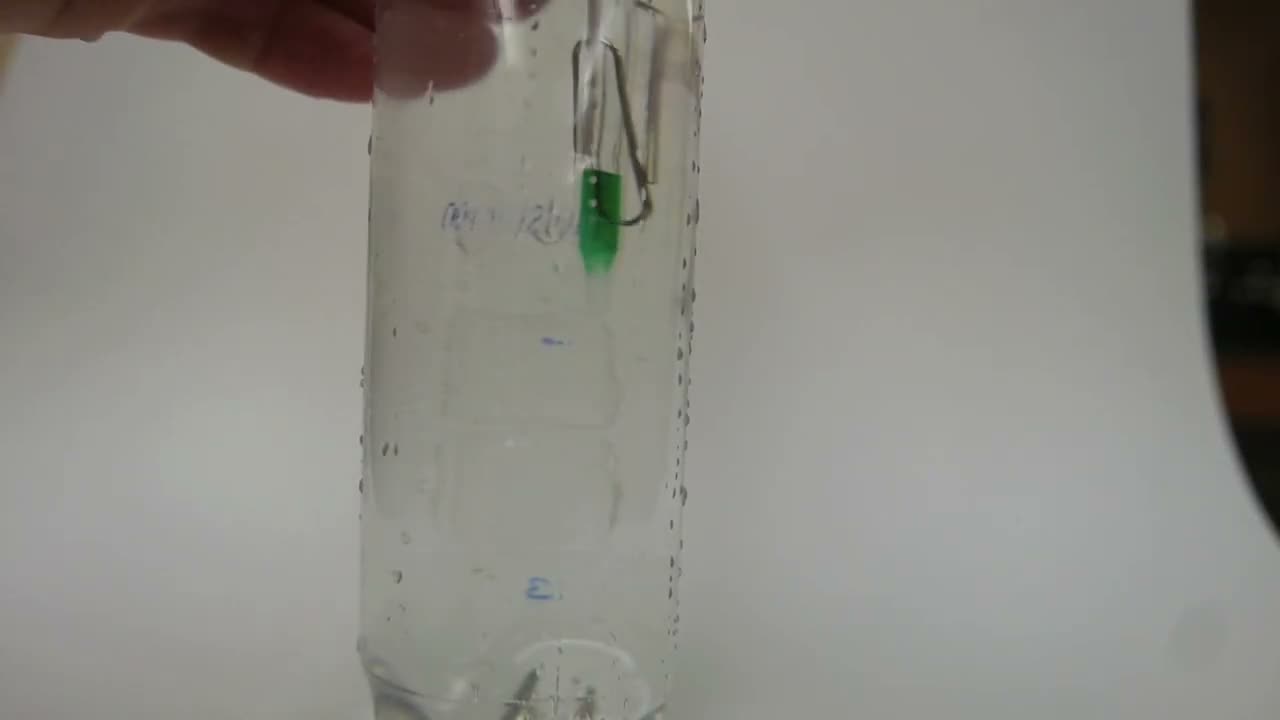
You'll make a little diver from an eye dropper and a paper clip, seal it in a bottle of water, and control it with one hand. Nothing touches the diver, yet it sinks when you squeeze and rises when you let go. A ketchup or mustard packet can do the same trick.
“When the bottle is squeezed, more liquid is forced into the dropper, making the air bubble smaller.”
Build it
Slide the large paper clip onto the dropper's glass tube. Its weight keeps the water level down in the clear tube where you can see it.
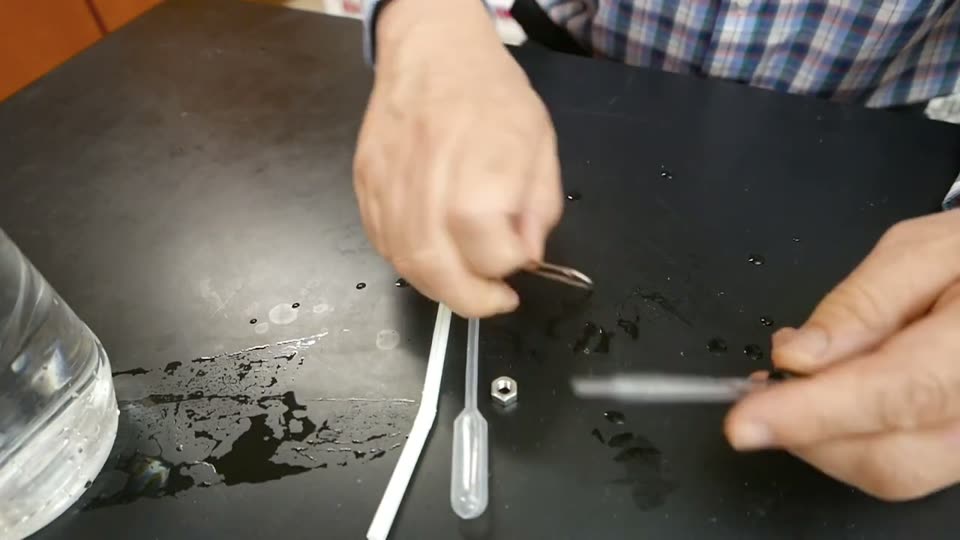
Squeeze the bulb, dip the tip into water (colored water is easiest to watch) and let go to suck some water in.
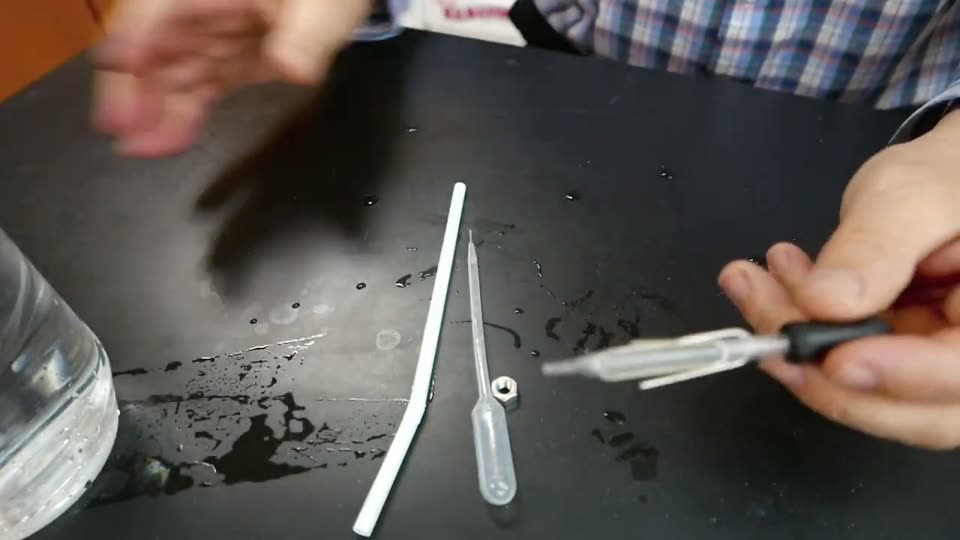
Float the diver in the cup of water and adjust it until it just barely floats, with only the top of the bulb above the surface. Squeeze out a drop if it sinks; add a little more water if it floats high.
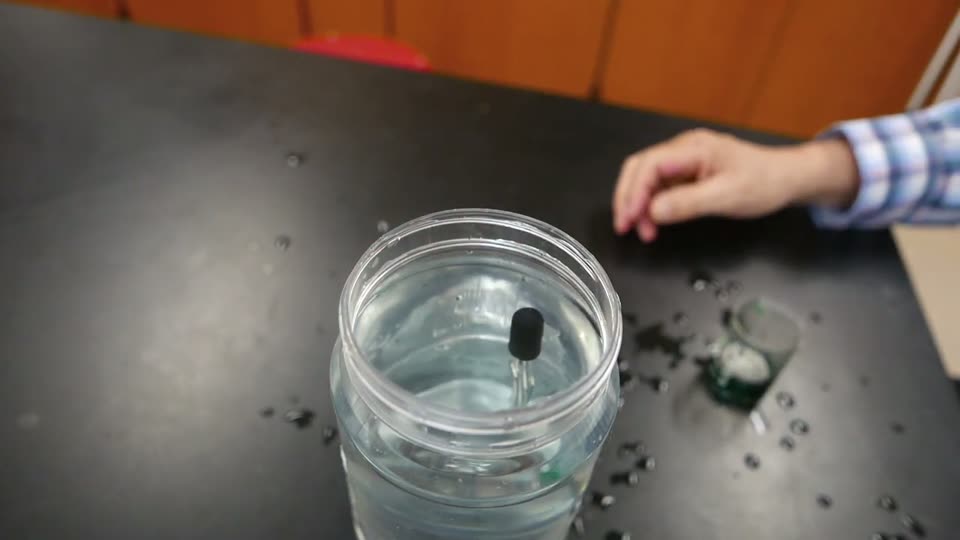
Fill the bottle with water right up to the brim.
Slide the diver into the bottle, bulb end up, and top up the water again if needed.
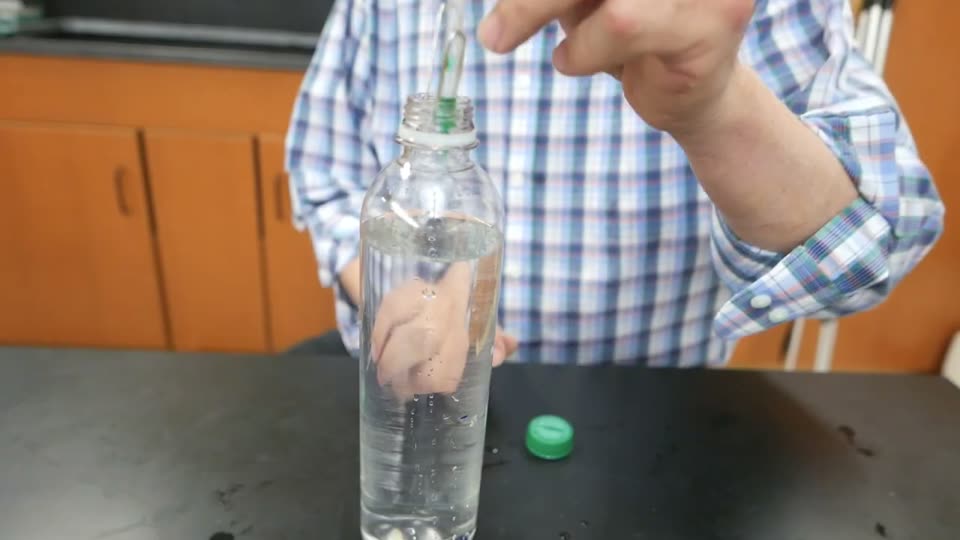
Screw the cap on tightly.
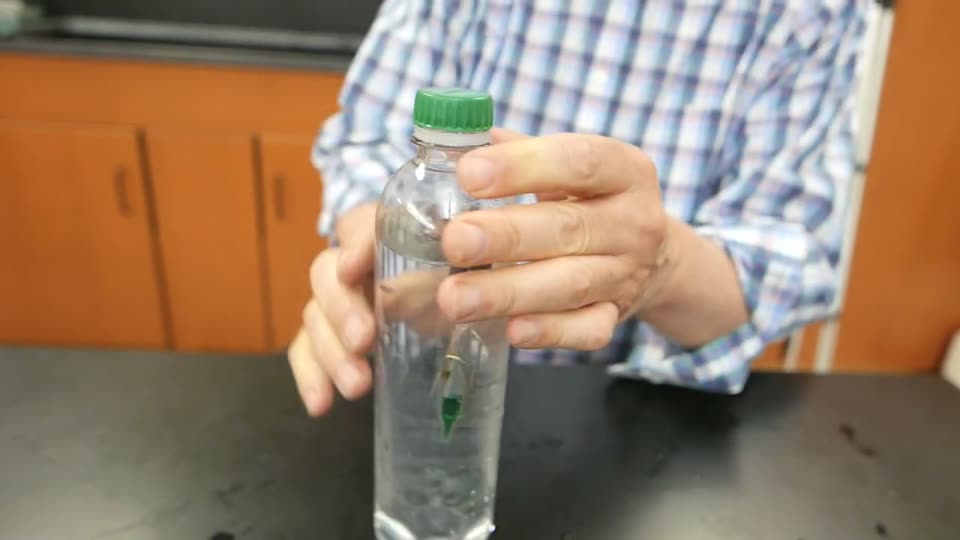
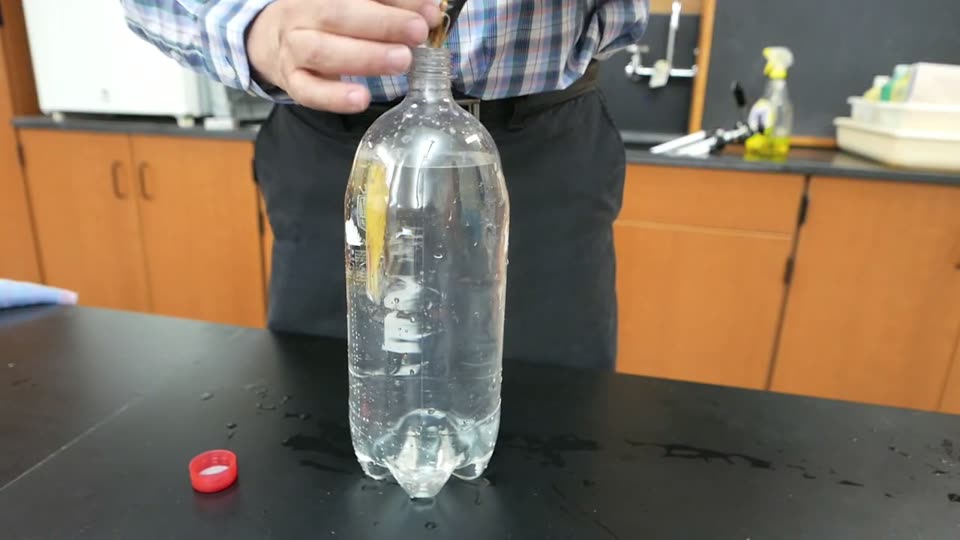
Squeeze the sides of the bottle hard and watch the diver sink. Let go and it floats back up.
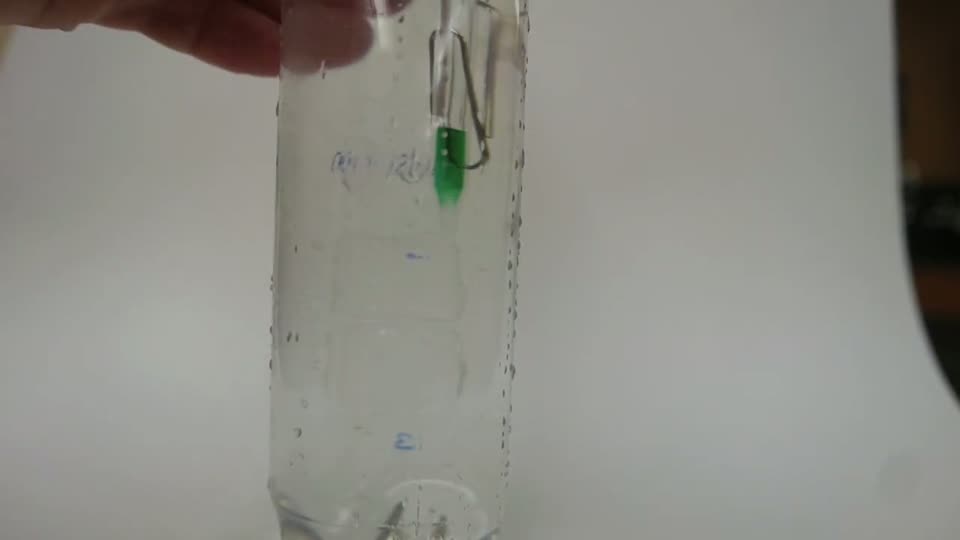
Packet diver: drop a few condiment packets into the cup of water. Keep the ones that float (the sinkers go back to the kitchen).
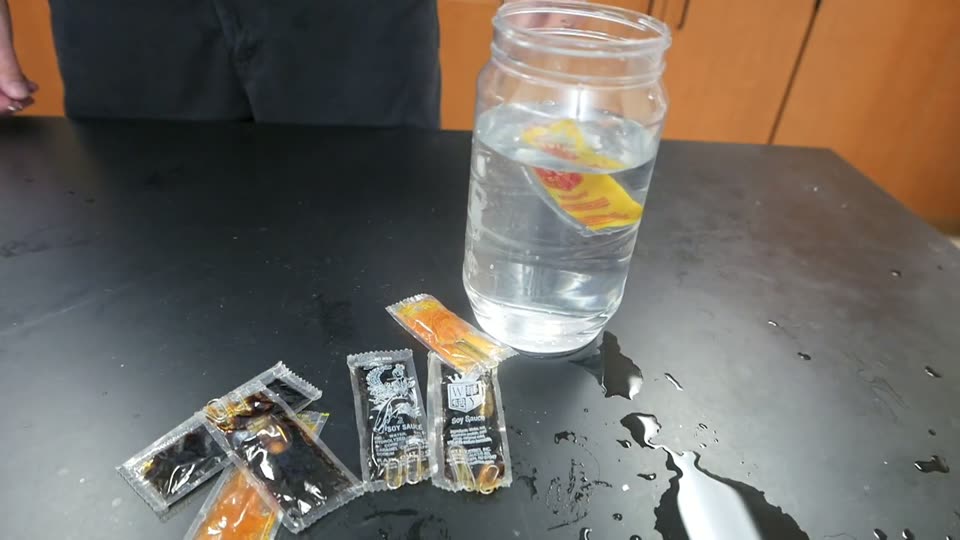
Slide one or two small paper clips onto a floating packet until it just barely floats.
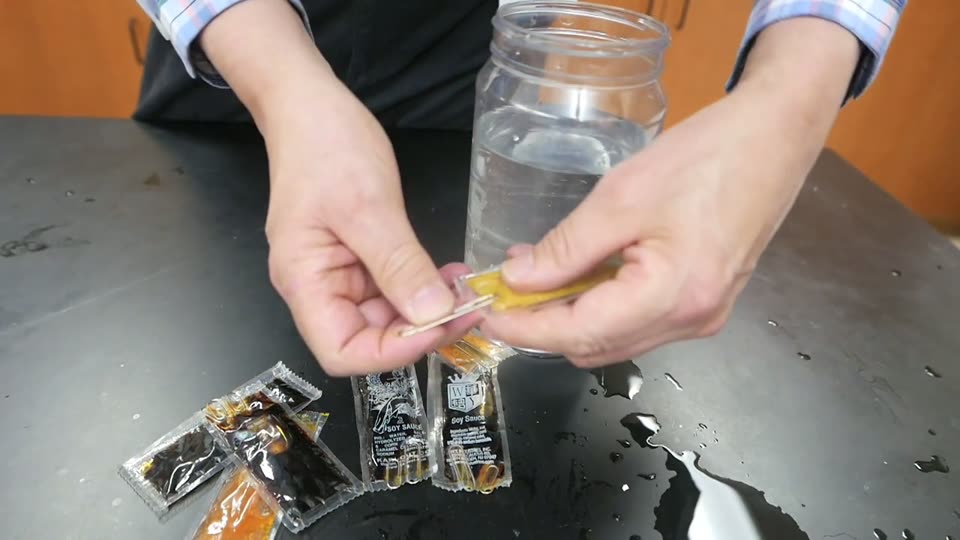
Fold the packet the long way, push it into the full bottle next to your dropper, cap it and squeeze.
Try it & notice
What's going on?
For young scientists
Your diver floats because of the bubble of air trapped inside the dropper. Air is very light, so the dropper plus its bubble is a little lighter than the same amount of water, and the water holds it up.
When you squeeze the closed bottle, your push spreads through all the water, even into the dropper. Water hardly squishes at all, but air squishes easily. So the air bubble gets smaller and water moves in to fill the space. Now the diver carries more water and less air, it is heavier for its size, and down it goes.
Let go, and the air bubble springs back to its old size, pushing that extra water out. The diver is light for its size again and floats up. With the cap off, your squeeze just pushes water out of the top of the bottle instead of squeezing the bubble, so the diver doesn't move much.
For grown-ups & teachers
Squeezing a sealed, completely full bottle raises the pressure of the water, and by Pascal's principle that increase is transmitted equally to every part of the fluid, including the air trapped in the diver. Water is nearly incompressible, but the air pocket is not: by Boyle's law its volume falls as the pressure rises. Water moves into the dropper to take up the space. That is why it doesn't matter where on the bottle you squeeze, and why it fails with the cap off: an open bottle can't build up pressure.
Archimedes' principle explains the rest. The buoyant force equals the weight of water displaced by the diver (glass, bulb and trapped air together). As the bubble shrinks, the diver displaces less water, so its average density rises. When its average density passes that of water, the weight beats the buoyant force and it sinks; release the bottle and the bubble expands, pushing water back out, and it rises. Tuning the diver to barely float matters because a small squeeze only changes the bubble a little. A hover means weight and buoyant force are balanced.
A common misconception is that the squeeze 'pushes the diver down' directly. The diver sinks because its own density changes. In Bruce's sealed plastic-pipette divers, no water can get in at all: the soft bulb is squeezed thinner instead, which shrinks its volume and gives the same result.
Depth adds pressure too, about 1 psi for every 2.3 feet of water. In Bruce's 4-foot tube, a diver that sinks below about 2 feet is squeezed so much by the water above it that it can't rise on its own when the squeeze stops; reducing the pressure with a syringe brings it back. Submarines, fish swim bladders and scuba divers' buoyancy vests all control depth by changing the size of an air space. The name honors Rene Descartes, though Bruce notes there's no clear reason it's tied to him.
NGSS performance expectations
- 3-PS2-1 Plan and conduct an investigation to provide evidence of the effects of balanced and unbalanced forces on the motion of an object.
- 5-PS1-1 Develop a model to describe that matter is made of particles too small to be seen.
- MS-PS2-2 Plan an investigation to provide evidence that the change in an object's motion depends on the sum of the forces on the object and the mass of the object.
Science words
Tips from 41 years of teaching it
Bruce used Cartesian divers with his classes for decades and wrote up ten ways to build them. Here is some of what he learned.
- Without the paper clip the dropper still works, but it needs so much water that the moving water level hides inside the black rubber bulb; the clip's weight keeps it down in the clear glass.
- Food coloring in the dropper makes the level easy to see, but it slowly mixes with the bottle water every time you squeeze, so re-tint it now and then.
- Condiment packets vary: test them in a cup first. Every so often a packet dives with no changes at all; the rest need a small paper clip or two.
- For divers that never need retuning, Bruce seals a cut-down plastic pipette with hot glue and weights it with a stainless steel or brass nut. Plain steel nuts rust. Some of his sealed divers worked as well after ten years as the day he made them.
- Always test a sealed or spinning diver in a bucket before it goes into the bottle; it is very hard to get back out if it needs adjusting.
- In a remote-control pair, students are often surprised that it doesn't matter which bottle you squeeze: the pressure is the same in both.
Bruce's students once asked how deep a diver could go and still come back up, so the class tried one in a 4-foot tube with a balloon membrane stretched over the top. Below about 2 feet the diver stayed on the bottom even after they let go. After some discussion, the students suggested reducing the pressure; a hand vacuum pump worked, and a stopper, hose and syringe worked best, letting them make the diver sink, rise or hover anywhere in the tube.
More to try
- Test tube and balloon diver: push a small balloon into a test tube with a pencil so it seals the open end, then tune it upside down in a bucket. It keeps its bubble even if the bottle is tipped, and the moving water level is easy to see.
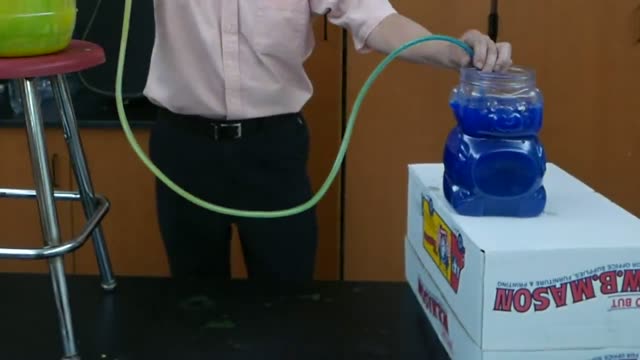
- Big divers: a jar of toy divers sealed with a plastic bag and rubber bands, or a 5-gallon container with a whole soda bottle as the diver, controlled by blowing into a hose or squeezing a second bottle.
Make it a challenge
Straw diver
Cut a soda straw in half, fold one half in the middle and push the two ends of a paper clip into the open ends to hold it. Tune it in a cup of water until it barely floats, then put it in your bottle. It's about as simple as a diver gets.
Reverse diver
Tune a dropper diver so it barely sinks and put it in a clean, oblong dish-soap bottle filled to the top. Squeeze the narrow sides and it rises instead of sinking. Squeeze front to back and see if it works the same way.
Foil diver
Squeeze a piece of aluminum foil into a tight cigar shape, pressing hard against the table. Test it in a jar, then try it in the bottle.
Toy divers in a jar
Small hollow plastic toys make great divers: a grown-up cuts a small hole in the bottom, then you add a little weight like a couple of pennies until the toy barely floats. In a wide jar, cover the top with a piece of plastic bag held down by lots of rubber bands, then press on the bag.
Remote-control diver
With a grown-up, drill a hole in two bottle caps just a little smaller than a piece of plastic tubing and push the tube through both. Fill both bottles and the tube with water, put a diver in each, and squeeze one bottle to control both.
How many can you fit?
Bruce got 33 straw divers into one 2-liter bottle, all diving and rising together. How many can you make work in yours?
More from Bruce