Teachers / Lesson plans / Catching Eggs
Lesson plan · Grades 3-8Can you catch a raw egg without breaking it?
Students compare a raw egg dropped onto a hard tray with one thrown hard into a loosely held bedsheet, then use the idea of impulse to explain why the slow stop saves the egg. In the second class they design, build and test a free-standing landing pad from a limited set of materials, following Bruce's 'Humpty Dumpty Survivor Series' lab.
A raw egg dropped from about 2 m onto a tray shatters, but the same kind of egg thrown as hard as possible into a hanging bedsheet doesn't even crack. Why?
Learning objectives
- Students will be able to predict and compare whether an egg survives landings on surfaces that stop it quickly or slowly.
- Students will be able to explain, using force and time, why lengthening the stopping time reduces the force on an object.
- Students will be able to design and test a landing pad within material constraints and evaluate why it did or did not work.
- Students will be able to identify real-world safety devices that work by increasing stopping time.
Lesson flow (5E)
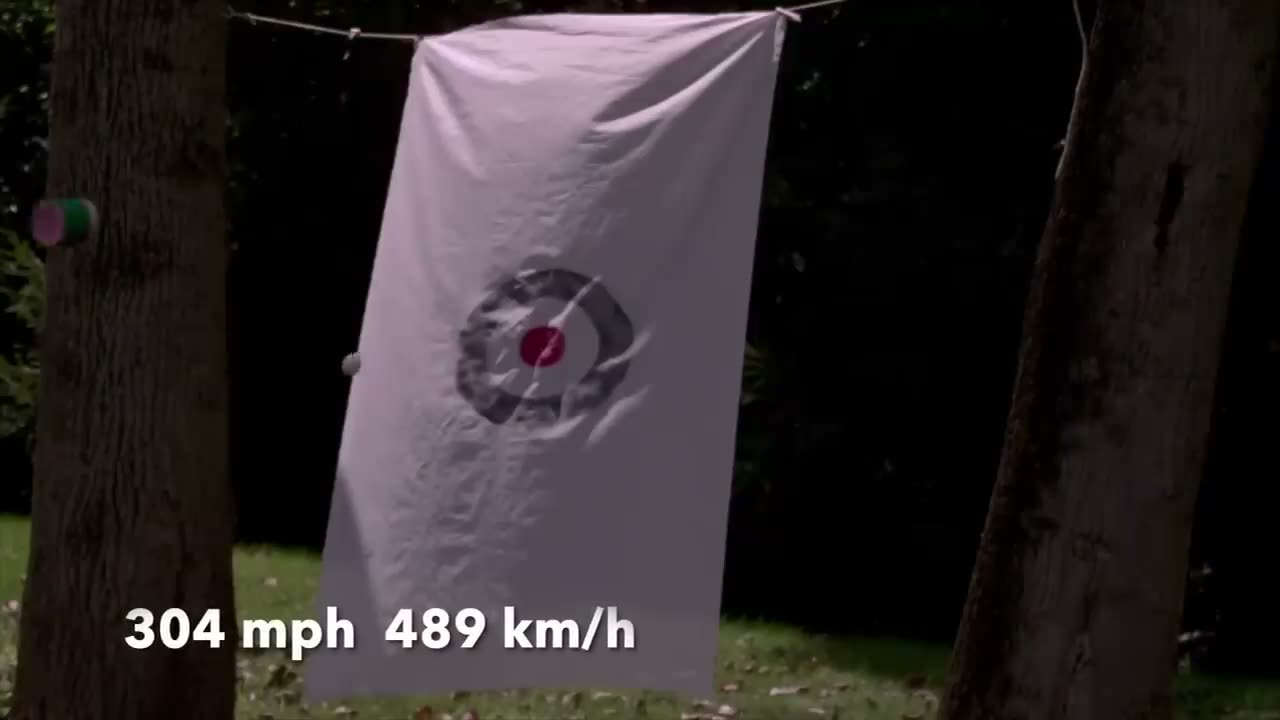
Show the first minute and a half of the 300 mph egg video, then ask: could you stop a raw egg thrown as hard as you can without breaking it? Students list ideas and vote. Then drop an egg onto the tray from about 2 m to show how fragile it is.
Outdoors or over a tarp, test landings from the same 2 m height: tray, folded towel, pillow in a bag. Students predict and record each result. Then two holders hang the bedsheet loosely with the bottom folded up, and students toss eggs underhand while the teacher makes the hard throws. Film the tray drop and a sheet catch in slow motion.
Back inside, watch the slow-motion clips. Introduce momentum and impulse (force x time = change in momentum). Students explain why the same change in momentum gives a huge force on the tray and a small one in the sheet. Connect to Bruce's quote about slowing the egg over a longer time.
Class 2: groups design and build a free-standing landing pad from their kit (no wrapping the egg, no taping to the floor), then test it with a teacher dropping each egg from about 2 m, guided by a hanging string target. Successful pads move up to higher drops only if the school has a safe, adult-run drop point.
Exit ticket: 'Explain why your pad did or didn't save the egg, using the words force and time.'
Discussion questions
- What was different about how the tray and the sheet stopped the egg?
- Did the sheet move when the egg hit it? How far, and why does that matter?
- If you were playing catch with raw eggs, how would you catch them?
- Why might a bounce make things worse for the egg?
- Why did Bruce's 300 mph eggs need so much more stopping distance than a thrown egg?
- How do air bags, crumple zones and helmets use the same idea?
Common misconceptions
Assessment
- Exit ticket using the words force and time.
- The 8-10 or 11-14 worksheet, especially the data table and the 'why' question.
- Performance task: each group's landing-pad test plus a labeled top and side view drawing explaining how the pad is supposed to work.
Differentiation
Support: Younger students compare just the tray and the sheet, use the 5-7 draw-and-tell sheet, and build pads from fewer materials with an adult helping tape.
Extend: Older students use frame-by-frame video and the camera's frame rate to estimate the egg's speed and stopping time, then estimate the average force on the tray versus the sheet; or they research how car crumple zones are tested.