Experiments / Catching Eggs
Catching Eggs
Can you catch a raw egg without breaking it?
Throw a raw egg as hard as you can into a floppy bedsheet, and it comes out without a crack.
Based on Bruce's demonstration in the video below.
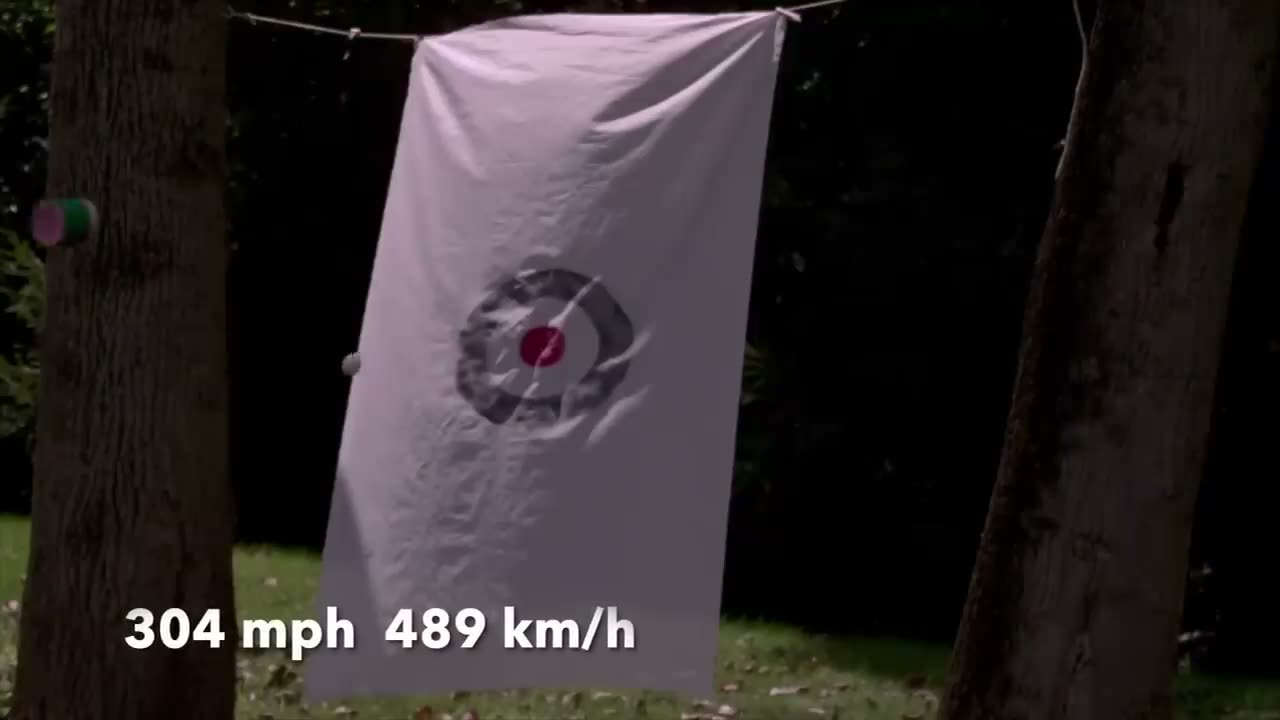
In the video, Bruce fires raw eggs from an air cannon at over 300 mph and tries everything to catch one: sheets, nets, a pool, 84 sheets of newspaper and a 16-foot tunnel of insulation. That cannon is a grown-up workshop machine, not a home project. At home you'll test the same idea safely: drop raw eggs onto a hard tray and a soft towel, then throw them into a loosely held bedsheet and find out why the egg survives. There's also a landing-pad design challenge from Bruce's classroom, and a detailed build plan for his impulse blowgun on the site.
“It's slowing the egg over a much larger distance, a much longer time. So the force is decreased enough that the egg isn't broken.”
Build it
Spread the shower curtain or tablecloth flat on the grass outside.
Lay the baking sheet in the middle of it. This is your hard landing pad.
Grown-up: Stand beside the baking sheet, hold a raw egg straight up at arm's length, about 6 1/2 feet (2 m) high, and let it go.
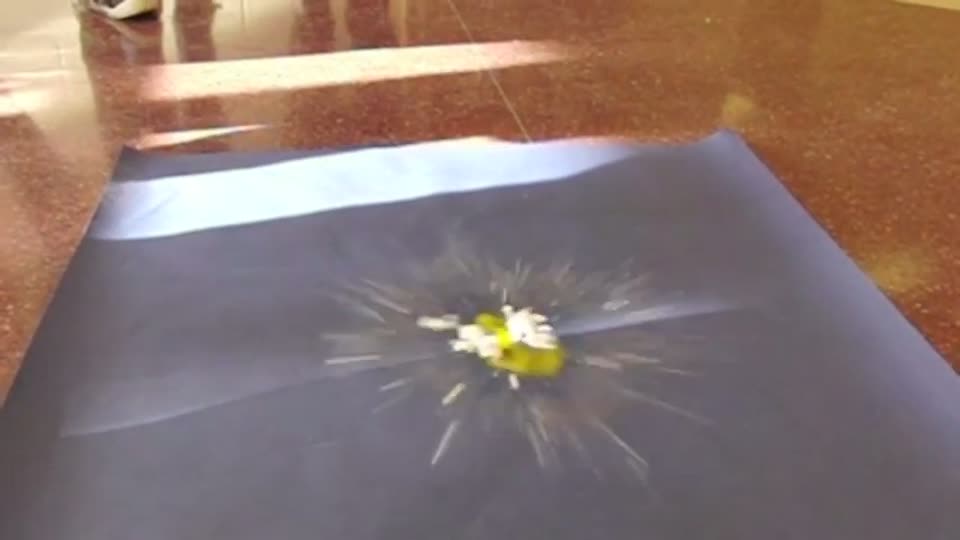
Scoop up the broken egg with paper towels and slide the baking sheet out of the way.
Grown-up: Drop a new egg from the same height onto the bath towel, folded into a thick square.
Have two people each hold one top corner of the bedsheet up high, so it hangs loosely like a curtain.
Have each holder lift their bottom corner up in front, so the bottom edge folds up into a pocket.
Stand about 10 feet (3 m) away and toss an egg gently underhand into the middle of the sheet.
Grown-up: Throw the next egg as hard as you can, aiming at the middle of the sheet.
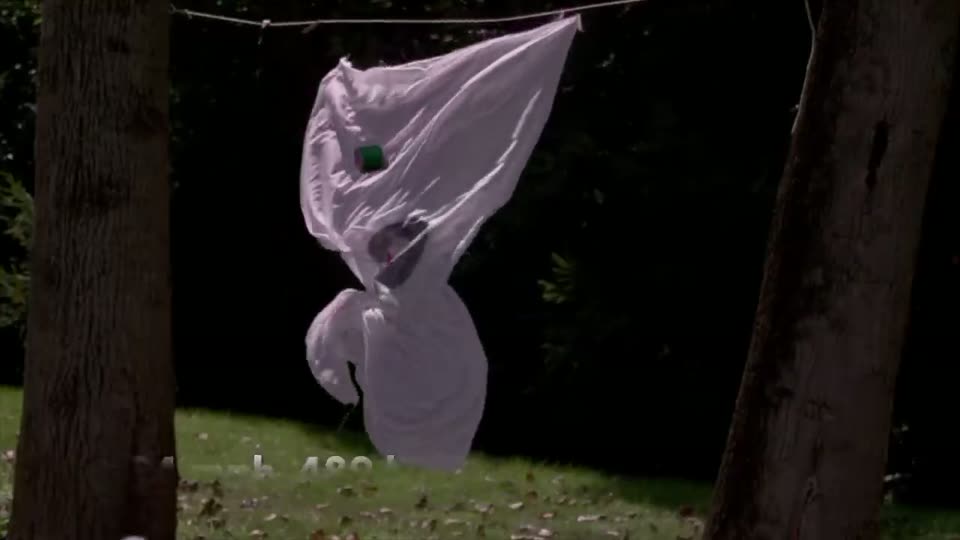
Look in the pocket at the bottom of the sheet and check the egg for cracks.
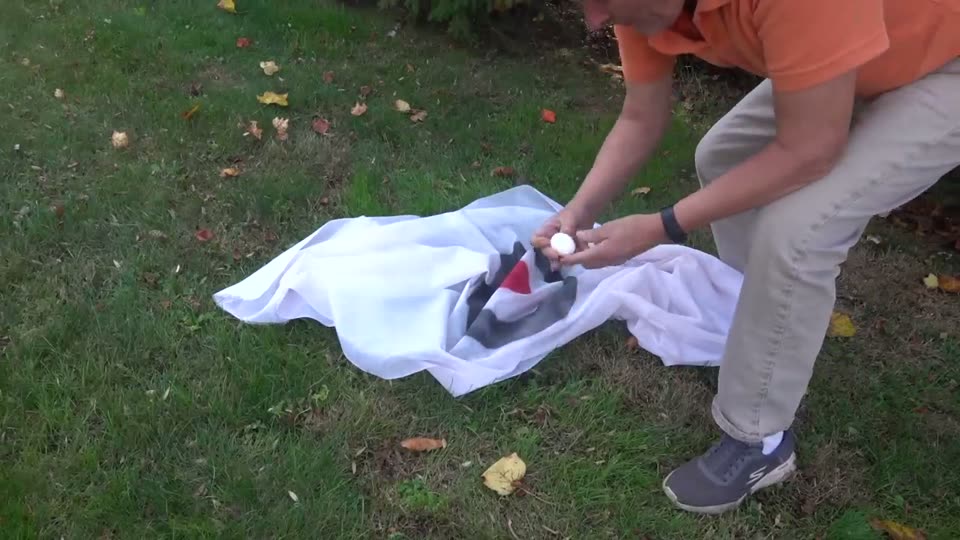
Try it & notice
What's going on?
For young scientists
A moving egg has momentum: it keeps going until something pushes back on it to stop it. To stop the egg, you need a push. You can use a big push for a very short time, or a small push for a longer time. Both stop the egg.
The baking sheet doesn't give at all, so the egg has to stop in a tiny fraction of a second. That takes a huge push, and the shell cracks. The bedsheet gives way and moves back, so the egg slows down bit by bit over a much longer time. The push it needs is small enough that the shell survives. Scientists call this idea impulse: force multiplied by the time it acts.
The faster the egg goes, the more stopping time and distance it needs. That's why Bruce's 300 mph eggs were so hard to catch: he finally saved one with 84 sheets of newspaper in front of a sheet, and another in about 14 feet of fluffy insulation. Car air bags, crumple zones, bike helmets and catching a ball with soft hands all use the same trick.
For grown-ups & teachers
This is the impulse-momentum theorem: the average force times the time it acts equals the change in momentum (F x t = m x change in v). To stop an egg of a given mass and speed, the change in momentum is fixed, so the only way to lower the force is to stretch out the stopping time (or, equivalently, the stopping distance). A 2 m drop gives the egg about 6 m/s (about 14 mph). A rigid tray stops it in roughly a millisecond; a sheet that gives about 30 cm stops it over a tenth of a second or so, about a hundred times longer, so the average force is about a hundred times smaller. These are order-of-magnitude estimates, not measurements.
Two other factors help the sheet. It wraps around the egg and spreads the force over a large area of shell instead of one point, and it absorbs the egg's energy instead of bouncing it back. A bounce actually makes things worse: reversing the egg's direction means a bigger change in momentum than just stopping it. Bruce's landing-pad rules count an egg that bounces out and breaks as a failure, and his lab asks students whether they want their egg to bounce.
A common misconception is that soft materials 'absorb the force'. What they really do is lengthen the collision. Another is that a faster egg just needs a bit more padding: kinetic energy grows with the square of speed, so at the same stopping force the stopping distance must grow with the square of speed too. That's why the sheet that easily caught eggs thrown at 75 mph let 300 mph eggs pass straight through it, and why Bruce needed rows of newspaper or 14 feet of insulation. In the video Bruce also points out that cannon eggs turn sideways as they leave the barrel and hit with their weaker broad side, while an egg is strongest end-to-end. His students found eggs started breaking at about 20 mph when hitting water.
Extensions: film the impacts and step through frame by frame using the camera's frame rate to estimate the stopping time and the egg's speed (Bruce's own method). Run the landing-pad design challenge below and compare designs by drop height survived. Pair this decelerating impulse with an accelerating one: Bruce's paper blowgun (see the impulse-blowgun build plan) shows that a shorter push time gives a slower dart.
NGSS performance expectations
- MS-PS2-2 Plan an investigation to provide evidence that the change in an object's motion depends on the sum of the forces on the object and the mass of the object.
- 3-5-ETS1-2 Generate and compare multiple possible solutions to a problem based on how well each is likely to meet the criteria and constraints of the problem.
- MS-ETS1-1 Define the criteria and constraints of a design problem with sufficient precision to ensure a successful solution.
Science words
Tips from 41 years of teaching it
Bruce first wrote up his egg-catching lab in 1982 and used the egg-in-a-sheet for impulse every year after. Here is what he learned.
- Bruce loops the bottom of the sheet up so the egg rolls down into the fold and stays there instead of dropping to the floor.
- He always throws softly first, then harder and harder, so everyone sees the egg survive each step up in speed.
- He films the throw and steps through it frame by frame; knowing the camera's frame rate and a measured distance, the class can work out the egg's speed.
- His landing-pad lab starts at 2 m and moves up to 4 m and then 5 m, but only if the egg survives the lower height. Each team gets one egg, and a cracked egg can't go higher.
- A string hung from above marks the target, so the dropper and the builders agree on exactly where the egg will land.
- His rules: the pad must stand by itself, can't be taped to the floor, and nothing may be wrapped around the egg. An egg that bounces off the pad and then breaks counts as a failure.
Bruce used to send home a 'how did I do it?' puzzle for families: how could he throw a raw egg as hard as possible and stop it without breaking it? The answer, in the next week's note, was a loosely held bedsheet that slows the egg over a long enough time. One winter, students asked whether they could build their catchers out of snow; he said no, though a few tried it anyway with mixed success.
More to try
- One of Bruce's lab questions: why might it be safer to build packaging around the egg than to build a landing pad to catch it? Try both designs and compare.
- Draw a top view and a side view of your landing pad, label every material, and explain in at least 90 words how it is supposed to work (Bruce's write-up requirement).
Make it a challenge
Humpty Dumpty landing pad
Bruce's classroom challenge: build a pad that stands on its own and catches a raw egg dropped from about 2 m, using only 12 sheets of copy paper, 3 sheets of newspaper, 10 straws, 2 m of masking tape, 3 m of string, 6 cups, 10 rubber bands and about 3 square feet of cardboard. Nothing may be wrapped around the egg, and the pad can't be taped to the floor. At home, the drop is from a grown-up's raised hand only.
Water balloon catch
Play catch with small water balloons. Try catching with stiff hands, then with soft hands that pull back as the balloon arrives. Which way pops more balloons?
Loose, tight, or towel
Throw eggs into a bath towel held loosely, then into the same towel held tight. Keep the throws gentle and the same each time. Which one breaks the egg?
The other side of impulse
Make Bruce's paper blowgun (see the impulse-blowgun build plan) and cut the barrel shorter after each shot. A shorter push time sends the dart a shorter distance. Only blow out through the tube; breathe in through your nose.