Teachers / Lesson plans / Sound You Can See
Lesson plan · Grades 3-8What does your voice look like?
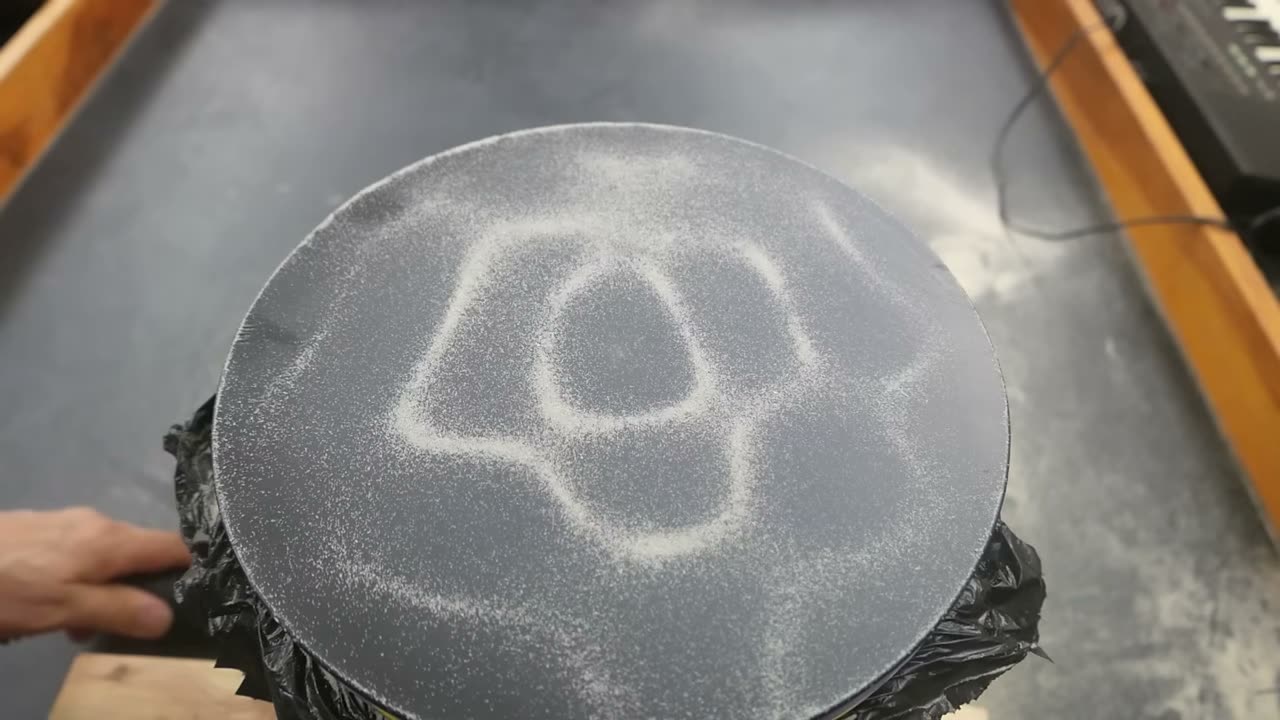
Students sprinkle sand on a stretched plastic or balloon drum, make sounds into it, and watch the sand gather into patterns. They discover that the sand collects where the membrane is NOT moving, and that higher frequencies produce more complex patterns.
When a single steady note plays under a sand-covered drum, the sand slides into a sharp geometric figure, and when the note changes, the figure suddenly changes too. Why does sound arrange the sand into shapes, and why are the bare spots where they are?
Learning objectives
- Students will be able to explain that sound is produced by vibrations and travels as a pressure (compression) wave that can make a surface vibrate.
- Students will be able to identify nodes and antinodes on the membrane and explain why sand collects along the nodes.
- Students will be able to predict and compare how the pattern changes as the frequency of a tone increases.
- Students will be able to design a fair test that changes one variable, such as pitch, volume or membrane tightness.
Lesson flow (5E)
Have students hum while touching their throats, then shout into the open bottom of the bucket drum while a volunteer touches the plastic and reports the buzz. Sprinkle sand on top, place the speaker underneath, and play one low steady tone. Ask students to sketch the pattern and write one question about it.
Groups sprinkle a thin layer of sand on their small drums and make sounds through the short tube: low hums, high hums, loud and soft. They record what the sand does for each sound. Prompt them to look at where the sand piles up and where the membrane is left bare, and to brush the sand smooth between tries.
Use the slinky to show that a vibrating source makes alternating bands of particles squeezed together and spread apart, a compression wave. Explain that when the wave's frequency matches a natural vibration of the membrane, the membrane resonates and forms standing waves: antinodes move a lot and bounce the sand away, while nodes barely move and collect it. Introduce the words vibrate, frequency, pitch, node and antinode.
Back at the bucket drum, step the tone generator slowly from a low frequency to higher ones. Students predict before each step whether the pattern will be simpler or more complex, then observe. Highlight that patterns snap into place only at certain frequencies, and that higher frequencies produce more nodal lines. Compare a steady speaker tone with a student's voice.
Students complete the exit ticket or the key items on their age-band worksheet: label a sketch of the sand pattern with node and antinode, and state what happens to the pattern as frequency increases.
Discussion questions
- What did you feel when you touched the plastic while someone talked into the drum?
- Where did the sand end up, and were those spots moving a lot or hardly at all? How do you know?
- What changed the shape of the pattern, and what only changed how fast the sand danced?
- Why do you think clean patterns appeared only at some notes and not in between?
- Why might a speaker tone make a cleaner pattern than your voice?
- Where else do surfaces vibrate to make or receive sound, and could they have nodes too?
Common misconceptions
Assessment
- Exit ticket: draw a sand pattern, label one node and one antinode, and explain in one sentence why the sand is where it is.
- Use the age-band worksheet (My Sand Picture for younger students, Low Notes, High Notes for grades 3-5, Seeing Standing Waves for grades 6-8) and check answers against the answer key.
- Quick performance task: given two tone settings, the student predicts which will produce the pattern with more lines, then tests it on the demo drum.
- Listen for correct use of frequency, vibration, node and antinode during the Elaborate discussion.
Differentiation
Support: Focus on vibration and the still-versus-moving idea: students feel the membrane buzz, compare a low hum with a high whistle, and circle where the sand went. Use the 5-7 worksheet and the words shake, still and pattern instead of node and antinode.
Extend: Students record the tone-generator frequencies that produce clean patterns and look for a sequence, compare a tight and a loose membrane or a large and a small drum as a fair test, or connect the figures to metal Chladni plates and to the mirror-and-laser can drum the teacher demonstrates.