Teachers / Lesson plans / Crushing Cans with Water
Lesson plan · Grades 3-8Can a tube of water crush a bottle?
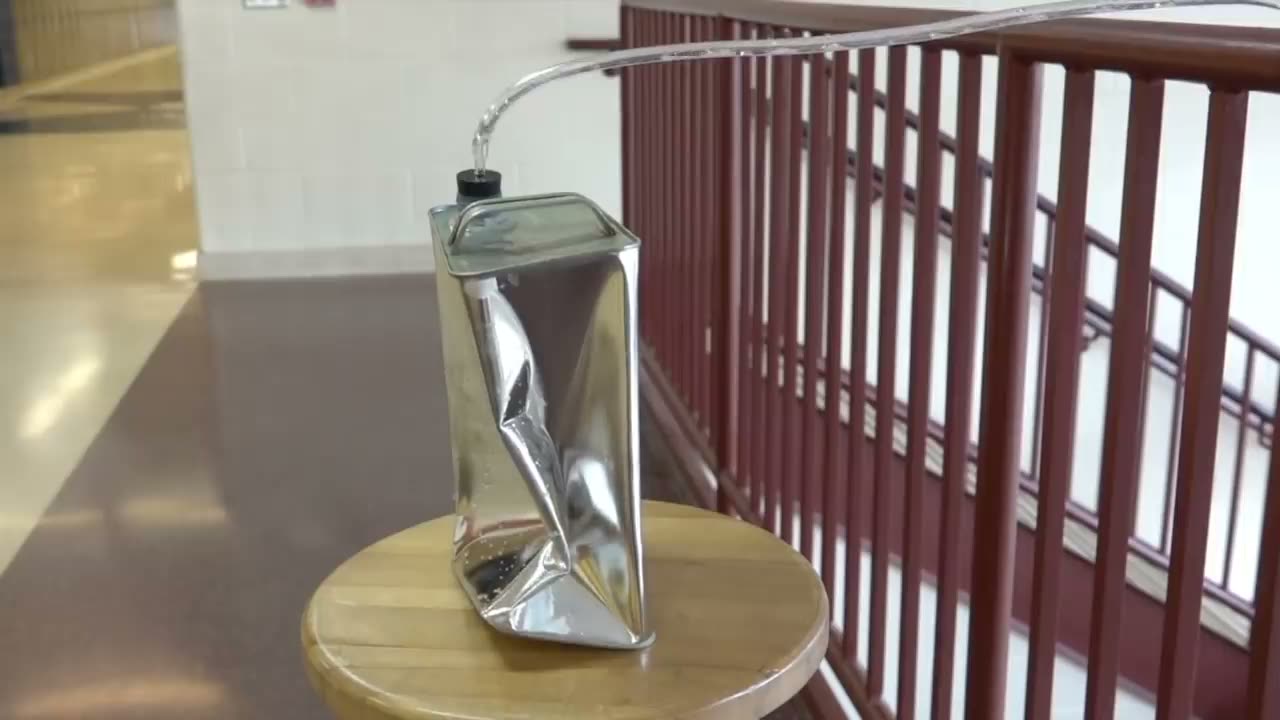
Students fill a thin plastic bottle and a tube with water, hang the tube into a bucket and watch the bottle crumple as the water drains. They test how the height of the bottle changes the crush and build an explanation based on air pressure and the weight of a water column. A teacher-run stairwell demo with a juice bottle or metal can shows the effect at full scale.
A bottle full of water is connected to a tube of water hanging into a bucket. When a pencil is pulled out of the bottom of the tube, the bottle crumples by itself. What is crushing it?
Learning objectives
- Students will be able to predict and observe what happens to a sealed, water-filled bottle when water drains down a hanging tube.
- Students will be able to explain that the outside air, not suction, crushes the bottle once the pressure inside drops.
- Students will be able to compare how much the bottle crushes at different heights and relate it to the height of the water column.
- Students will be able to calculate the pressure drop using 1 psi for every 2.3 feet of water (grades 6-8).
Lesson flow (5E)
Show a full bottle with a holey cap turned upside down: the water stays in. Then attach the filled tube, ask students to predict what will happen when the pencil comes out, and pull it.
Groups fill their bottles and tubes, set the tube end in the bucket and crush a bottle with it held at the table edge. They refill and repeat with the bottle held as high as a standing student can reach, measuring the height above the bucket water and recording how much it crushed. They also pinch the tube partway through to see the crushing stop.
Build the explanation from their observations: air presses on everything at about 14.7 psi. Gravity pulls the water down the tube, but the sealed cap and the submerged tube end keep air from getting in, so the pressure inside drops and the outside air pushes the walls in. Introduce the rule of thumb: 1 psi less for every 2.3 feet of water column, up to a limit of about 34 feet.
Take the class to a stairwell and run the teacher demo: an adult carries a thick juice bottle (or a metal can) up about 15-17 feet while a helper keeps the hose end in the bucket. Have students calculate the expected pressure inside first (17 / 2.3 is about 7.3 psi lower). Point out that the container size doesn't matter, only the height.
Students finish the worksheet conclusion or an exit ticket explaining what crushed the bottle and why holding it higher made a difference. Clean up the wet areas.
Discussion questions
- What did you predict, and what actually happened?
- Where did the water go, and what would normally take its place in the bottle?
- Why did pinching the tube stop the crushing?
- Why does the end of the tube have to stay under water?
- Bruce says the size of the container doesn't matter, only the height. How could you test that?
- Why couldn't you crush anything harder by going higher than about 34 feet?
Common misconceptions
Assessment
- Exit ticket: "Draw the bottle and tube with arrows showing where the air pushes, and write one sentence explaining what crushed the bottle."
- Check the height table on the 8-10 worksheet for consistent refilling, measured heights and a conclusion that matches the data.
- Ask students to calculate the pressure drop for a bottle 6.9 feet above the bucket (about 3 psi).
- For older students, use the 34-foot limit question on the 11-14 worksheet.
Differentiation
Support: Use the 5-7 worksheet, do the setup together step by step with a pre-fitted cap and tube, and focus on the idea that the air outside pushes when nothing inside pushes back.
Extend: Calculate the pressure inside at several heights, graph pressure against height, and connect the 33.9-foot limit to water barometers and to why suction pumps can't lift water out of deep wells.