Teachers / Lesson plans / Falling Cones
Lesson plan · Grades 3-8Which falls faster: a big cone or a small one?
Students turn a fluttering paper circle into a stable 90-degree cone, then work in pairs to choose a variable (number of stacked cones, cone angle, size, color or spin), write a hypothesis, and run timed trials. They use their averaged data to explain air resistance and terminal velocity, and to separate real effects from building and timing errors.
A flat paper circle flutters and lands differently every time, but the same paper, cut and taped into a cone, drops straight and steady. What changed, and what could make the cone fall faster or slower?
Learning objectives
- Students will be able to construct a paper cone to a measured angle using a protractor.
- Students will be able to design a fair test that changes one variable and keeps the others the same.
- Students will be able to measure fall times over repeated trials, calculate averages, and graph the results.
- Students will be able to explain, using the forces of gravity and air resistance, why heavier cones of the same shape fall faster but not in proportion to their mass.
Lesson flow (5E)
Day 1. Drop a flat paper circle several times and have students describe its path and landing. Then fold the demo cone and drop it beside the circle. Ask what changed, and list on the board everything students think might make a cone fall faster or slower.
Day 1. Pairs build three matching 90-degree cones by tracing a circle, marking the 105-degree wedge, cutting one line and taping. They drop one cone three times from the marked height, then stack two and three cones and time each stack three times, recording all times and averages in the data table.
Day 2. Pairs share their stacking averages. Draw force arrows on a falling cone: gravity pulling down and air resistance pushing up. Explain that air resistance grows as the cone speeds up until the two forces balance, and the cone then falls at a steady terminal velocity. A heavier stack must go faster before the air balances it, but air resistance grows faster than speed, so three cones fall faster than one, not three times as fast.
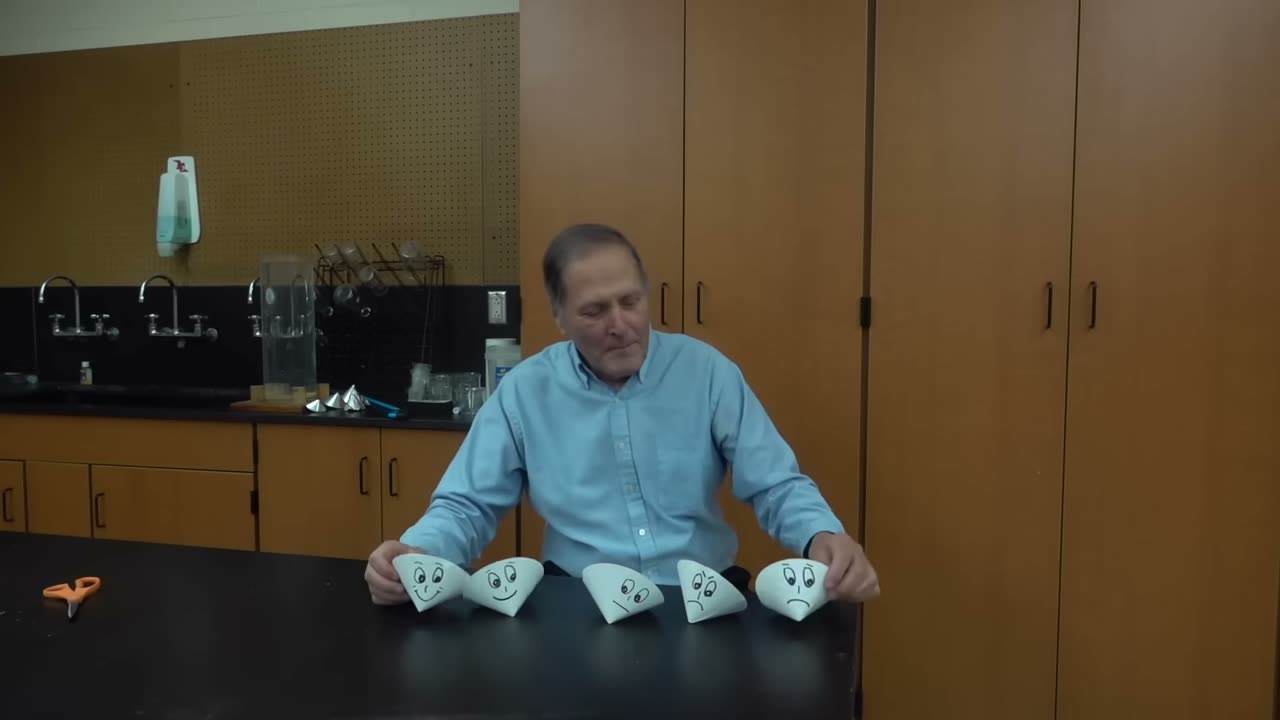
Day 2. Each pair picks a new variable from the class list (cone angle, big versus small, color or faces, spin flaps), writes a hypothesis and procedure, and runs at least three trials per condition. Encourage head-to-head races for quick comparisons and timed trials for data. Pairs testing color or faces should explain any differences they find.
Day 2. Pairs graph their results and write a short conclusion that states whether the data supported their hypothesis and names one likely source of error. Collect the worksheet.
Discussion questions
- Why did the flat circle fall differently each time while the cone fell the same way?
- Did your three trials give exactly the same time? Why not, and why do scientists take an average?
- Two stacked cones are twice as heavy. Did they fall twice as fast? What does that tell you about air resistance?
- If a red cone beat a blue one, how would you decide whether color really matters?
- A big cone and a small cone made from the same paper fall at about the same speed. What changes along with the size that could explain this?
- Bruce predicted the happy-face cones would win and found he may have been wrong. Why is being wrong a useful result in science?
Common misconceptions
Assessment
- Check the completed data table for three trials per condition and correctly calculated averages.
- Exit ticket: "Draw a falling cone with arrows for the forces on it when it reaches terminal velocity, and explain what the arrows show."
- Review each pair's fair-test design on the 11-14 worksheet: one variable changed, a clear measurement, and the controlled variables listed.
- Quick performance task: hand a pair two cones and ask them to predict and demonstrate which falls faster, then justify the prediction using air resistance.
Differentiation
Support: Provide pre-drawn circles with the 105-degree wedge already marked, use the 8-10 worksheet, and have pairs race cones side by side instead of timing. Focus on one cone versus a stack of two.
Extend: Test for terminal velocity by dropping from several heights, calculating average speed (distance divided by time), and graphing to see where it levels off. Compare cones of different paper types adjusted to the same mass, or relate the stacking results to the idea that drag grows roughly with the square of speed.