Teachers / Lesson plans / Hero's Fountain
Lesson plan · Grades 4-8How can a fountain run with no pump?
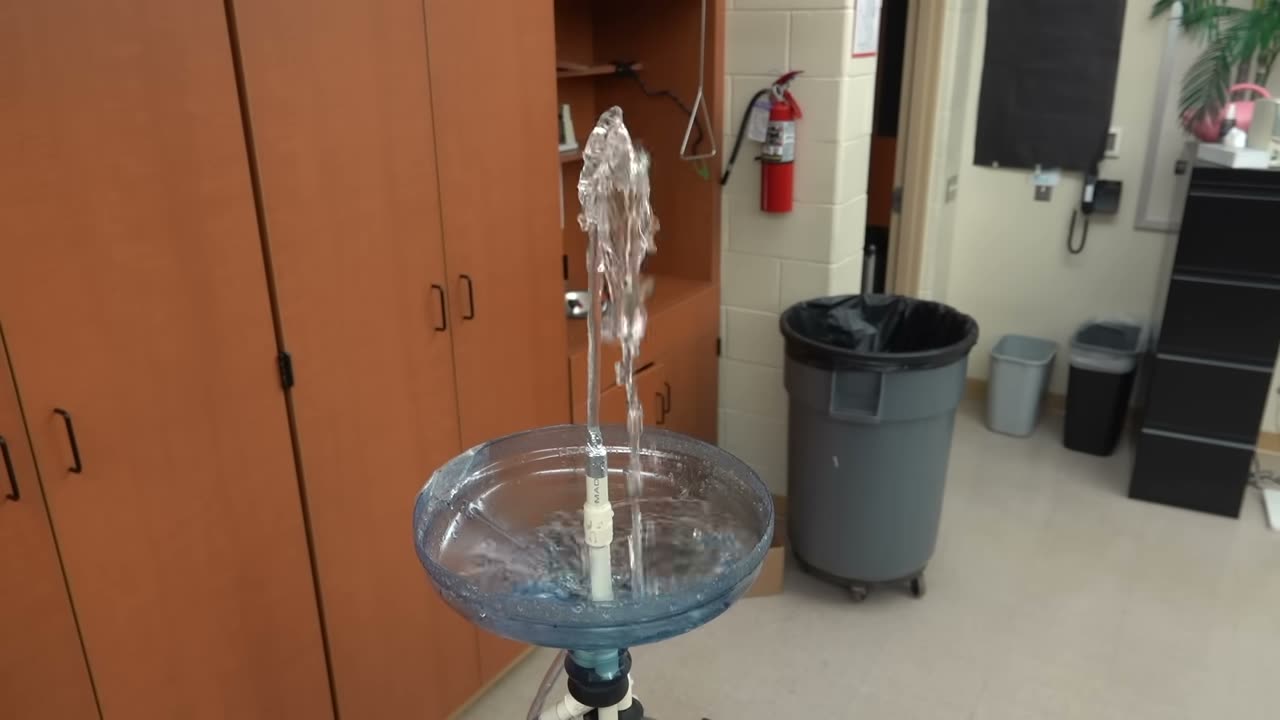
Students assemble and prime a three-bottle Hero's fountain, then investigate why water falling into a sealed bottle can push water up out of a nozzle with no pump. They test how the drop from the basin to the floor bottle controls the fountain and use energy reasoning to show it is not a perpetual-motion machine.
How can pouring one cup of water into a bowl make a fountain shoot up out of the middle of it, with nothing plugged in?
Learning objectives
- Students will be able to explain how falling water compresses trapped air and how that air pressure pushes water out of the nozzle.
- Students will be able to trace the path of water and the path of air through the fountain on a labeled diagram.
- Students will be able to predict and test how raising or lowering the floor bottle changes the fountain's height.
- Students will be able to use the idea of gravitational potential energy to explain why the fountain eventually stops.
Lesson flow (5E)
Day 1. Set up the demonstration fountain with the floor bottle on the floor, and ask students to predict what will happen when you pour a cup of water into the basin. Prime it and let the fountain run. Then lift the floor bottle above the basin so the fountain stops, and set it back down so it starts again. Students write what they noticed and one question.
Day 1. Groups connect their hoses using the diagram (basin drain to the floor bottle's long tube, floor bottle's short tube to the supply bottle's short tube, supply bottle's long tube to the nozzle), fill the supply bottle about three-quarters full of colored water, set the heights, and prime their fountain. They watch which bottle fills and which empties, and whether the fountain gets shorter as it runs.
Day 1. Using the projected diagram, lead the class through the cause-and-effect chain: water falls into the sealed floor bottle and takes up space, the trapped air is compressed and its pressure rises, that air is connected to the supply bottle, and the higher pressure pushes the supply water up the long tube and out of the nozzle. Introduce compress, air pressure, prime and potential energy.
Day 2. Groups run a fair test: they change the drop from the basin to the floor bottle (floor bottle on a chair, on the floor, at the bottom of a step) and measure the fountain height with a meter stick, keeping the nozzle, amount of water and supply bottle height the same. Groups that finish early try a narrower nozzle and compare the stream. Each group records results in a table and shares one finding.
Day 2. Students draw the fountain with arrows showing where the water goes and where the air goes, and complete the worksheet for their age group. Close with the question: is this a perpetual-motion machine? Students answer in writing using the words potential energy and where the water ends up.
Discussion questions
- What did you notice about which bottle filled up and which bottle emptied while the fountain ran?
- Is the empty floor bottle really empty? What is inside it, and what happens to that when water pours in?
- Why did the fountain stop when the floor bottle was lifted above the basin?
- How did the size of the drop from the basin to the floor bottle affect how high the fountain went?
- The fountain lifts water above the basin. Does that mean the water gains energy overall? Where does all the water end up?
- Why does the fountain slowly get shorter as it runs, and what would you change to make it run longer or higher?
Common misconceptions
Assessment
- Exit ticket: "Explain why the fountain stopped when the floor bottle was lifted above the basin."
- Labeled diagram: students draw the three bottles and use two colors of arrows to show the path of water and the path of air.
- Review the fair-test table on the 11-14 worksheet for a correctly identified changed variable (the drop), measured variable (fountain height) and controlled variables.
- Quick performance task: give a group a fountain that is not running and ask them to get it going and explain each step.
Differentiation
Support: Give younger students fully pre-connected fountains so they only fill, set heights and prime. Focus on the 8-10 worksheet items about predicting, watching which bottle fills, and what happens when the floor bottle is lifted. A color-coded hose diagram helps students follow the connections.
Extend: Older students measure the drop and the fountain height for several setups, graph fountain height against drop, and compare their results to the idea that the jet can rise roughly as high above the supply water as the water falls into the floor bottle. They can also research Hero of Alexandria or connect the fountain to water towers and gravity-fed water systems.