Teachers / Lesson plans / High Road, Low Road Race
Lesson plan · Grades 3-8Can the long way be the fast way?
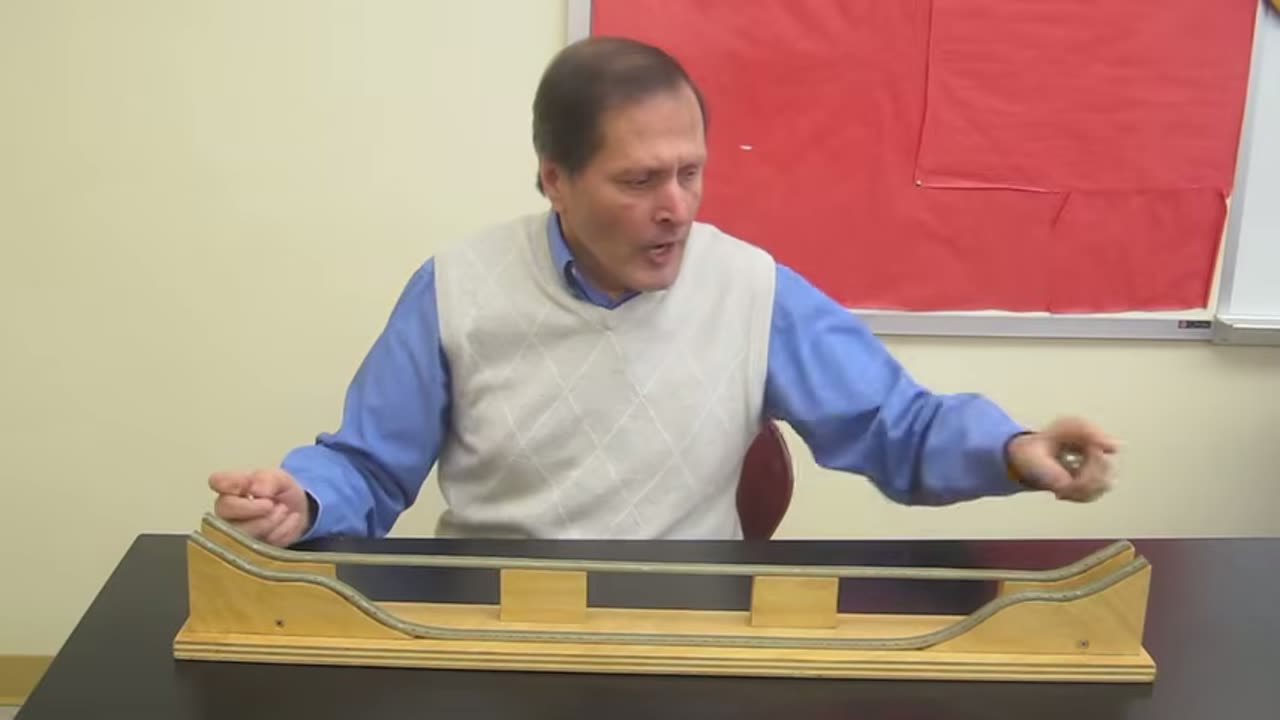
Students build a two-lane marble race from foam pipe insulation, a yardstick and books, in which a straight high road and a longer low road with a dip share the same start and finish heights. They predict, race, swap balls to rule out the marble, measure both paths, and explain the surprising result with potential and kinetic energy.
Two marbles start at the same height and finish at the same height, but the one that takes the longer road gets there first. How can the long way be the fast way?
Learning objectives
- Students will be able to predict and test which of two paths between the same heights gets a marble to the finish first.
- Students will be able to measure and compare the lengths of the two paths.
- Students will be able to explain, using potential and kinetic energy, why the longer low road is faster.
- Students will be able to design a fair test by changing one feature of the low road and controlling the others.
Lesson flow (5E)
Show the demo track with the marbles held at the start. Students vote on the winner (high road, low road or tie) and write one reason. Race once and record the surprise.
Groups set up their own tracks, race at least three times, swap the marbles and race again, and measure both roads with string. Use the age worksheet table to record results.
Groups share results. Introduce potential energy (height) and kinetic energy (motion). Sketch the low road on the board and have students mark where the marble is fastest and slowest, and why that beats the shorter path.
Groups change one thing: a deeper dip, or hills that rise to the height of the straight road. They predict, race and compare. Show Bruce's hill tracks or the giant bowling-ball track.
Exit ticket: 'The low road is longer but faster. Explain why using the words potential energy and kinetic energy.'
Discussion questions
- What did most people predict, and why?
- Did swapping the marbles change the winner? What does that tell us?
- Where on the low road is the marble moving fastest? How do you know?
- Both marbles end at the same height. Should they be going the same speed at the finish? Why?
- If you added hills to the low road that rise to the height of the straight road, what would happen?
- Is the shortest path always the fastest? Where else do you see this?
Common misconceptions
Assessment
- Exit ticket explaining the result with potential and kinetic energy.
- Completed worksheet table showing repeated trials and a swap of marbles.
- Performance task: groups predict, then demonstrate, whether a low road with hills still beats the straight road, and explain why.
Differentiation
Support: Give younger students a pre-built track and focus on predicting, racing and drawing where the marble went fastest; use 'stored energy' and 'moving energy' as everyday terms.
Extend: Older students time races from slow-motion video, compare path lengths as a percentage, and research the brachistochrone (the fastest curve between two points).