Experiments / High Road, Low Road Race
High Road, Low Road Race
Can the long way be the fast way?
Race two marbles between the same start and finish: the one that takes the longer road through a dip gets there first.
New home version. Bruce's original demonstration is in the video; these home instructions were adapted for this site and are still being test-built.
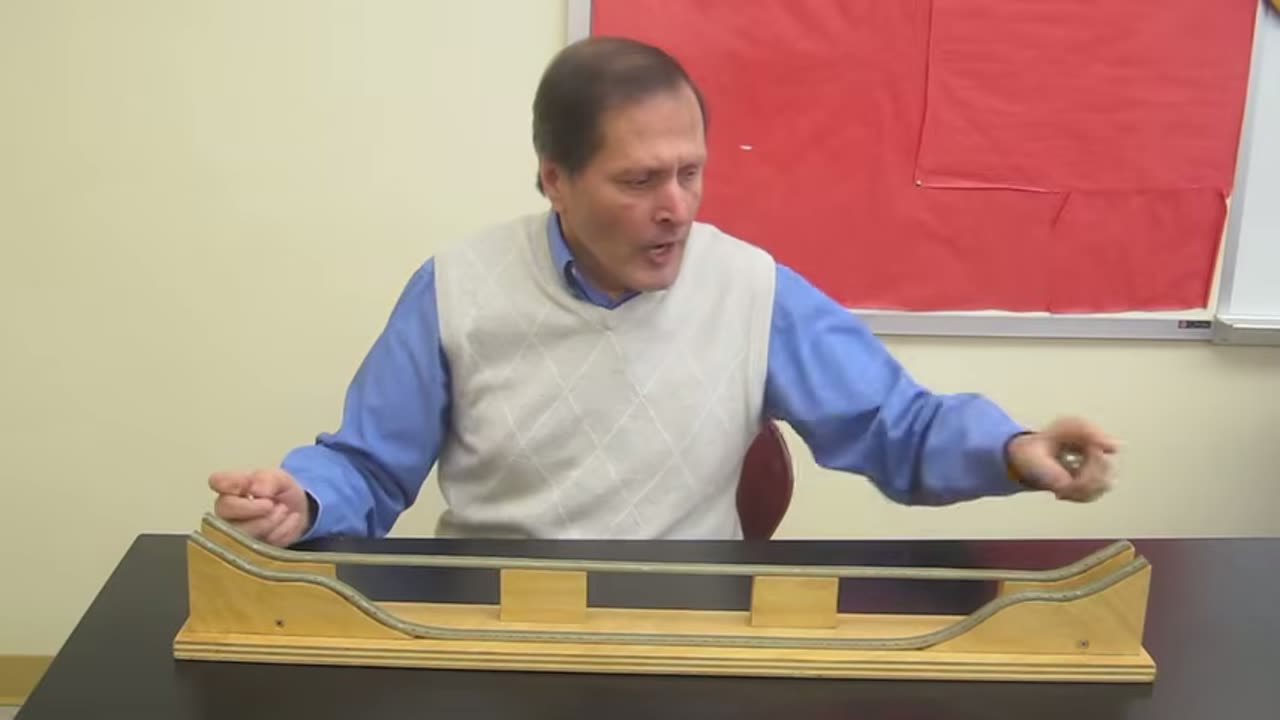
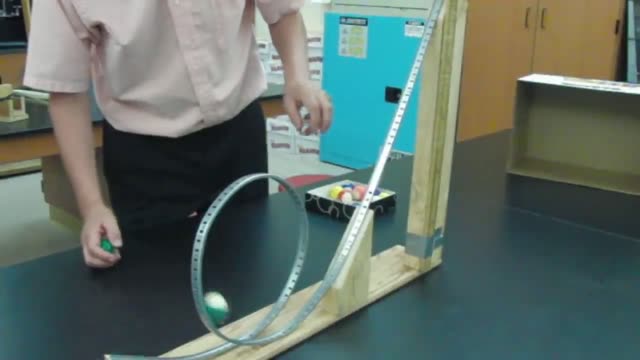
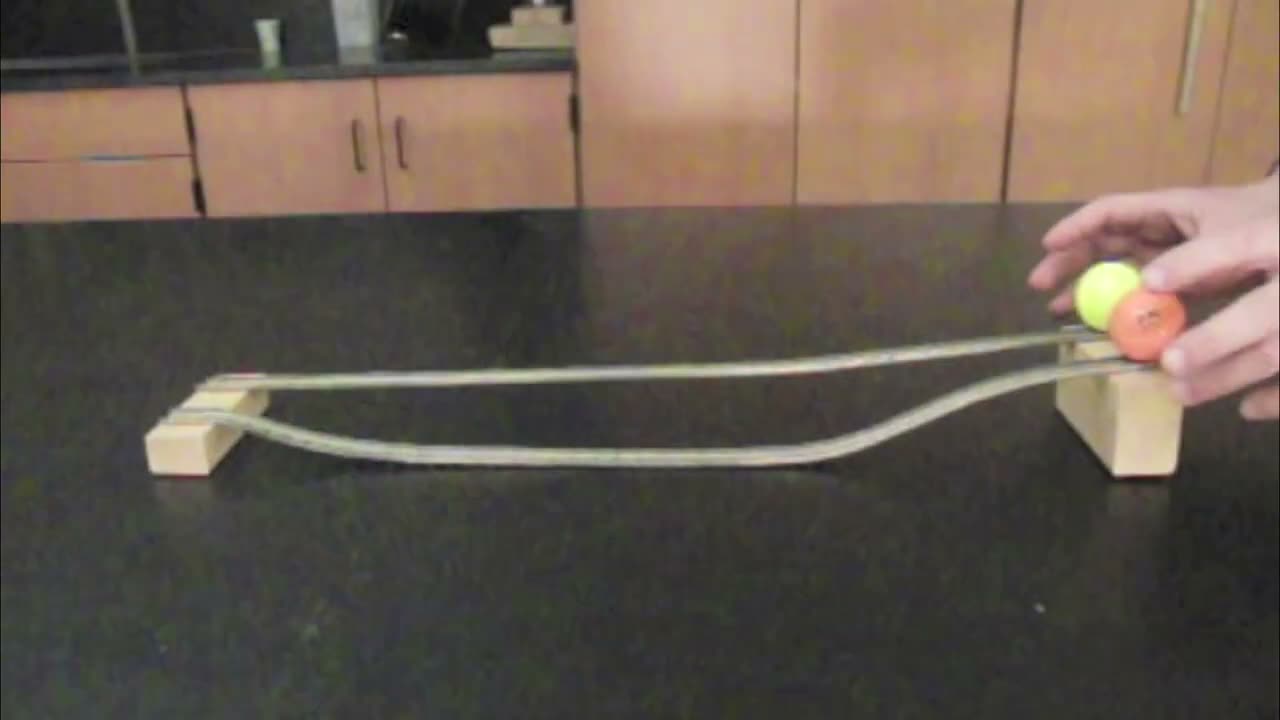
You'll build two side-by-side marble roads that start at the same height and finish at the same height. The high road runs straight from start to finish. The low road dips down to the table and climbs back up, so it is a little longer. Most people bet on the short, straight road, and most people lose. Bruce builds his tracks from wood and metal shelf track (there is a detailed build plan for that); this version uses foam pipe insulation and a stack of books.
“Watching in slow motion you can see both balls start together, but look at the big lead the one ball gets as it drops to a lower position.”
Build it
Grown-up: Cut the foam tube the long way into two matching channels. Most tubes already have one slit, so cut along the opposite side with scissors.
Grown-up: Cut one channel to the same length as the yardstick. Save the other channel at full length.
Tape the short channel along the top of the yardstick, open side up, so it stays perfectly straight. This is the high road.
Make two stacks of books on a table: a start stack about 6 inches (15 cm) high and a finish stack about 3 inches (7.5 cm) high.
Lay the yardstick from the top of the start stack to the top of the finish stack. Slide the stacks until each end of the yardstick rests about 1 inch (2.5 cm) on a stack, then tape both ends down.
Tape one end of the long channel on top of the start stack, right beside the high road, with the two starting ends even.
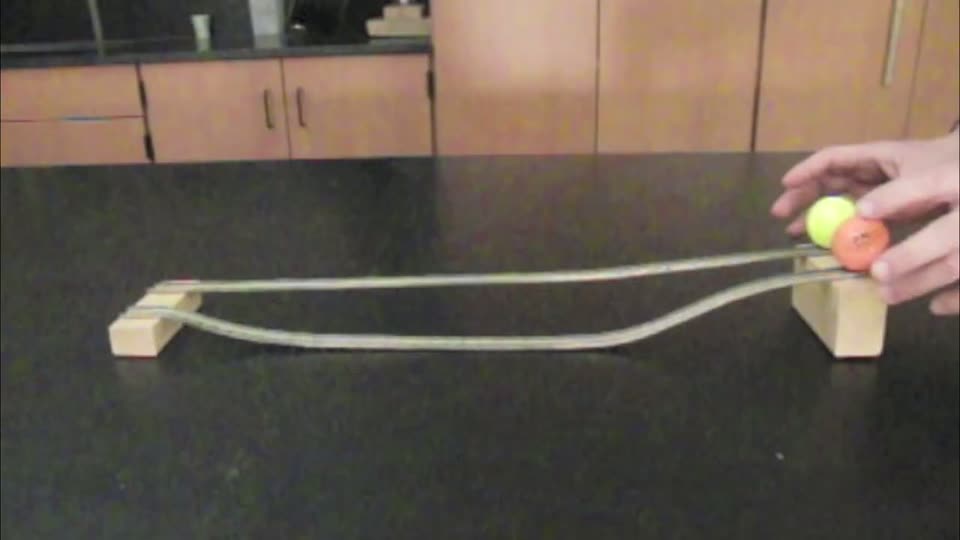
Bend the long channel in a gentle curve down to the table, and tape its flat middle part to the table. This is the low road.
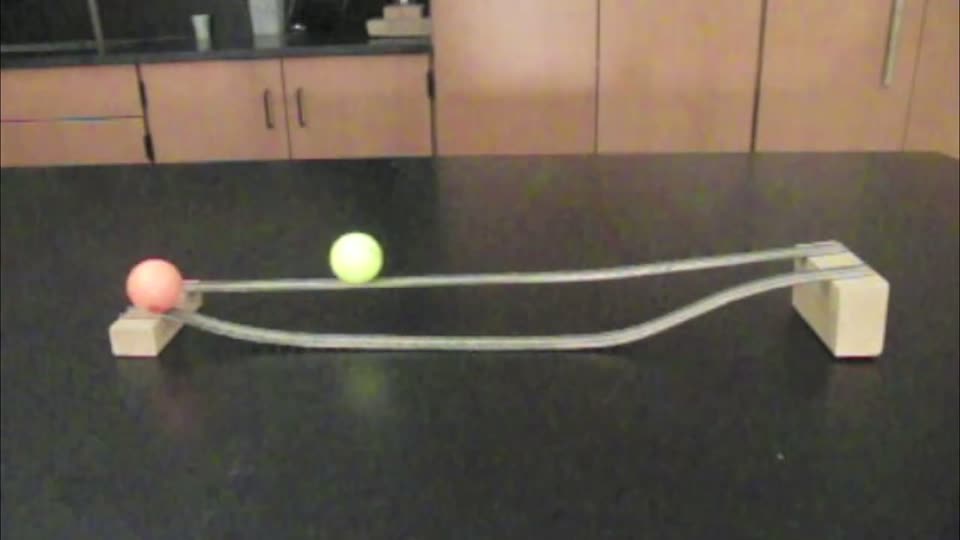
Curve the far end of the low road gently back up onto the finish stack, and tape it beside the high road.
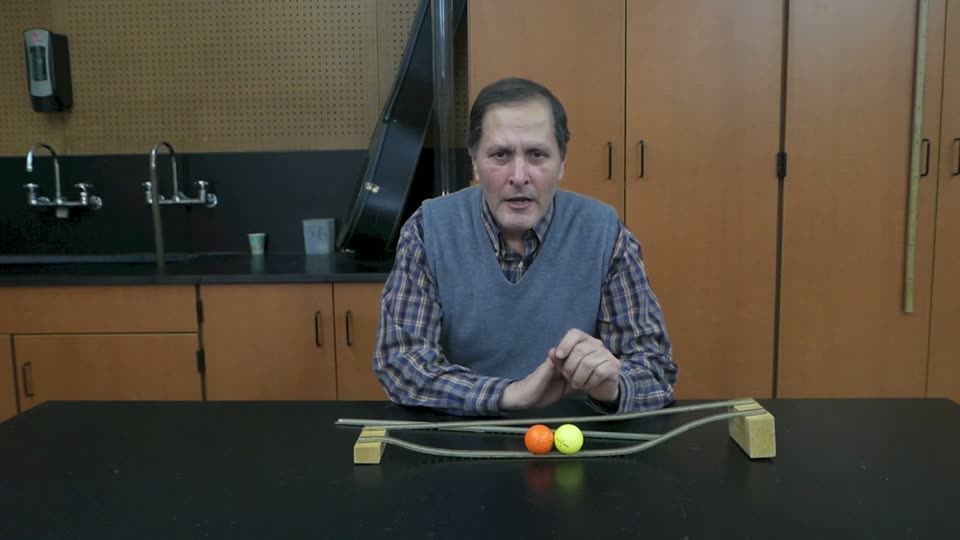
Grown-up: Trim the end of the low road so both roads stop at the same spot on the finish stack.
Roll one marble down the low road by itself. If it can't climb back out of the dip, make the curves gentler and try again.
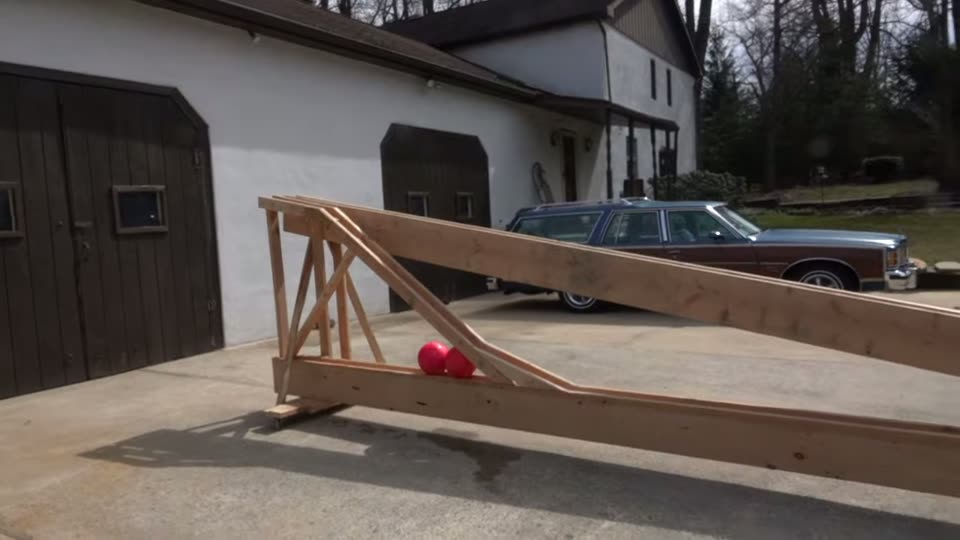
Try it & notice
What's going on?
For young scientists
When you lift a marble up high, it stores energy, like a stretched rubber band waiting to go. The higher it is, the more energy it can turn into speed as it rolls downhill. Both marbles start with the same height, so they start with the same stored energy.
The low-road marble drops much lower, so it turns much more of its height into speed, right near the start. It zooms along the bottom of the dip much faster than the high-road marble, which only creeps down its gentle slope. Climbing out at the end slows it down again, but by then it has a big lead.
The low road really is longer. But speed matters more than distance here: the low-road marble is faster for almost the whole trip, so it wins even though it goes farther.
For grown-ups & teachers
This is conservation of energy. Each ball starts with the same gravitational potential energy (mgh). As it rolls, the drop in height becomes kinetic energy, so at any point its speed depends only on how far it is below the start: for a solid ball rolling without slipping, v = sqrt(10/7 g h). The low-road ball reaches a lower point earlier, so it is faster over most of the course, and the time for a trip is the sum of distance divided by speed along the way. A modest increase in distance (Bruce measures about 5 percent on his classroom track and about 8 percent on the giant outdoor one) is easily outweighed by much higher average speed.
The common misconception is that the shortest path must be the fastest. The straight line is the shortest path, but not the quickest one under gravity. The fastest route between two points is a curve that drops steeply early, called the brachistochrone (a cycloid); Bruce's identical-curved-tracks build plan explores the related idea of a curve where the time to the bottom hardly depends on where you start.
Rolling matters. A rolling ball splits its kinetic energy between moving forward (translational) and spinning (rotational), so it is slower than a sliding block would be, but both balls share the same split, so the race stays fair. Bruce's part 2 video uses this to explain why slopes must stay gentle: if a climb is so steep that the ball slips instead of rolling, it loses energy to friction and may not make it out. Foam channels also have more rolling resistance than metal track, which is why the home version ends lower than it starts.
Ignoring friction, both balls arrive at the finish with the same speed, because they end at the same height. Only the time differs. To extend it, add hills to the low road that rise to the height of the straight road (Bruce's hill tracks still win), make the dip deeper, or time the races with slow-motion video.
NGSS performance expectations
- 4-PS3-1 Use evidence to construct an explanation relating the speed of an object to the energy of that object.
- MS-PS3-2 Develop a model to describe that when the arrangement of objects interacting at a distance changes, different amounts of potential energy are stored in the system.
- MS-PS3-5 Construct, use, and present arguments to support the claim that when the kinetic energy of an object changes, energy is transferred to or from the object.
Science words
Tips from 41 years of teaching it
Bruce wrote up his high road, low road tracks in 1997 and has built many versions since. Here's what his notes add.
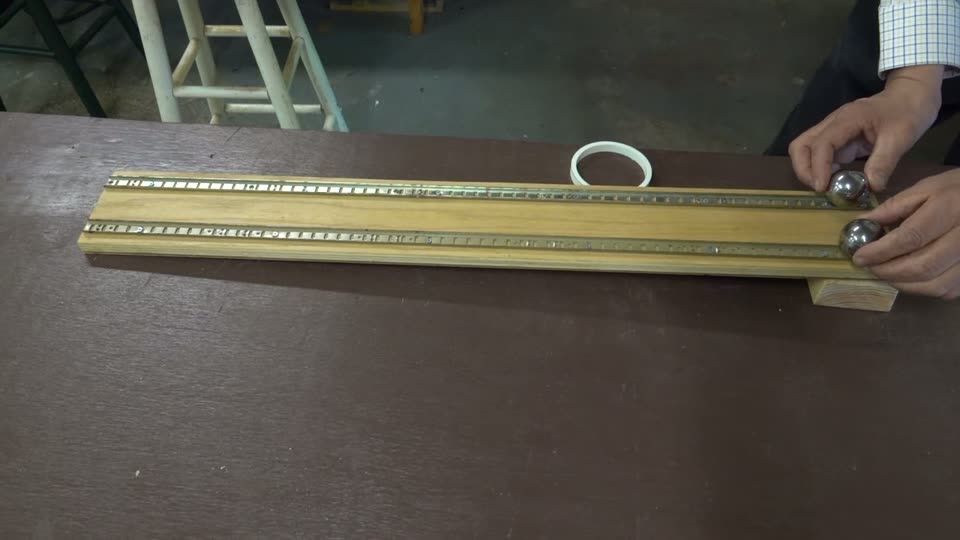
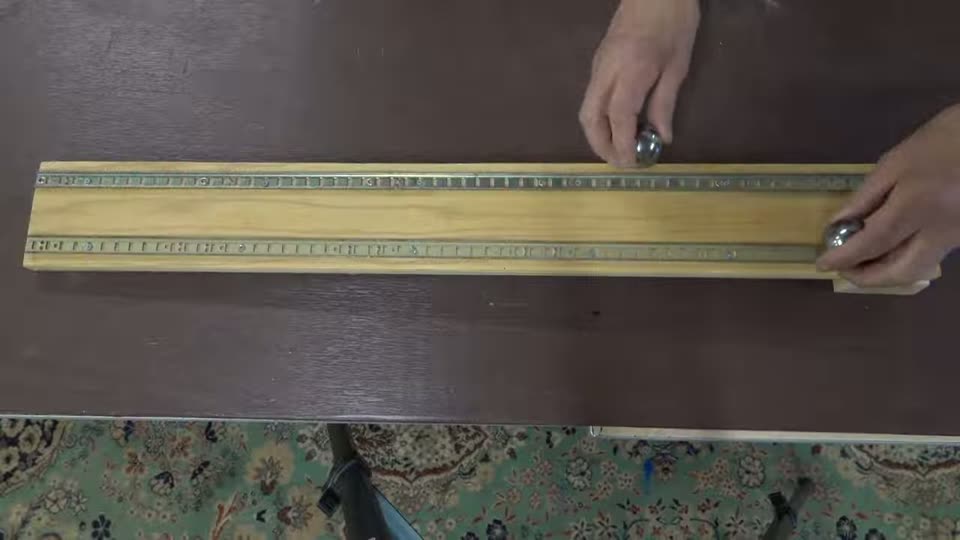
- Bruce's first, sturdier version raced two pool balls; his quick version used golf balls. Steel balls and large glass marbles work too.
- His quick version is small: a 2-foot straight track, a low road about 4 inches longer, sloping down to the table over about 5 1/2 inches and climbing back up over about 2 inches.
- The tracks can be made taller, but only if the low road's slope isn't so steep that the ball slips. Bruce notes that a slipping ball loses some of its rotational (spinning) energy and won't make it back to the top.
- On his hill tracks, every little hill rises to the same height as the straight track. Wherever the ball is lower than the straight track, it moves faster, so the hilly track still wins.
- Bruce runs fine sandpaper along the edges of the track so the balls roll smoothly; any roughness shows up as a slower ball.
- The space between the two lanes depends on the balls: they must be far enough apart that the balls can't touch as they race side by side.
Bruce poses the question before he ever lets the balls go: which track will get the ball to the other side first, and why? Once he had the basic pair working, he kept raising the stakes, building low roads with one, two, three and four humps and one with a much bigger drop, and asking the same question each time.
More to try
- From Bruce's track notes: race different types of balls against each other, such as brass against aluminum, and see if there is a difference.
Make it a challenge
Add hills
Bruce builds low roads with as many as four humps. Tape a few small books under the low road to make hills. Does it still win?
Deeper dip
Raise the start and finish stacks so the dip is deeper, keeping the curves gentle. Does the low road win by more?
Measure the difference
In part 2, Bruce lays a strip of paper along each road to compare their lengths. Measure yours with string and work out how much longer the low road is.
Different balls
Race a steel marble against a glass marble on the same road, or swap in bigger balls. Does the type of ball matter as much as the shape of the road?
Go big
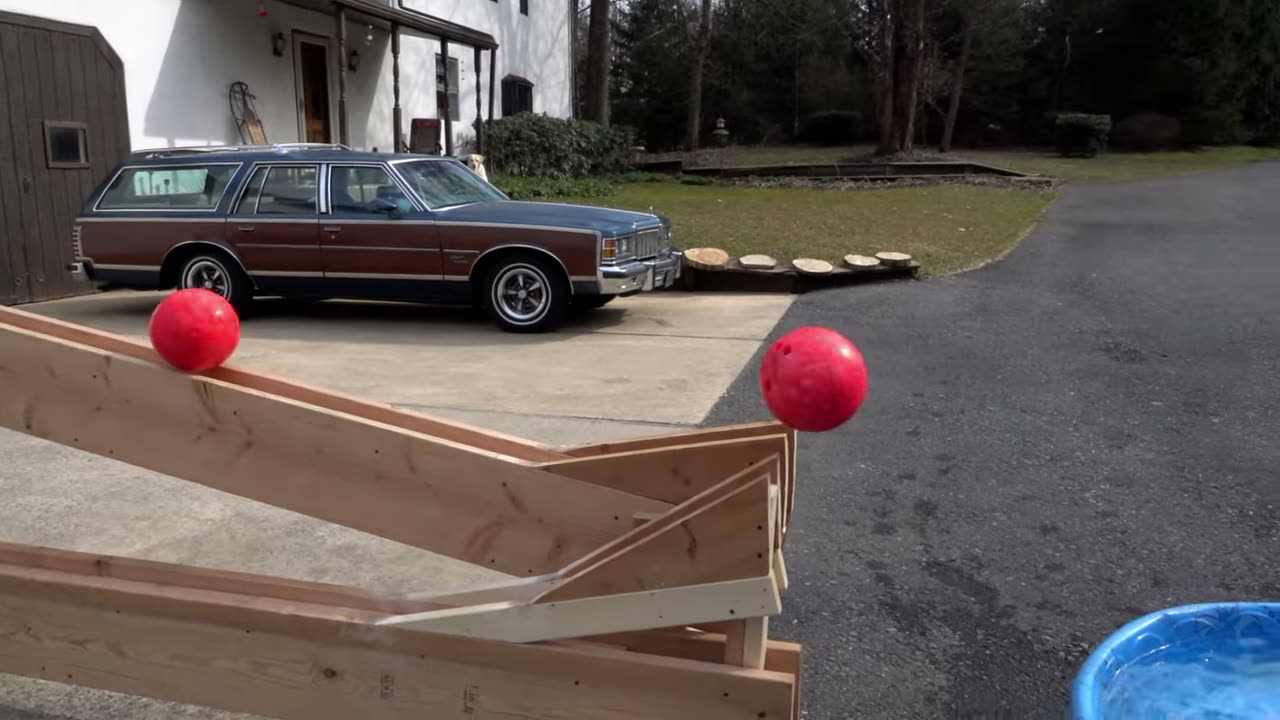
Bruce built a giant version outdoors with two bowling balls that splash into a wading pool. With a grown-up, try pool noodles cut in half and golf balls on a longer, sturdier slope.
More from Bruce