Teachers / Lesson plans / Marble Tracks & Loop-the-Loop
Lesson plan · Grades 3-8How high do you have to start to loop the loop?
Student groups build a foam loop-the-loop marble track running from a table top to the floor and mark release heights on the ramp. They predict, then measure, the lowest start that gets a marble around the loop, compare it with the loop's height, and explain the result with potential and kinetic energy and the speed needed at the top.
A marble released level with the top of a loop falls off before it gets around. How high does it really need to start, and why isn't the top of the loop high enough?
Learning objectives
- Students will be able to predict and measure the minimum release height for a marble to complete a loop.
- Students will be able to compare the minimum release height with the height of the loop and express it as a ratio.
- Students will be able to explain, using potential and kinetic energy, why the marble must start above the top of the loop.
- Students will be able to identify sources of energy loss (friction, spin, track imperfections) that raise the measured minimum.
Lesson flow (5E)
Show the demo track. Release a marble level with the top of the loop; it falls off. Students write a prediction of the lowest start that will work.
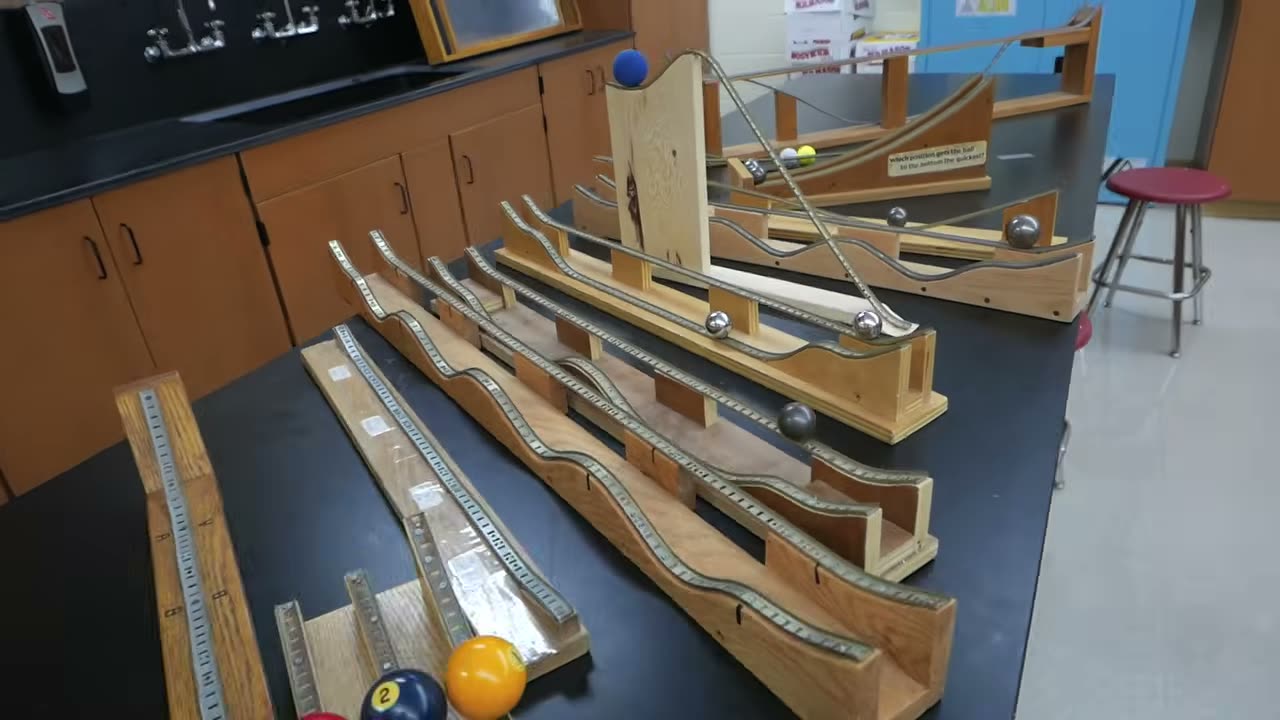
Groups build the loop and ramp from pre-cut channels, add height flags, and work up from low flags to find the lowest start that succeeds three times in a row, recording results in the worksheet table.
Groups report loop heights and minimum starts; compute ratios on the board. Introduce potential and kinetic energy and the idea that the marble must still be moving at the top. Mention the ideal ratio of about 1.35 and ask why measured ratios are higher.
Groups change one thing (loop size or type of ball) and find the new minimum, or build a Galileo valley and check that the marble never rises above its start.
Exit ticket: 'Why must the marble start higher than the top of the loop? Use the words potential energy and kinetic energy.'
Discussion questions
- What did you predict, and how close were you?
- Did a marble ever climb higher than where it started? What does that tell us about energy?
- Where on the track is the marble moving fastest? Slowest?
- What happens to the marble at the top of the loop when it is moving too slowly?
- Why did everyone's ratio come out higher than the 'perfect ball' value?
- How do roller-coaster designers make sure a train always gets around a loop?
Common misconceptions
Assessment
- Exit ticket explaining the minimum height with potential and kinetic energy.
- Completed worksheet table showing repeated trials at several heights and a clear minimum.
- Performance task: given a new loop, a group predicts the minimum start from its earlier ratio, then tests it.
Differentiation
Support: Give younger students a pre-built track and focus on 'too low / just right' trials, drawing where the marble falls off; use 'stored energy' and 'moving energy' as everyday terms.
Extend: Older students derive h = 2.7r from energy conservation and v^2 = gr at the top, compare it with their data, and estimate how much energy was lost.