Experiments / Marble Tracks & Loop-the-Loop
Marble Tracks & Loop-the-Loop
How high do you have to start to loop the loop?
Build a marble roller coaster with a real loop, then hunt for the lowest starting spot that still gets the marble upside down and all the way around.
New home version. Bruce's original demonstration is in the video; these home instructions were adapted for this site and are still being test-built.
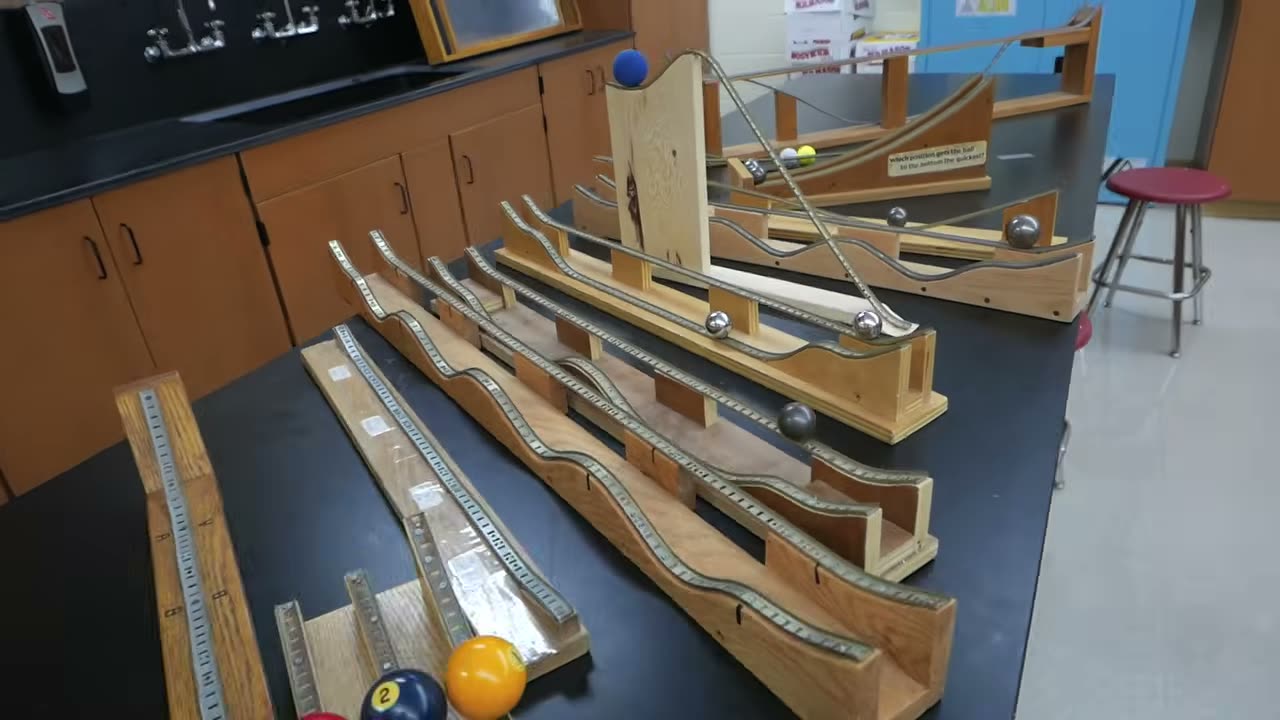
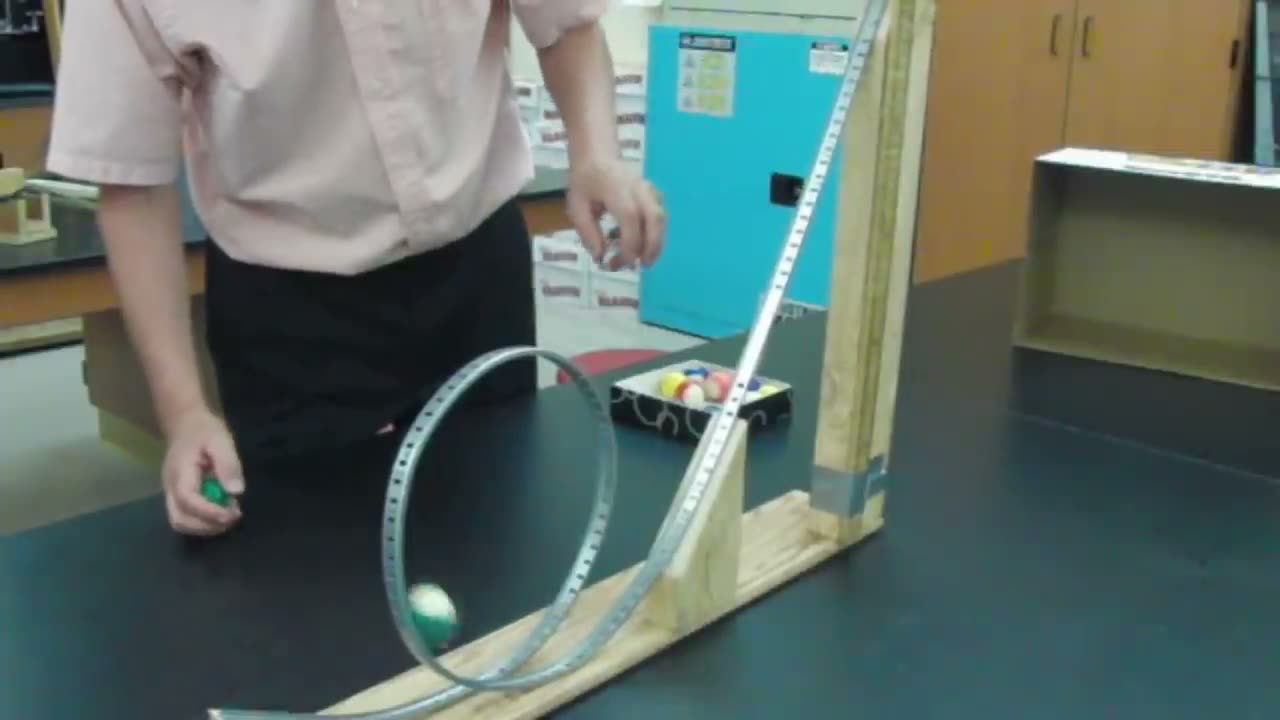
Bruce has built dozens of marble tracks for his classroom, from a Galileo track to racing tracks to a loop-de-loop, all to show how height turns into speed and back again. You'll build a loop-the-loop track from foam pipe insulation, then find the lowest start that still gets a marble all the way around. Most people guess you only need to start as high as the top of the loop. You need more, and finding out how much is the fun part. Bruce bends his tracks from metal shelf track on wooden frames; detailed build plans for two of his classroom tracks are on the site.
“Now that we have the track done, it would be an interesting investigation to compare the height of the loop to the minimum height that we could release the ball and still make it.”
Build it
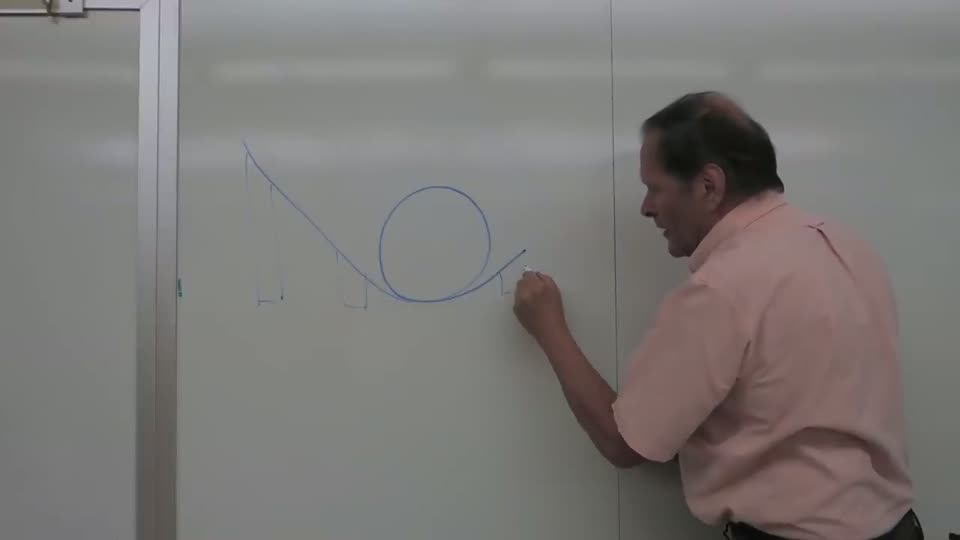
Draw a side view of your track on paper first: a ramp coming down off the table, a loop, and a flat run-out. Bruce starts every track with a design like this.
Grown-up: Cut the foam tube the long way into two matching channels. Most tubes already have one slit, so cut along the opposite side with scissors.
Tape one end of a channel onto the table top, open side up, about 6 inches (15 cm) from the edge. This is the top of your ramp.
Let the channel curve smoothly over the table edge and down to the floor. Tape it to the floor where it lands, about 2 feet (60 cm) out from the table, with no sharp bends.
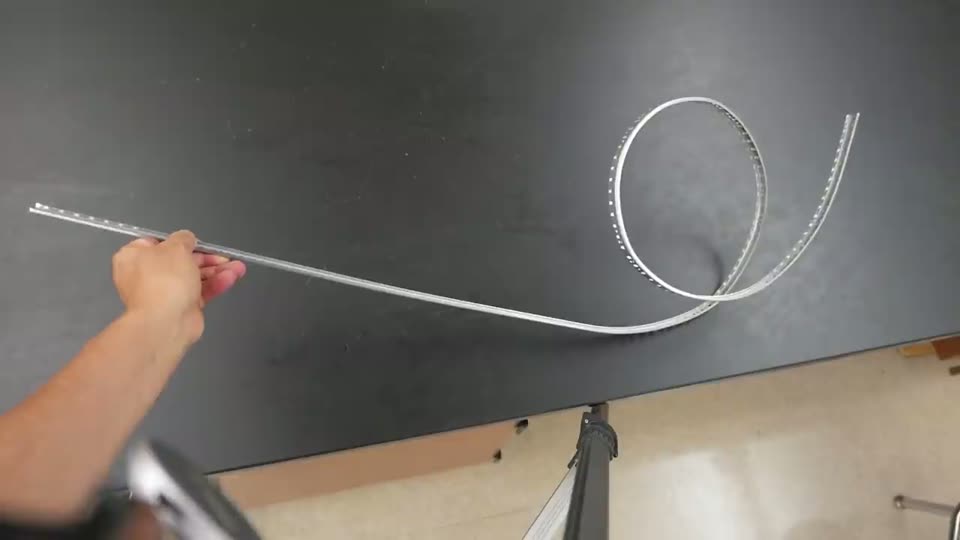
Curl the rest of the channel up and over into a loop about 8 inches (20 cm) across, open side facing in, so the track comes back down right beside where it went in.
Tape the bottom of the loop to the floor, both where the track goes in and where it comes out.
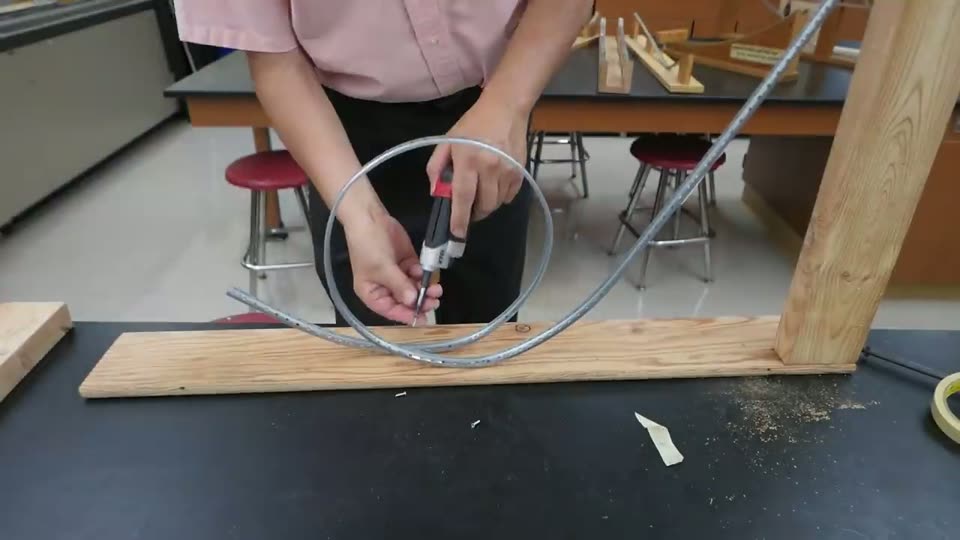
Stand the cereal box beside the loop and tape the loop to it at the top and on both sides, so the loop stays round.
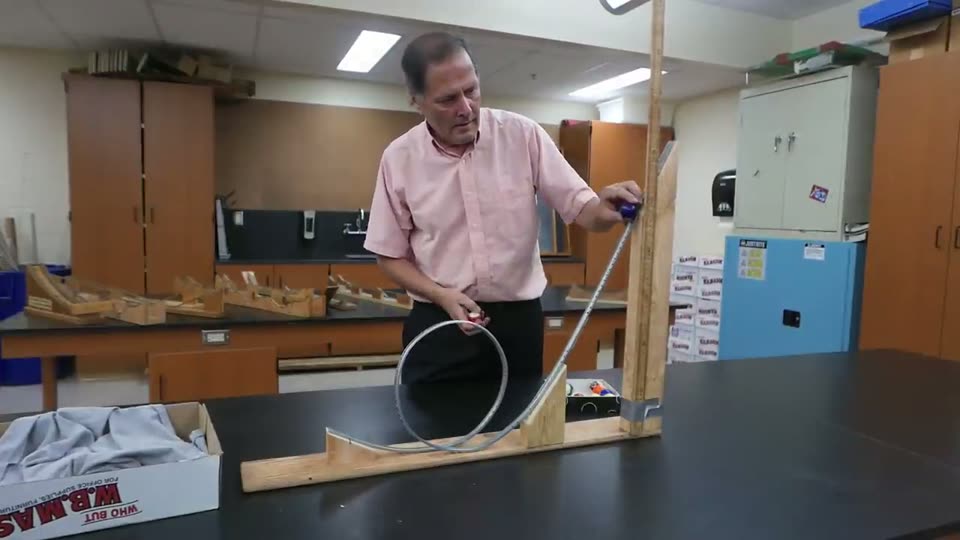
Butt the second channel up against the end coming out of the loop, tape the joint on the outside, and tape the channel flat along the floor. Set the shoebox lid at its end to catch the marble.
Measure straight up from the floor with the ruler and stick a small tape flag on the side of the ramp every 2 inches (5 cm) of height. Write the height on each flag.
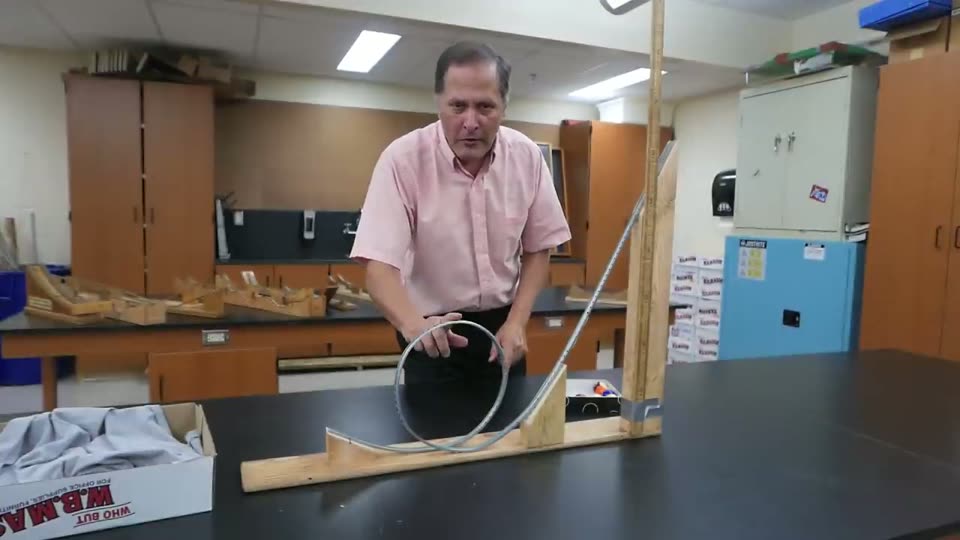
Roll one marble from the very top of the ramp. If it falls out at the top of the loop even from there, make the loop a little smaller or rounder, smooth out any kinks, and try again.
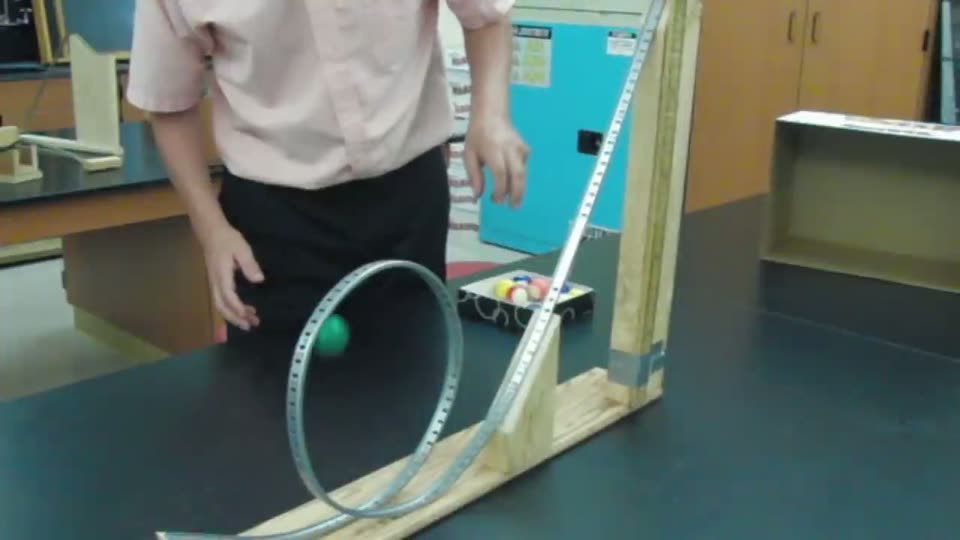
Try it & notice
What's going on?
For young scientists
A marble held up high has stored energy, called potential energy. As it rolls down, that stored energy turns into speed, called kinetic energy. When it rolls uphill again, the speed turns back into height. A marble can never climb higher than where it started, and because rubbing (friction) steals a little energy, it always ends up a bit lower. Galileo noticed this hundreds of years ago, and Bruce's Galileo track shows it.
At the top of the loop the marble is upside down. It only stays on the track if it is still moving fast enough to keep pressing against the track as it curves around. If it gets to the top too slowly, gravity pulls it down and it falls.
So starting level with the top of the loop is not enough: the marble would arrive with no speed left. It needs extra height to still be moving at the top, a little more to make it spin as it rolls, and a little more to make up for friction. That is why the lowest start that works is quite a bit higher than the loop.
For grown-ups & teachers
This is conservation of energy plus circular motion. To stay on the track at the top of the loop, the ball needs enough speed that gravity alone can't pull it inward faster than the circle curves: v^2 >= g r at the top, where r is the radius of the path of the ball's center. Energy from release height h (measured from the bottom of the loop) is shared between the height of the top (2r), forward motion and spin. For a solid ball rolling without slipping, total kinetic energy is 7/10 m v^2, so the minimum release height is h = 2.7 r, about 1.35 times the loop's height. A block sliding without friction would need 2.5 r. Bruce's part 2 video ends with exactly this comparison of a measured minimum height against the calculated one.
Expect your measured minimum to be higher than 1.35 times the loop height. Foam has much more rolling resistance than metal track, tape joints and kinks cost energy, and a homemade loop is rarely a perfect circle (a tight spot at the top needs more speed). The channel itself matters too: the ball rides on the two edges of the channel rather than on its bottom, so it rolls on a smaller radius and spins faster for the same forward speed. More of its energy goes into spin, leaving less for forward speed. Bruce's track notes raise the same question about how fast balls rotate on rails of different widths.
Common misconceptions: that starting at the loop's height is enough (the ball must still be moving at the top), and that 'centrifugal force' holds the ball up. From the ground, nothing pushes the ball outward: the track pushes it inward, and the ball stays on as long as it is moving fast enough that it would otherwise fly off in a straight line (inertia). Roller-coaster loops are teardrop shaped, tighter at the top, so riders can take them at lower speed with gentler forces at the bottom.
Bruce's part 1 video shows the other energy ideas: on his Galileo track (one side three times longer than the other) the ball returns to nearly its starting height whichever side it starts on, Galileo's route to the idea of inertia. On the identical curved tracks, balls released from different points on matching circular curves reach the bottom together, just as pendulums of equal length keep the same period at different swing sizes. His 'stringless pendulum' tracks are curved like pendulums with periods of 1, 2 and 3 seconds, showing why longer pendulums swing more slowly. His high road, low road tracks show a longer path through a dip winning the race.
NGSS performance expectations
- 4-PS3-1 Use evidence to construct an explanation relating the speed of an object to the energy of that object.
- MS-PS3-2 Develop a model to describe that when the arrangement of objects interacting at a distance changes, different amounts of potential energy are stored in the system.
- MS-PS3-5 Construct, use, and present arguments to support the claim that when the kinetic energy of an object changes, energy is transferred to or from the object.
Science words
Tips from 41 years of teaching it
Bruce built marble tracks for his 7th and 8th graders over four decades. Here's what his notes add.
- Bruce opened his 8th-grade energy unit with the Galileo track and one question: why won't the ball roll off the other side? The lesson he drew from it: you can never get more energy out of a machine than you put in.
- In his notes on sharing track plans, Bruce says tracks can be made higher and steeper, but not so steep that a ball slips as it rolls uphill. The balls rely on friction to keep turning as they roll.
- His 'stringless pendulum' tracks are curved like pendulums 24.9 cm, 99 cm and 224 cm long, with periods of 1, 2 and 3 seconds. The lengths go up 4 times and 9 times (2 squared and 3 squared), and he adds 0.5 cm to each to allow for the thickness of the metal track.
- To draw a pendulum curve full size, Bruce anchors a long string under a heavy weight on the floor, wraps the other end around a pencil, and swings the pencil across paper taped to the floor.
- Bruce points out that ball-on-track 'pendulums' run slower than real pendulums of the same length, because of friction and because some energy goes into making the ball spin.
- His race-track notes say balls of different sizes run down a track together, as long as each one sits on its rails at the same ratio of ball size to rail spacing. He leaves 'why?' as a question for students.
In 1987 Bruce wrote a joke instruction manual for a ball-on-a-track 'Multi-Functional Potential Kinetic Random Result Generator'. Students could supposedly use it to pick multiple-choice answers, and teachers to hand out grades, propping up one end to improve the odds. The real use comes at the end: release the ball from the same spot several times, watch it stop in different places, and have students list every small thing that might change the result.
More to try
- From Bruce's race-track notes: race balls made of different materials, such as brass against aluminum, on the same track and see whether there is a difference.
Make it a challenge
Galileo's valley
Bruce's Galileo track starts at the same height on both sides, but one side is three times longer. Tape a foam channel into a U with one short steep side and one long gentle side, roll a marble from one end, and put a tape mark where it turns back. Does it ever roll out the other end?
Bigger loop, bigger start?
Re-curl your loop larger or smaller and find the lowest starting flag again. Divide the lowest start height by the loop height each time. Does the answer stay about the same?
Bowl race
Bruce's identical curved tracks show that balls released from different spots on the same curve reach the bottom together. Release two marbles at the same moment from different heights on opposite sides of a wide, shallow bowl. Where do they meet?
Prediction track
Bruce's joke 'prediction tracks' let a ball roll back and forth until it stops on a label: 'Yes', 'Chances are slim' or 'No way'. Let a foam channel sag in a gentle valley between two book stacks, label the bottom, and release a marble from the same spot five times. Does it stop in the same place every time?
Long way or short way
Bruce's favorite tracks race a ball along a straight road against one that dips down low. Use your second channel to try it; there's a whole page on the high road, low road race.