Teachers / Lesson plans / Musical Bottles
Lesson plan · Grades 2-8Why does the same bottle sing high when you blow but low when you tap?
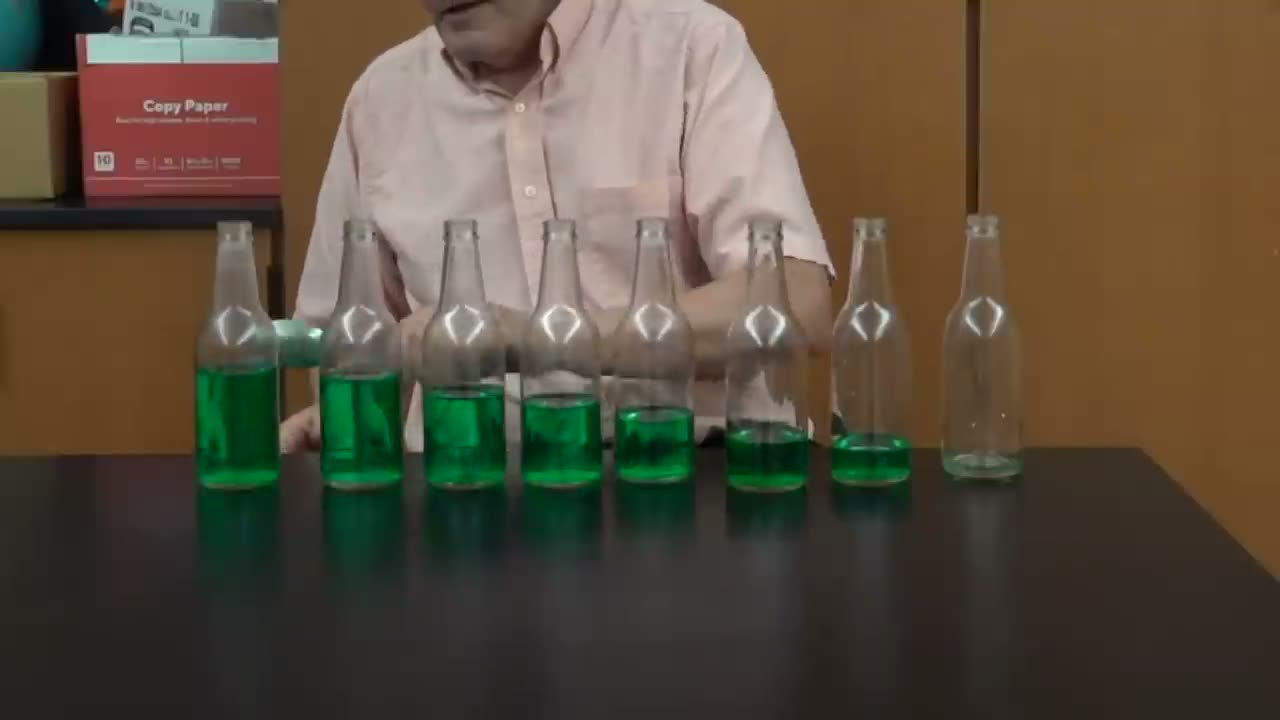
Students tune a row of identical bottles with water, then compare the notes they get by blowing across the tops with the notes they get by tapping the sides. They discover that the two methods run the scale in opposite directions and explain why: blowing makes the air inside vibrate, while tapping makes the bottle itself vibrate.
The bottle with the most water plays the highest note when you blow across it, but the lowest note when you tap it. How can the same bottle go both ways?
Learning objectives
- Students will be able to explain that sound is produced by vibrating matter.
- Students will be able to predict and test how the amount of water in a bottle changes its pitch when blown and when tapped.
- Students will be able to compare the two results and identify which part of the system (the air column or the bottle) is vibrating in each case.
- Students will be able to design a fair test that changes only one variable, such as bottle size or the temperature of the air inside.
Lesson flow (5E)
Play a few notes on the tuned glass bottles by blowing, then tap the same bottles with the spoon, emptiest to fullest. Ask students what they noticed about the direction of the notes. Record their ideas without correcting them.
Groups fill their plastic bottles to different water levels, predict which will sound highest when blown, test it, and then tap the bottles with a pencil and compare. They record rankings on the worksheet and adjust water to build a short scale.
Groups share results. Guide students to the idea that sound comes from vibration, and that two different things vibrate: when blowing, the air above the water bounces in and out like a spring, and less air vibrates faster for a higher note; when tapping, the bottle vibrates, and the water it carries makes it heavier and slower for a lower note. Introduce the terms pitch, vibrate and air column.
Groups pick one new variable to test: a larger bottle with the same water, or (if prepared) a chilled versus warm bottle. Then demonstrate the dish-soap bottle: tapped, it barely rings, which shows true damping as the thick liquid soaks up the vibration.
Students complete the final worksheet questions or an exit ticket explaining why blowing and tapping go in opposite directions.
Discussion questions
- What did you hear when you blew across the emptiest bottle compared with the fullest?
- Did tapping give you the same order of notes? What was different?
- When you blow, what is actually vibrating? When you tap, what is vibrating?
- Why would a bigger bottle with the same water play a lower note when you blow?
- Bruce shows that cooling the air in a bottle lowers the note. What does that tell you about the air's role?
- What other instruments use a larger or smaller space of air, or a longer or shorter tube, to change pitch?
Common misconceptions
Assessment
- Exit ticket: "The fullest bottle sounds highest when blown but lowest when tapped. Explain why in two sentences."
- Check the ranking table on the 8-10 worksheet or the fair-test table on the 11-14 worksheet for correct patterns and a single changed variable.
- Performance task: hand a group an empty bottle and ask them to tune it to match a note you play on the demo set, then explain whether they added or removed water and why.
Differentiation
Support: Use the 5-7 worksheet, limit groups to three bottles (a little, half, nearly full), and focus only on high versus low. Students who cannot get a blown note can tap instead and listen to a partner blow.
Extend: Measure the height of the air space in each bottle and use a tuner app to record frequencies, then graph air height against frequency. Research Helmholtz resonators and how the shape of the bottle neck affects the note.