Experiments / Musical Bottles
Musical Bottles
Why does the same bottle sing high when you blow but low when you tap?
Tune a row of bottles with nothing but water, then discover that blowing and tapping play the scale in opposite directions.
Based on Bruce's demonstration in the video below.
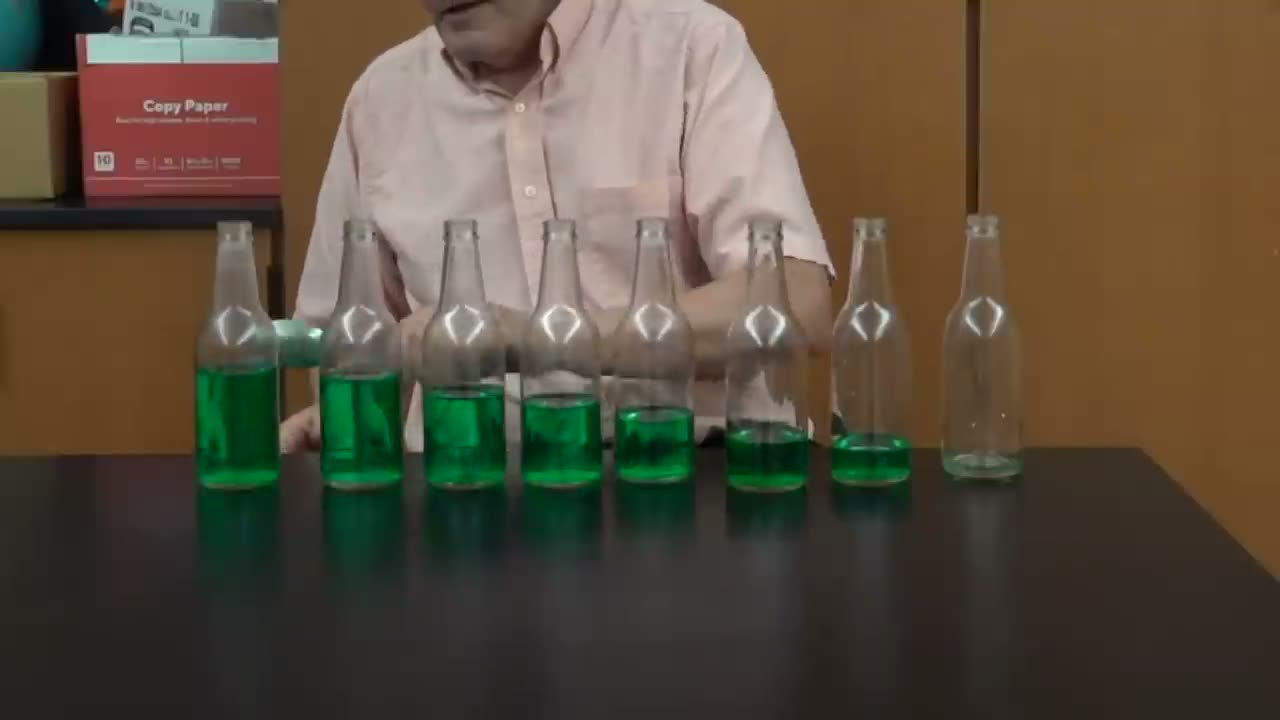
You'll tune a row of bottles into a musical scale just by changing how much water is in each one. Then comes the surprise: blow across the tops and the fullest bottle plays the highest note, but tap them with a spoon and the fullest bottle plays the lowest.
“The water actually has a damping effect on the vibrations of the bottle. The more we add, the lower the pitch. It's just the opposite with the air column.”
Build it

Stand your bottles in a row on a towel.

Fill the pitcher with water. If you like, add a few drops of food coloring so the water is easy to see.
Pour a little water into the first bottle, a bit more into the next, and so on, so each bottle has more than the one before. Leave the last bottle nearly full.
Rest the mouth of one bottle against your bottom lip and blow a gentle stream of air straight across the top. Listen for a hooting note.

Blow across each bottle in turn, from emptiest to fullest, and listen to how the notes change.

Pour a little water in or out of the bottles until the notes climb step by step, like a musical scale (do-re-mi).
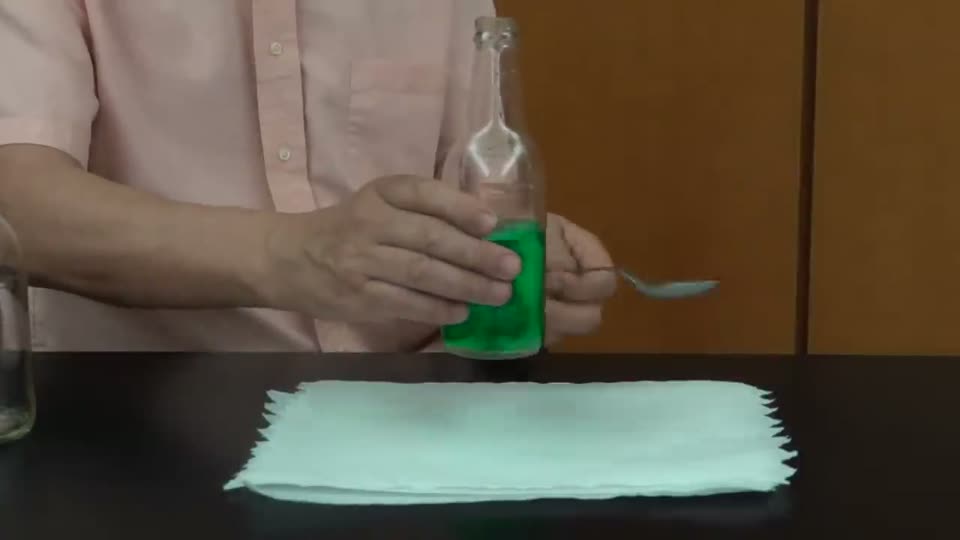
Grown-up (for glass bottles): Tap each bottle gently on its side with the spoon, from emptiest to fullest, and listen.
Play a simple song, like "Mary Had a Little Lamb", by blowing across the right bottles in order.

Try it & notice
What's going on?
For young scientists
Sound is made by something shaking back and forth very fast. Scientists call this vibrating. When you blow across a bottle, the thing that vibrates is the air inside it. The air bounces in and out of the bottle like a spring. Less air (more water) makes a stiffer spring, so it bounces faster and the note is higher.
When you tap a bottle, the air isn't doing the work any more. Now the bottle itself vibrates. The water inside makes the bottle heavier and slower to wiggle, so more water means a slower shake and a lower note.
That's why blowing and tapping go in opposite directions in your row of bottles: two different things are vibrating. One is the air, the other is the bottle.
For grown-ups & teachers
Blowing across the mouth turns the bottle into a Helmholtz resonator. The slug of air in the neck acts like a mass, and the larger body of air below it acts like a spring. The resonant frequency rises as the air volume shrinks, so adding water raises the pitch. Bigger bottles (more air) play lower. The jet of breath across the opening flips back and forth over the edge, feeding energy in at that resonant frequency.
Tapping excites the glass wall instead. Water in contact with the wall moves with it and adds effective mass, so the bottle's natural frequency drops as you fill it. Bruce calls this a damping effect on the bottle; strictly, the pitch drop comes from the added mass, while true damping (energy loss) is what you hear with thick dish soap, which kills the ringing almost entirely.
Bruce also shows that the blown pitch depends on the gas inside: cooling a bottle in the freezer (denser air, slower sound) lowers it, a bottle warmed on a car dashboard raises it, carbon dioxide from baking soda and vinegar lowers it, and helium raises it a lot. For tapping, changing the liquid (salt water, rubbing alcohol, soap) changes the pitch too.
A common misconception is that the water itself is what sings when you blow. It isn't; it only sets the size of the air space. To extend the activity, measure the air height in each bottle and plot it against note, or use a free phone tuner app to read the frequencies.
NGSS performance expectations
- 1-PS4-1 Plan and conduct investigations to provide evidence that vibrating materials can make sound and that sound can make materials vibrate.
- 4-PS4-1 Develop a model of waves to describe patterns in terms of amplitude and wavelength and that waves can cause objects to move.
Science words
Tips from 41 years of teaching it
When Bruce taught sound, every student built a musical instrument. His notes on straw flutes and tuned tubes go beyond the bottles.
- Bruce prefers the big, fat plastic straws from fast-food restaurants for straw flutes. After cutting the points, bite down on them with your back teeth so the tips sit about 1/8 inch (3 mm) apart; then blow.
- A full-length straw flute usually plays near middle C to D (roughly 256-288 Hz). Snip off an inch at a time and the note climbs; slide extra straws onto the end (cut a 1-inch slit so they fit) and it drops to a deep bass tone.
- For the straw trombone, Bruce makes the reed on the wider straw and slides the narrower one in and out of it. A piece of tape on the end of the sliding straw makes a handle.
- To make any straw instrument louder, add a bell on the end: the cut-off top of a 2-liter bottle, a cut-off milk jug (bigger is better), or a paper cone. The bigger the bell, the louder.
- To turn a straw into a flute with finger holes, flatten it slightly and snip a V-shaped notch, which opens into a diamond-shaped hole. Bruce gives each student two or three straws: test hole positions on the first, then copy them onto the next. Tape covers a hole in the wrong spot.
- For older students: the wavelength of a note is the speed of sound (about 1,128 feet per second) divided by its frequency.
Bruce admits that 30 kids blowing on off-key straw flutes can get annoying, and he jokingly recommends the slide trombone for annoying students. Still, with a little practice, several of his students tuned their flutes and played a simple song on them.
More to try
- Bruce's instrument project: build your own instrument that changes pitch by itself (no kazoos, since your voice can't do the work), plays at least 8 notes in a row, can play softer and louder, and plays at least one line of a song.
- Sound tubes: an open tube rings loudest with a note whose wavelength is twice the tube's length. Bruce cut donated carpet tubes into a scale, with the low C tube about 1.32 m (4.3 ft) long, and hung them on the wall. Hold different lengths of tube up to your ear and listen.
Make it a challenge
Straw flute
Flatten one end of a paper or plastic drinking straw and snip the corners into a point. Press it lightly between your lips and blow hard until it buzzes, then snip the straw shorter while you play and listen to the note climb.
Straw trombone
Slide a slightly wider straw over the end of your straw flute. Pull it in and out like a trombone slide: longer tube, lower note; shorter tube, higher note.
Hot and cold bottles
Blow across a bottle straight from the fridge and one that has warmed up in the sun. The cold one plays a little lower, because sound travels more slowly through cold air.