Teachers / Lesson plans / Ramp Walkers
Lesson plan · Grades 3-6How can a cardboard toy walk with no motor?
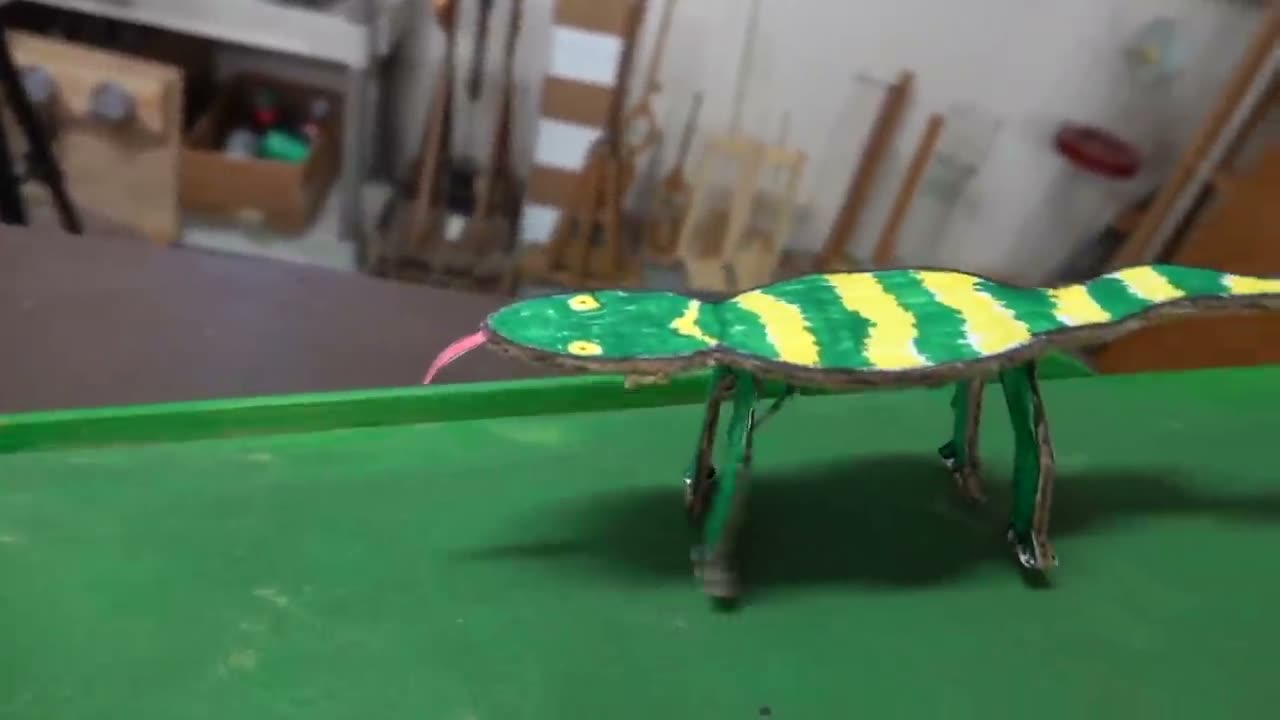
Students cut and fold a strip of cereal-box cardboard into a four-legged walker and watch it rock and step down a ramp with no motor or push. They test how ramp surface and slope change whether it walks, slides or falls, and explain the motion using gravity, friction and the shifting of support under the center of gravity.
The same cardboard walker slides straight down the smooth side of a ramp but walks step by step down the rough side. How can a piece of cardboard with no motor take steps, and why does the surface matter so much?
Learning objectives
- Students will be able to explain that the walker is powered by gravity, using energy from its height on the ramp.
- Students will be able to describe how the curved feet let the walker rock from side to side so one leg lifts and swings forward.
- Students will be able to compare how the walker behaves on a rough and a smooth surface and explain the difference using friction.
- Students will be able to design and carry out a fair test that changes one variable, such as ramp slope or foot shape.
Lesson flow (5E)
Place the demo walker on the smooth side of the ramp and let students watch it slide. Flip the ramp to the rough side and release it again so it walks. Ask what is different and what is powering it, and record student ideas.
Pairs trace the template, cut the rectangle, make the four cuts at the ends, round each foot, crease the fold lines and bend the legs down. They test on the rough side of a ramp, adjusting until the legs match and point straight down. Pairs that finish early compare the rough and smooth sides.
Have students watch a walker from the front, or show the slow-motion section of Bruce's build video. Explain that the curved feet let the walker rock side to side; as it leans onto one front leg, that leg bends back under the load and the other leg lifts and swings forward, then the springy tension in the bent leg rocks it the other way. Gravity provides the energy from the ramp's height, and friction on the rough surface lets the feet grip so the walker pivots instead of sliding. The back legs drag and act as a brake.
Pairs choose one variable to change (ramp height, a coin taped to the body, or one walker with straight-cut feet) while keeping everything else the same. They record whether the walker walks, slides or falls over and share one finding with the class.
Students complete the exit ticket or the key items on their age-band worksheet: explain what powers the walker and why it needs curved feet and a rough ramp.
Discussion questions
- What did the walker do on the smooth side compared with the rough side?
- Watching from the front, what does each front leg do when the walker leans onto it?
- Why might the walker need curved feet instead of feet cut straight across?
- What happened when the ramp was too flat or too steep?
- Where does the energy to walk come from, and why does the walker stop at the bottom?
- If you were designing a walker to go farther or more steadily, what would you change and how would you test it fairly?
Common misconceptions
Assessment
- Exit ticket: what powers the walker, and why does it walk on the rough side but slide on the smooth side?
- Use the age-band worksheet (My Ramp Walker, Walker Test Lab, or Walker Science: Explain & Extend) and check against the answer key.
- Check each pair's fair-test record: did they change only one thing, and does their conclusion match what they observed?
- Quick performance task: give a pair a walker that falls over or will not step and ask them to fix it and explain what they changed.
Differentiation
Support: Provide the rectangle already cut out with the cut lines and fold lines drawn, so students focus on cutting the legs, rounding the feet and bending. Use the 5-7 worksheet and the words rock, step, grip and downhill.
Extend: Students design a new creature with legs set closer together and explain why it tips over more easily, build the larger corrugated walker with an adult cutting it, test where added weight helps most, or measure the lowest and highest ramp heights at which their walker still walks.