Experiments / Ramp Walkers
Ramp Walkers
How can a cardboard toy walk with no motor?
Fold a strip of cereal box into a little four-legged animal, set it on a slope, and watch it waddle down all by itself.
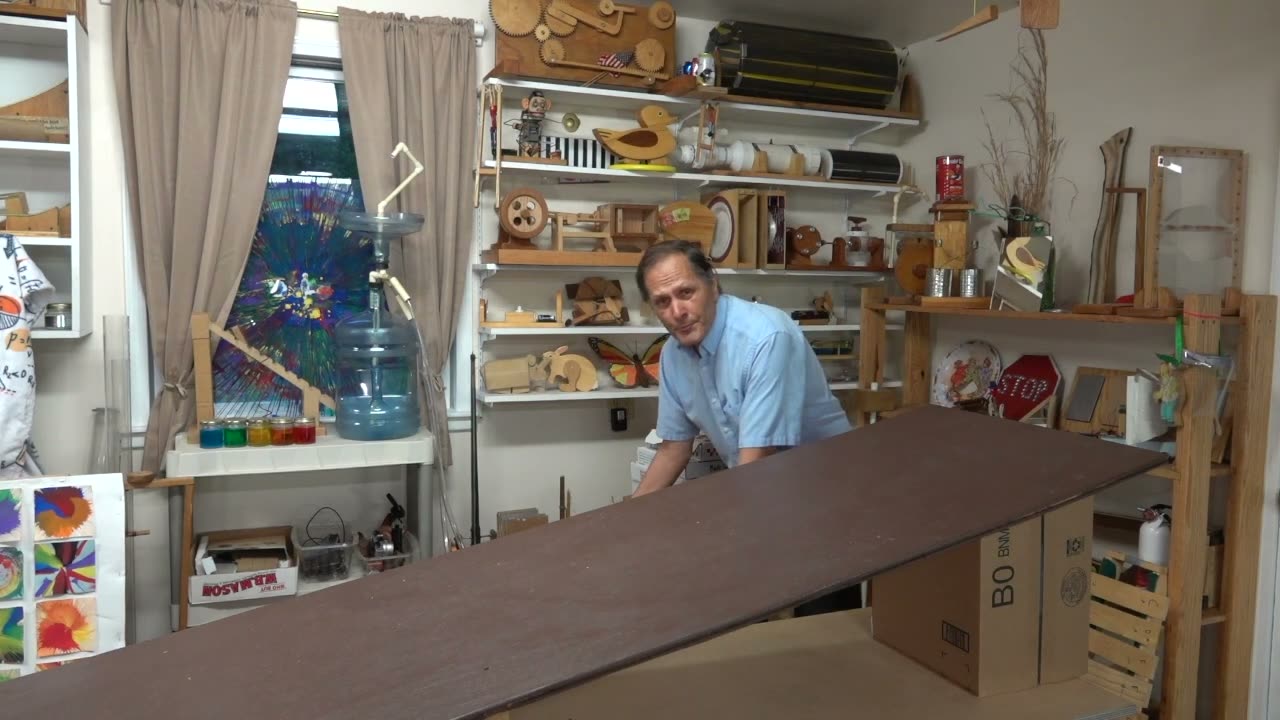
Based on Bruce's demonstration in the video below.
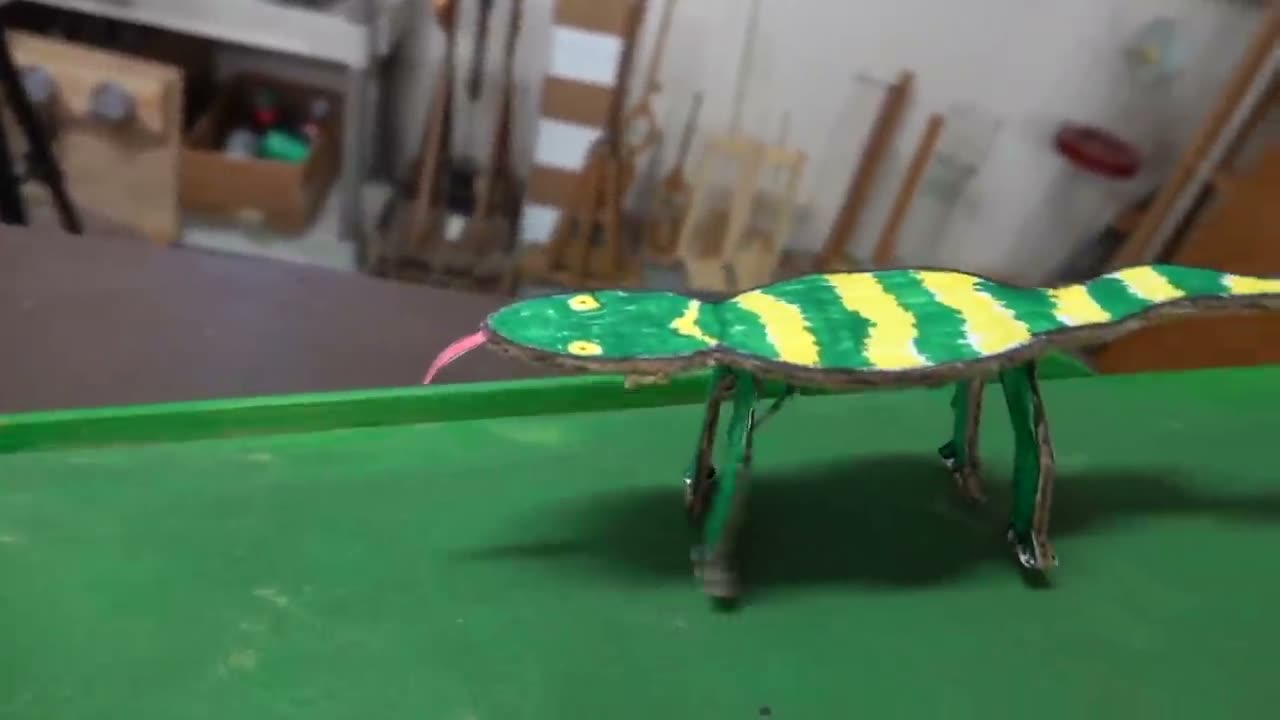
You'll cut and fold one strip of cereal-box cardboard into a little four-legged walker. Set it at the top of a gentle ramp and it rocks from side to side, stepping its way to the bottom with no motor, no batteries and no push. Gravity does all the work, but only if the feet, the legs and the ramp are just right.
“What causes both of these animals to move is the shifting of support underneath the center of gravity as they rock back and forth and work their way down the ramp.”
Build it
Rub sandpaper back and forth across one side of the big flat cardboard. A slightly rough surface lets the walker's feet grip instead of sliding.
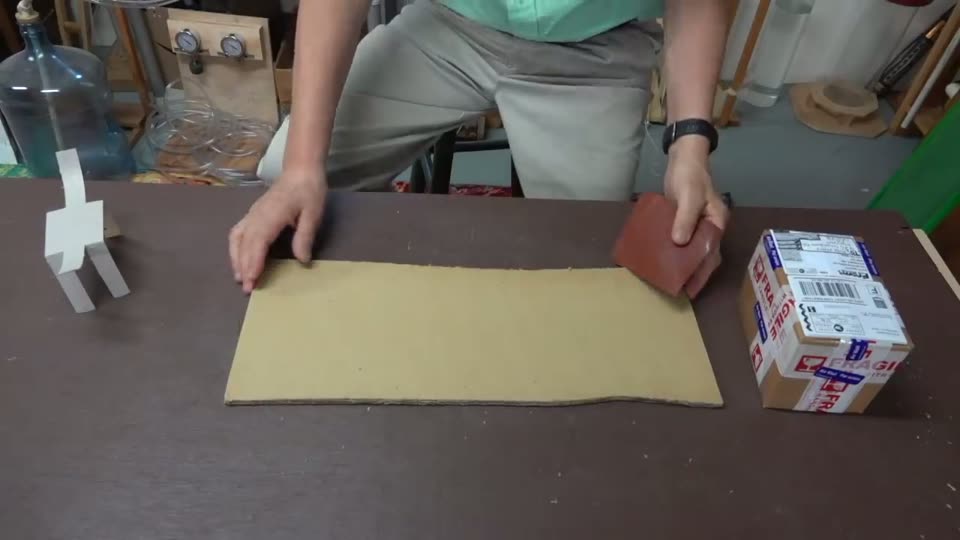
Prop one end of the cardboard on a box or books, rough side up, so it makes a gentle slope. This is your ramp.
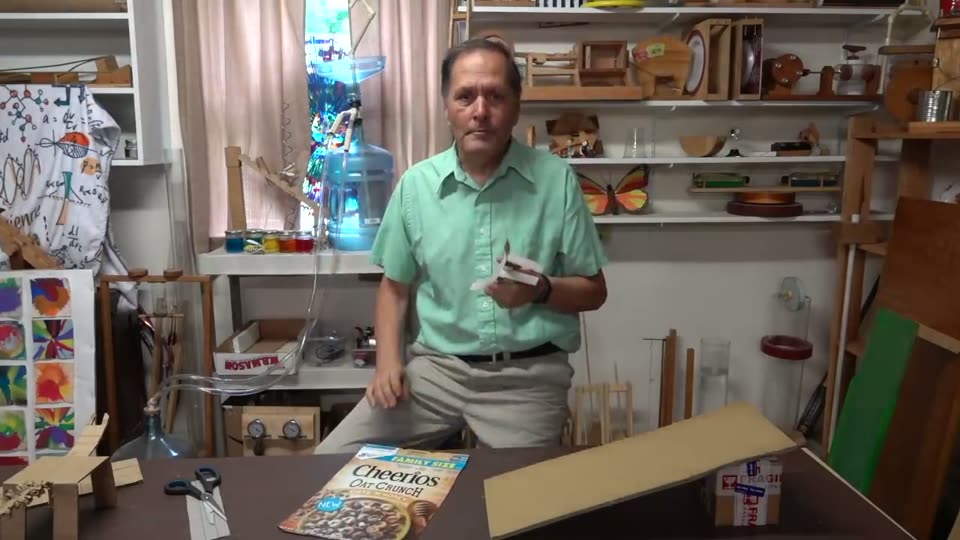
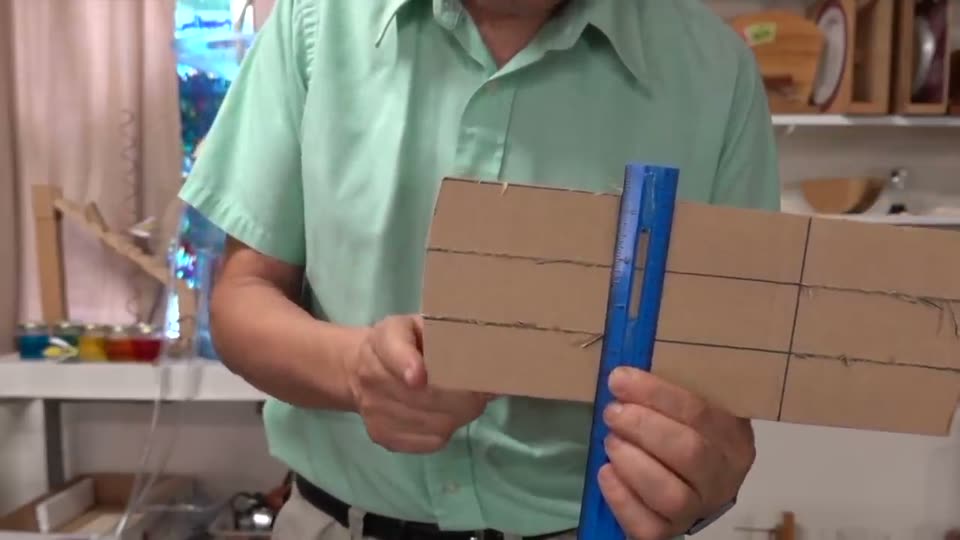
On the cereal-box cardboard, draw the pattern: a rectangle about 9 inches (23 cm) long and 2 1/4 inches (5.7 cm) wide. Draw two lines along its length to split it into three strips, each 3/4 inch (2 cm) wide. Then draw two fold lines across it, 3 inches (7.5 cm) in from each end.
Cut out the rectangle.
At each end, cut along the two long lines, stopping at the fold line. That makes four cuts in all. The middle section stays in one piece.
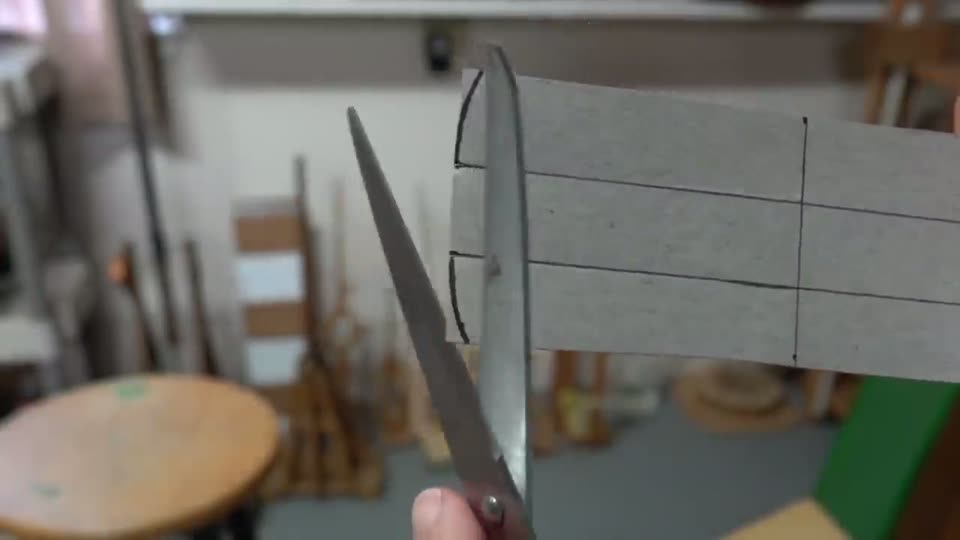
Trim the bottom of each outside strip into a smooth curve, so each leg ends in a rounded foot, like the bottom of a rocking chair.
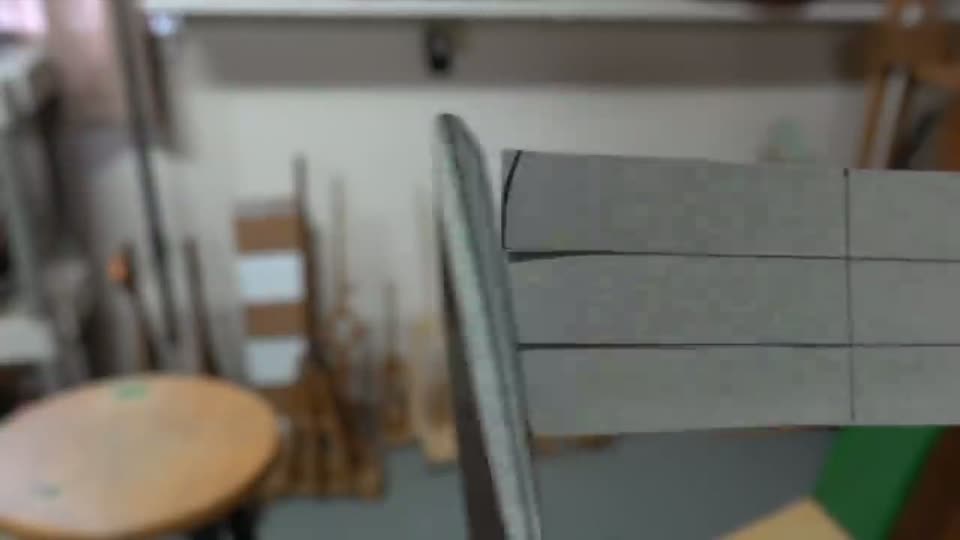
Crease each fold line by pressing along it with a ruler edge, then bend the two outside strips at each end straight down to make four legs. Leave the middle strips sticking out flat at the front and back.
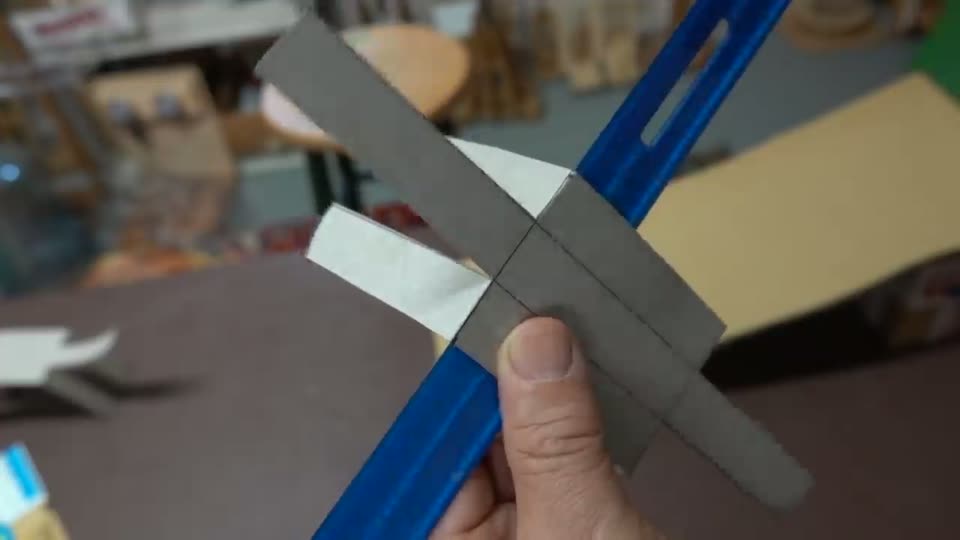
Check that all four legs point straight down and match each other. Set the walker at the top of the ramp and let go.
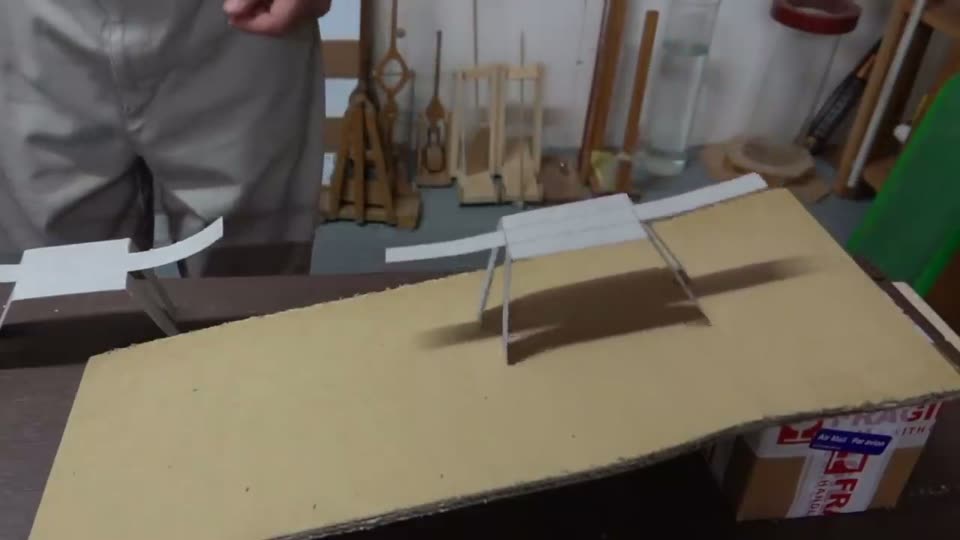
Once it walks, turn it into an animal: bend the front middle strip up for a neck, then fold the tip down for a nose and the ears up. Snip the back middle strip into thin strips and squeeze them together for a furry tail. Color it with markers if you like.
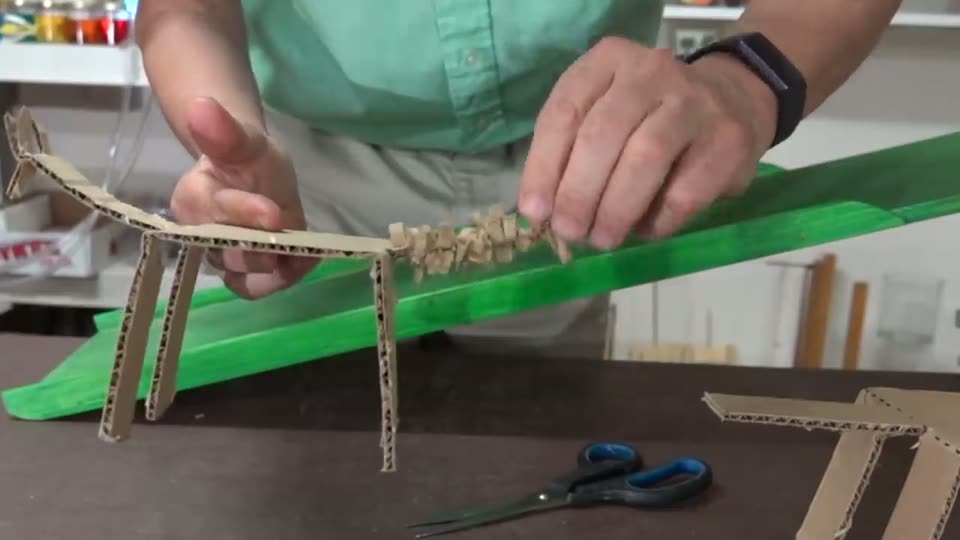
Grown-up: For an optional bigger walker, cut the same pattern from corrugated cardboard: about 12 by 4 1/2 inches (30 by 11.5 cm), with fold lines 4 inches (10 cm) from each end and strips 1 1/2 inches (4 cm) wide. Press the creases harder so the legs bend down square.
Try it & notice
What's going on?
For young scientists
The walker has no motor, so where does its energy come from? From gravity. Every time it moves a little lower on the ramp, gravity gives it a tiny bit of energy, just like a ball rolling downhill.
The curved feet are the secret. They let the walker rock from side to side like a rocking chair. When it leans onto one front leg, the other front leg lifts off the ramp and swings forward a little. Then it rocks back the other way and the other leg swings forward. Rock, step, rock, step, all the way down.
The legs have to bend just the right amount. If they are too floppy, the walker falls over; if they are too stiff, it won't step at all. And the ramp needs to be a little rough, so the feet grip instead of sliding.
For grown-ups & teachers
Ramp walkers are passive dynamic walkers: toys that convert gravitational potential energy into motion with no stored energy of their own. Each step lowers the center of mass slightly, and that small energy drop pays for what is lost to friction and to the small impacts as each foot lands. On level ground the energy source disappears and the walker stops after a step or two.
In the cardboard walker the curved feet make the front legs a rocker, so the body rolls side to side. As weight shifts onto one leg, that leg flexes back under the load while the unloaded leg swings forward, and the spring tension in the folded leg rocks the walker back the other way. In the video the balance is described this way: not enough tension and it falls over, too much and it doesn't walk. The back legs mostly drag as stabilizers. They act as a brake, which keeps it from running away but means this design needs a slightly steeper ramp than the wooden walkers. Narrow-set legs (the spider and gecko designs) are less stable and tip over more easily.
The wooden duck and rabbit in the physics video work by a fore-and-aft version of the same idea: one leg is fixed, the other swings through about an inch before hitting a stop, and tilting the toy on the incline shifts the center of gravity from over the back leg to over the front leg. The shift in support makes the body rock forward, and the rocking repeats. A common misconception is that the toy is simply sliding. Slow motion shows it is stepping, and on a slick surface it really does slide instead, which is why friction on the ramp matters.
To extend it, treat it as an engineering design problem: change one variable at a time (ramp angle, ramp surface, leg length, foot curvature, leg spacing, added weight) and record whether the walker walks, slides or falls. Bruce notes that adding small weights helps some designs walk better.
NGSS performance expectations
- 3-PS2-1 Plan and conduct an investigation to provide evidence of the effects of balanced and unbalanced forces on the motion of an object.
- 5-PS2-1 Support an argument that the gravitational force exerted by Earth on objects is directed down.
- 3-5-ETS1-2 Generate and compare multiple possible solutions to a problem based on how well each is likely to meet the criteria and constraints of the problem.
Science words
Tips from 41 years of teaching it
Bruce has collected ramp walkers for years, built his own big wooden ones, and had students design walkers as a class project. Here's what he learned.
- For a ramp that grips, Bruce painted his and sprinkled fine sand onto the wet paint; on his wooden walkers he varnished the bottoms of the feet and sprinkled sand on them too.
- His display ramp has railings along both sides so the walker can't step off the edge, an adjustable prop so one ramp works for several walkers, and an angled bottom end so his big duck walks right off the ramp.
- On a one-leg wooden walker, the moving leg should swing about an inch between its two stops and move freely; sand any spot where it rubs the body.
- Balance check for a wooden walker: hold it upright by the legs and it should rock backward, because the rear should be heavier. If the head dips forward, take wood off the front or add a screw in the tail.
- To get students started on their own walkers, Bruce's class took apart a store-bought wooden duck and photocopied its parts as a starting pattern. Once students get the idea, the walker doesn't have to be a duck.
- Bruce uses the walking duck in his energy lessons: it walks down a ramp but never up one, a quick way to show that its energy comes from moving lower.
Bruce has built several walkers just for the challenge, including a walking soda can and one with a clear body so students could watch the moving parts. When his 2012 wooden bunny turned out to be faster than his duck, his first thought was whether he could build a turtle walker to race it.
More to try
- Make a walker go on a level table: tie a string to its front, run the string over the table edge and hang a small weight (a few paper clips) from it. The walker steps toward the edge and stops just before it, because as it gets closer the string pulls more downward and less forward, so friction wins.
- Build a walker with a clear plastic body so everyone can see the leg swing and hit its stops.
Make it a challenge
Turtle walker
Draw a turtle around a slightly stretched 5-inch circle, glue it to cardboard and color it. Hot-glue four cardboard legs (about 4 by 3/4 inch, cut with the grain, rounded at the bottom) spaced 3 1/2 inches front to back. Pinch each leg just above the glue so it can flex, and tilt the front legs slightly forward.
Spider or gecko
Design your own creature. Bruce's spider has eight legs but walks on four. Set the legs closer together and see how much more easily it tips over.
Add a little weight
Tape a coin or a paper clip to the body in different spots. Does extra weight help it walk, and where does it work best?
Pizza-box delivery walker
Bruce built a giant walker from a pizza box and sent lunch down a ramp on it. Try a big version from a large box, starting it with a gentle sideways push. It's slow, and you'd have to live downhill from the pizza shop.
More from Bruce