Teachers / Lesson plans / Come-Back Can
Lesson plan · Grades 3-8Why does this can roll back to you?
Students build a come-back can from a coffee can, two rubber bands and a hanging battery, then roll it and measure how far it goes out and how far it returns. They trace the energy from their push into the twisted band and back into motion, and use their data to explain why the can never comes all the way back.
Why does a can you roll away from you slow down, stop and then roll right back on its own?
Learning objectives
- Students will be able to build a working come-back can and explain the role of the hanging weight.
- Students will be able to describe the energy transformations from kinetic to elastic potential energy and back.
- Students will be able to measure out-and-back distances and calculate the percent of distance recovered.
- Students will be able to design a fair test of one variable (push, weight or floor surface) and compare results.
Lesson flow (5E)
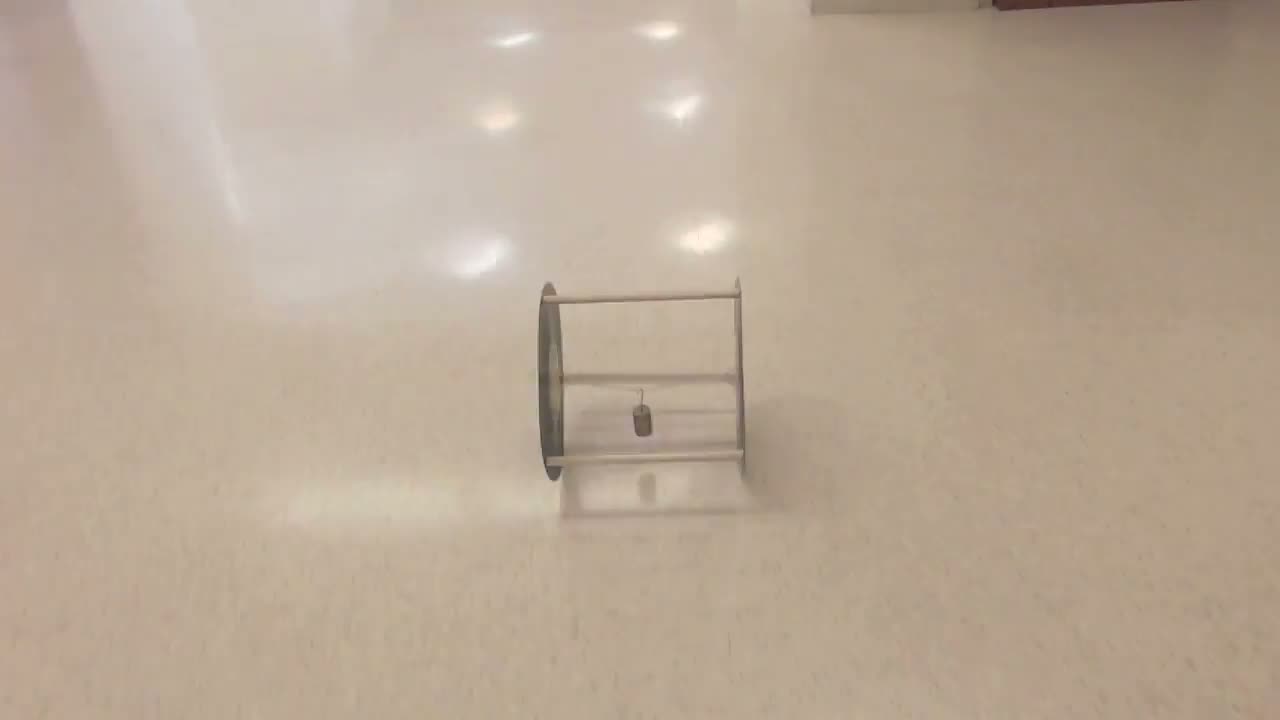
Roll the finished demo can across the floor without explanation and let it stop and return. Roll it again harder. Ask students to sketch what they think is inside the can.
Pairs assemble their cans: tie the two bands together, tie a string to each end, tape the battery beside the middle knot, thread one string out the bottom and pin the loop with a stick, thread the other out the lid, snap it on and pin that loop. Pairs shake the can to check the battery hangs freely, then do a first roll test and troubleshoot (battery flips over, band too loose, battery rubbing the side).
Start day two with the see-through can. Build the explanation together: the heavy battery stays hanging down while the ends of the band turn with the can, so the band twists and stores elastic potential energy; when the can stops, the band unwinds and turns the can back. Introduce kinetic energy, potential energy and friction.
Pairs mark a start line and measure distance out and distance back for a gentle, medium and hard push, then run a fair test of one variable: a AA instead of a D cell, or carpet instead of a smooth floor. Older students calculate distance back divided by distance out times 100. Share Bruce's distance versions (165 ft for the vinyl-record roller, 54 ft for the CD version after tuning) and the trade-off between more bands and a heavier weight.
Pairs present one data result and its explanation. Exit ticket: an energy chain from the push to the return roll, including where some of the energy went.
Discussion questions
- What is inside the can, and what does each part do?
- Why does the battery have to hang down instead of turning with the can?
- Where is the energy when the can has stopped at its farthest point?
- Why does the can never come all the way back to the start line?
- What happened when you used a lighter battery or pushed very hard, and why?
- If you wanted the can to go farther and still come back, what would you change, and what might go wrong?
Common misconceptions
Assessment
- Check the measurement table on the 8-10 'Come-Back Can Test Lab' or 11-14 'Energy in a Come-Back Can' worksheet against the answer key.
- Exit ticket: draw an energy chain (push, kinetic energy, elastic potential energy, kinetic energy, friction losses).
- Performance task: show a can whose battery is taped to the side wall and ask pairs to predict and explain why it will not come back, then fix it.
- Percent-recovered calculation from one trial, with a sentence on where the rest of the energy went.
Differentiation
Support: Pre-assemble the band, strings and battery so students only thread and pin the ends; focus discussion on 'the band winds up and pushes the can back' and use simple far/near measurements.
Extend: Graph roll-out distance against return distance, compare surfaces, and treat the motion as a damped oscillation; challenge students to build a CD or record version and tune bands and weight for maximum distance.