Experiments / Come-Back Can
Come-Back Can
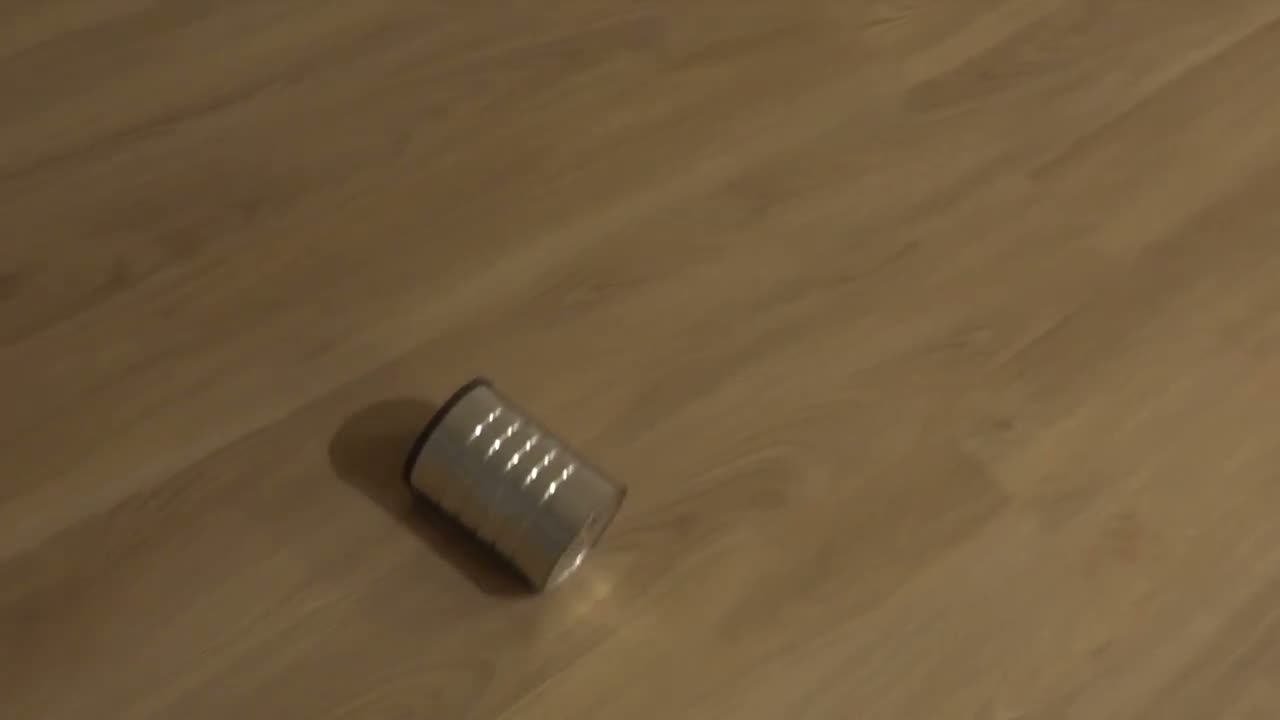
Why does this can roll back to you?
Roll a can across the floor and watch it stop, think about it, and roll right back to you.
Based on Bruce's demonstration in the video below.
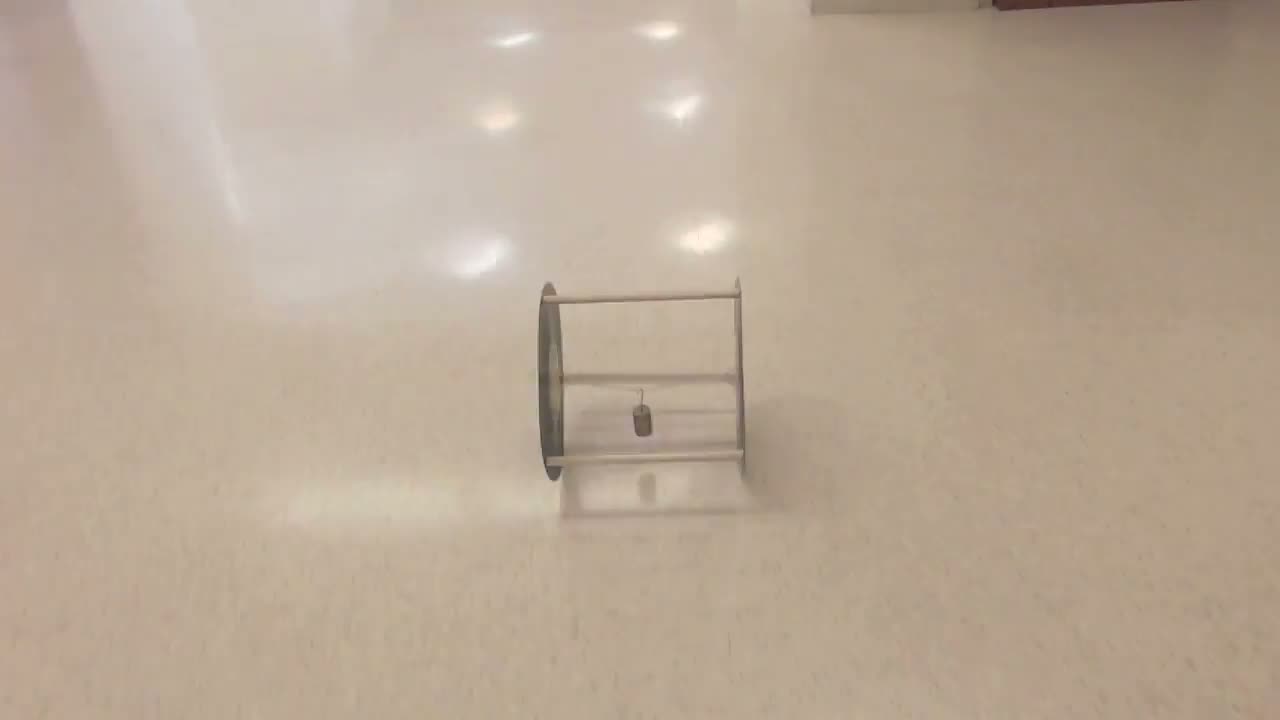
You'll turn an empty can into a toy that comes back when you roll it away. Hidden inside is a rubber band with a battery hanging from it. As the can rolls, the band secretly winds up, and then it pushes the can home.
“I hope you consider trying one of these for yourself and see how far you can get it.”
Build it
Grown-up: Poke a small hole in the very center of the can's metal bottom and another in the center of the plastic lid, then tape over any sharp edges.
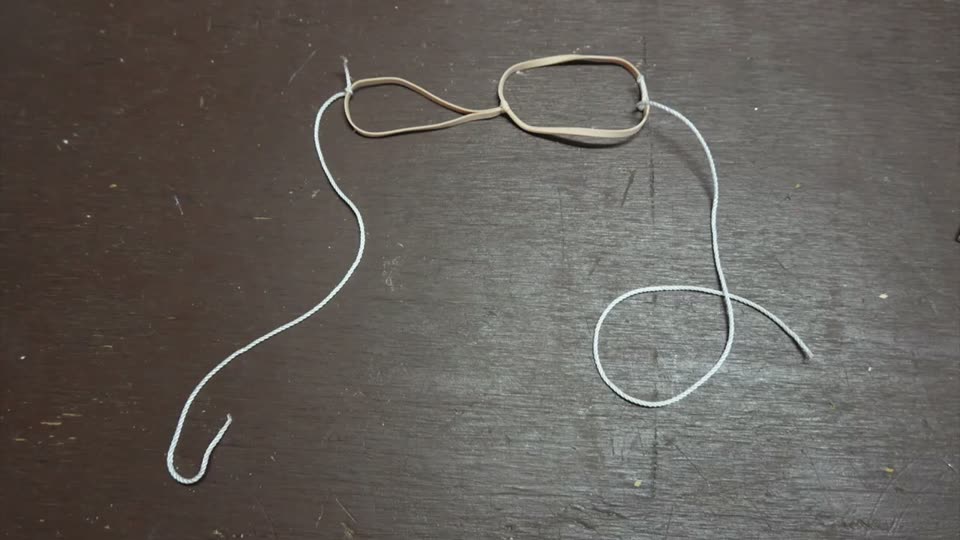
Tie the two rubber bands together end to end to make one long band.
Tie a string to each free end of the long band. The strings help you pull the band through the holes.
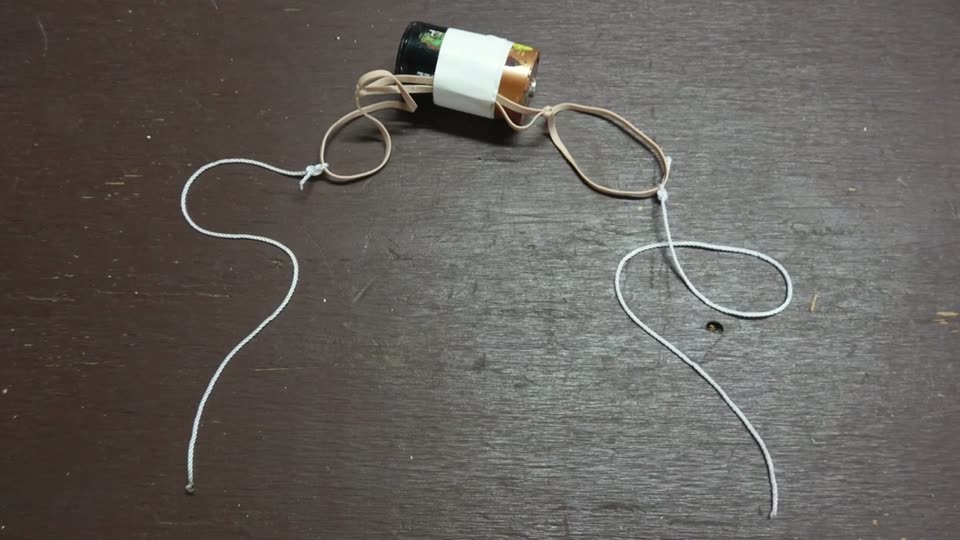
Tape the battery tightly to one of the rubber bands, right next to the knot in the middle, so it hangs from the band.
Drop one string into the can and push it out through the hole in the bottom. Pull until the end loop of the band pokes out.
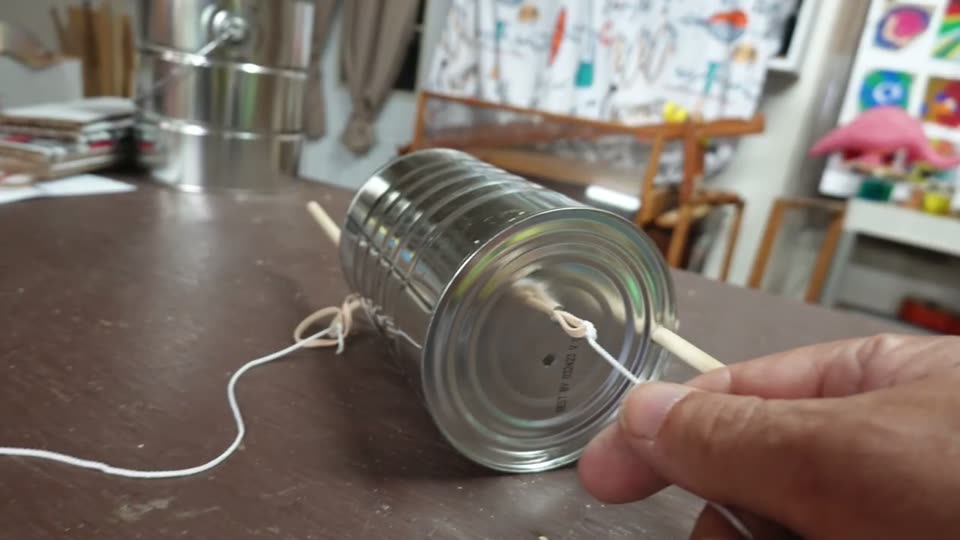
Slide a short stick through that loop, so the stick lies across the bottom of the can and the band can't slip back in.
Push the other string out through the hole in the lid, from the inside.
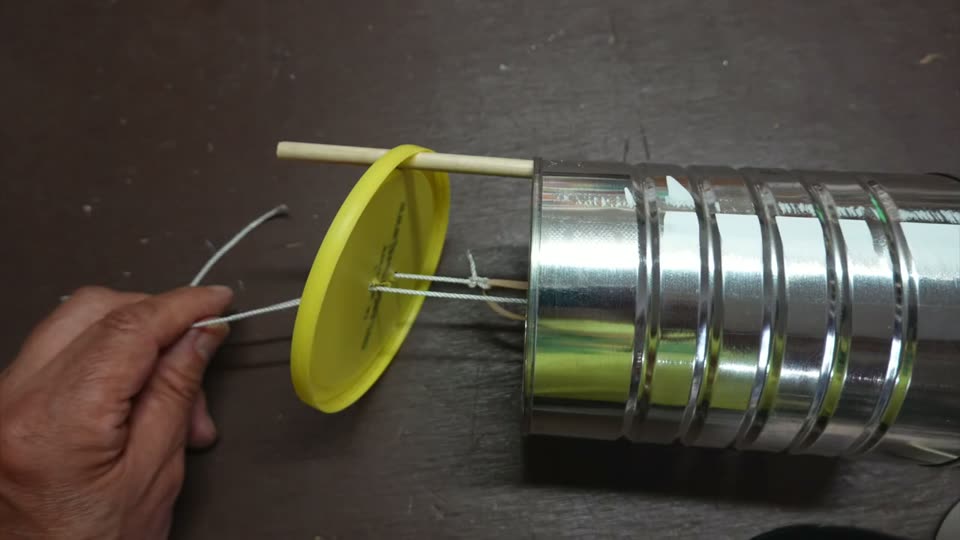
Snap the lid onto the can while you pull the string, until the band's other loop pokes out of the lid hole and the band is gently stretched.
Slide the second stick through that loop. Gently shake the can: the battery should hang in the middle without rubbing the sides.
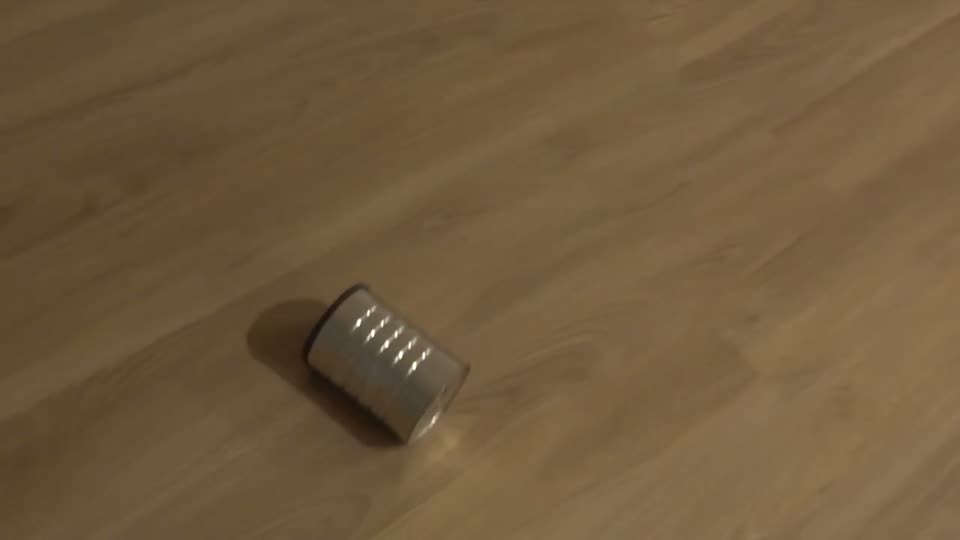
Set the can on its side on a smooth floor and give it a gentle roll away from you. Watch it slow down, stop, and roll back.
Try it & notice
What's going on?
For young scientists
The battery is heavy, so it always wants to hang down, even while the can is spinning around it. The ends of the rubber band are tied to the can and turn with it, but the middle is held still by the hanging battery. So every time the can rolls, the band gets twisted tighter, like wringing out a towel.
A twisted rubber band is storing energy, the same way a stretched bow stores energy for an arrow. When the can runs out of speed and stops, the twisted band starts to untwist. It turns the can the other way, and the can rolls back toward you.
It doesn't quite come all the way back. Some energy is lost to rubbing (friction) on the floor and inside the rubber, which is why it eventually rocks to a stop.
For grown-ups & teachers
This is an energy-conversion toy. The push gives the can kinetic energy; as it rolls, the band twists and that energy is stored as elastic potential energy. When the can stops, the band unwinds and converts it back into kinetic energy in the opposite direction. Some energy is lost each trip to rolling friction and to internal friction (hysteresis) in the rubber, so the return distance is always shorter and the can rocks back and forth with shrinking swings, like a damped oscillator.
The key part is the hanging weight. Because its center of mass sits below the axle line, gravity produces a restoring torque that keeps it hanging down while the can rotates around it. That makes it the fixed anchor the band twists against. A common misconception is that the can 'remembers' its direction; in fact nothing works unless the weight stays put. If the band is too tight or the weight too light, the band's torque flips the weight over the top and it just spins with the can, so no energy gets stored. If the band is too loose, the weight drags on the inside of the can.
Bruce's challenge versions push this hard: his big model made from two vinyl records joined by three dowels, with three rubber bands and a popsicle stick holding the ends, rolled 165 ft; a smaller CD version reached 54 ft after tuning the bands and weight. The tuning trade-off (more bands store more energy but need a heavier weight to stay down) makes a good engineering-design investigation.
To extend it, have kids graph push strength versus out-and-back distance, compare surfaces, or calculate what fraction of the outgoing distance is recovered on the return.
NGSS performance expectations
- 4-PS3-4 Apply scientific ideas to design, test, and refine a device that converts energy from one form to another.
- MS-PS3-5 Construct, use, and present arguments to support the claim that when the kinetic energy of an object changes, energy is transferred to or from the object.
- 3-PS2-2 Make observations and/or measurements of an object's motion to provide evidence that a pattern can be used to predict future motion.
Science words
Tips from 41 years of teaching it
Bruce's files don't include a write-up of the roll-back can itself, but his energy lessons and rubber-band projects show how he taught the idea inside it.
- In his energy lessons Bruce grouped a stretched rubber band with a wound-up spring, a drawn bow and a blown-up balloon: energy stored by changing an object's shape, rather than by lifting it up high. The twisted band in the can belongs on that list.
- For a class distance challenge, Bruce handed out the rubber bands himself (three per student) and everyone had to use his. That way the contest tests the design, not who brought the strongest bands.
More to try
- Rubber-band car: build a car from cardboard and wheels, powered only by three rubber bands. Bruce found that small wheels spin and lose grip, while big wheels turn slower but go farther; cars with wheels about 2 feet (60 cm) across went over 100 feet.
Make it a challenge
Hopping frogs
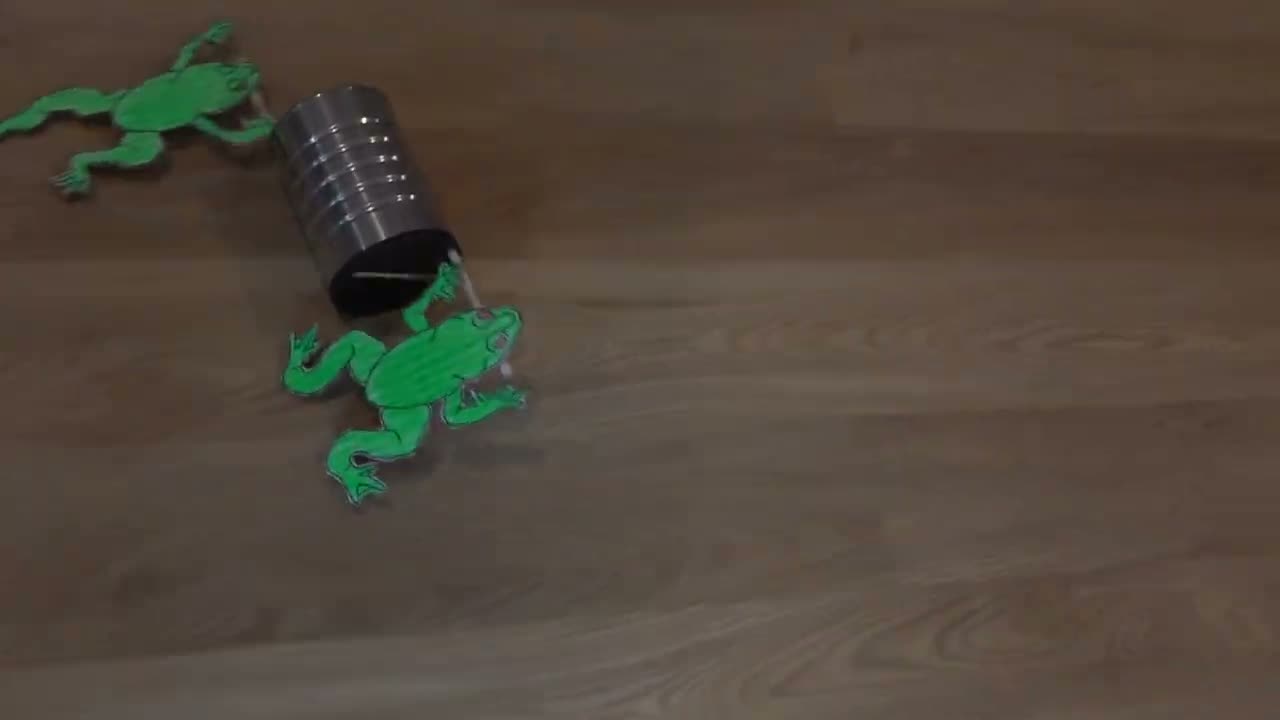
Add a dowel poking out of each end of the can near the rim, then slide cardboard frogs with a straw glued on their backs over the dowels. As the can rolls, the frogs flip and hop.
Walking shoes
Build a rollback toy from two CDs joined by wooden dowels, then hang cardboard sneakers or boots on the dowels so it looks like it is walking. Bruce even made a pair of moonwalking shoes.
Tortoise and hare race
Put the tortoise on an axle at the exact center of a wheel so it glides smoothly, and the hare on a dowel near the rim so it bounces. Put one halfway between and it moves in a smaller circle, like Bruce's grasshopper and kangaroo.
Distance challenge
Bruce's big version made from two vinyl records went 165 ft. Tune your rubber bands and weight and see how far yours will go and still come back.
More from Bruce