Teachers / Lesson plans / Sand Pendulum Art
Lesson plan · Grades 3-8Can a swinging bottle of sand draw a picture?
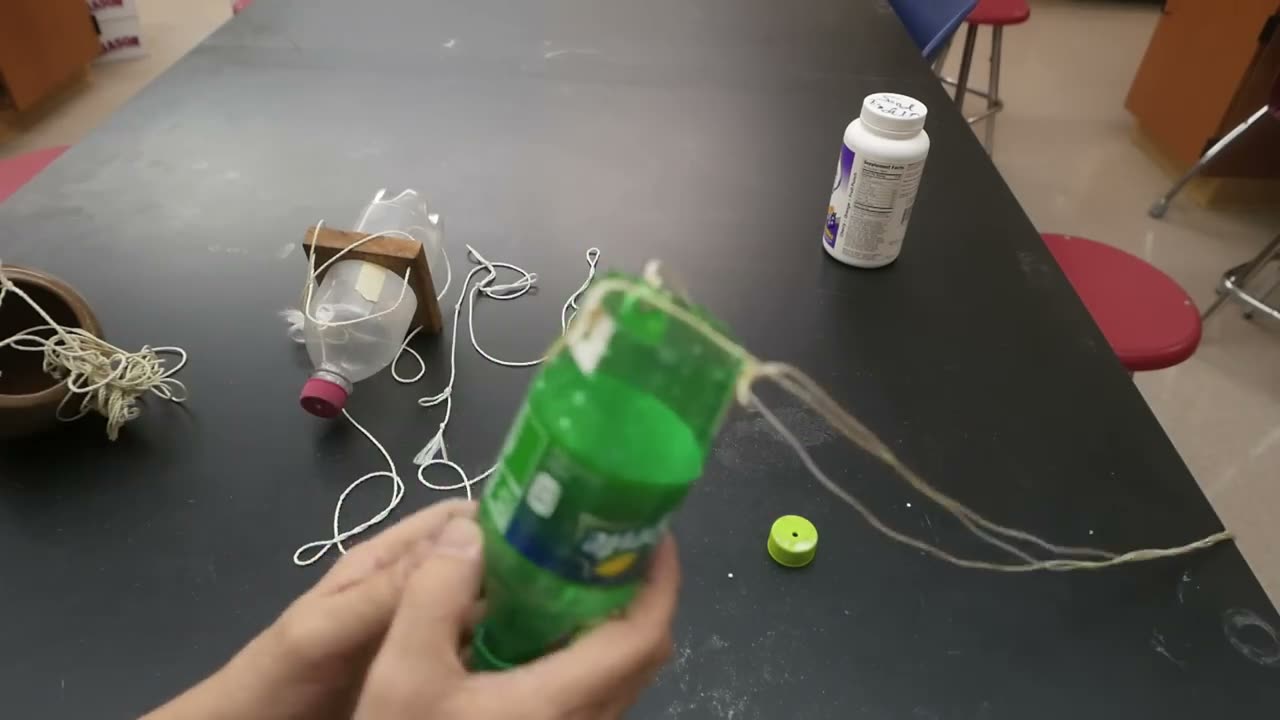
Students hang a leaky soda-bottle bob from a Y-shaped string, time its swing in two directions, and discover that one pendulum can have two different periods. They then use the sand traces to see how changing string length changes the pattern, connecting a measurable pattern of motion to the looping designs it draws.
How can one bottle of sand, given a single push, draw a neat woven pattern that no one is steering?
Learning objectives
- Students will be able to measure the period of a pendulum by timing 10 full swings and dividing by 10.
- Students will be able to compare the periods of a Y-string pendulum swinging along and across the line between its two ceiling supports.
- Students will be able to explain, using string length, why the Y-string pendulum swings faster in one direction than the other.
- Students will be able to predict how moving the knot of the Y will change the pattern drawn in the sand, and test that prediction.
Lesson flow (5E)
Day 1. Fill the demonstration bob on the Y-string, pull it toward a corner of the box, peel off the tape and release it with a sideways nudge. Let students watch the first loops form and ask them to sketch what they think the finished picture will look like and to write one question about why it moves the way it does.
Day 1. Groups tie the short strings to their bob and attach it to their station. With sand in the bottle and the cap hole taped shut, they swing the bob straight along the line between the two hooks and time 10 full swings, then swing it straight across that line and time 10 more. They record both times, divide by 10, and watch which strings move in each direction.
Day 1. Groups report their two periods. Guide them to the idea that a longer pendulum has a longer period. Swinging across the line between the hooks, the whole Y hinges at the ceiling, so the pendulum is long and slow. Swinging along that line, the top two strings stay still and only the strand below the knot swings, so it acts like a shorter, faster pendulum. Introduce the words period, bob, and Lissajous pattern.
Day 2. Each group fills its bob with sand (layered colors if available), releases it with a sideways nudge, and sketches the pattern. Then each group moves its knot to a new height (higher, lower, or about one quarter of the way up from the bob), predicts how the pattern will change, and runs it again. One station hangs the bob from a single string for comparison. Groups compare patterns on a gallery walk.
Day 2. Students complete the age-appropriate worksheet items about which direction was faster and why, then answer an exit ticket: explain why the loops shrink toward the middle, and predict what shape a single-string pendulum draws.
Discussion questions
- What did the sand pattern look like at the start of the swing, and how did it change by the end?
- Which direction did the bottle swing faster, and which strings were moving each time?
- Why would a shorter pendulum swing back and forth more quickly than a longer one?
- Why do the loops get smaller and fill in toward the center instead of repeating forever?
- What happened to the pattern when the knot was moved, and why would moving the knot change the two periods?
- If the bottle were heavier, would it swing faster or slower? How could we test that fairly?
Common misconceptions
Assessment
- Exit ticket: "Which way did your bottle swing faster? Explain why using the word length."
- Check the timing table on the worksheet for the age group: two directions timed over 10 swings, with one-swing periods calculated.
- Quick performance task: show the student a knot position and ask them to predict whether the two periods will be closer together or farther apart, then test it.
- Older students: use the 11-14 worksheet to identify the changed, measured, and controlled variables when moving the knot.
Differentiation
Support: Have younger students focus on watching and drawing the pattern and on noticing which strings move. The teacher can run the stopwatch while students count 10 swings aloud, and the choice items on the 5-7 worksheet can replace written explanations.
Extend: Older students measure the total length (bob to ceiling) and the lower length (bob to knot), then compare their measured period ratio to the square root of the length ratio. They can also hunt for the near 2:1 ratio that gives a figure-eight by making the lower strand about one quarter of the total length.