Experiments / Sand Pendulum Art
Sand Pendulum Art
Can a swinging bottle of sand draw a picture?
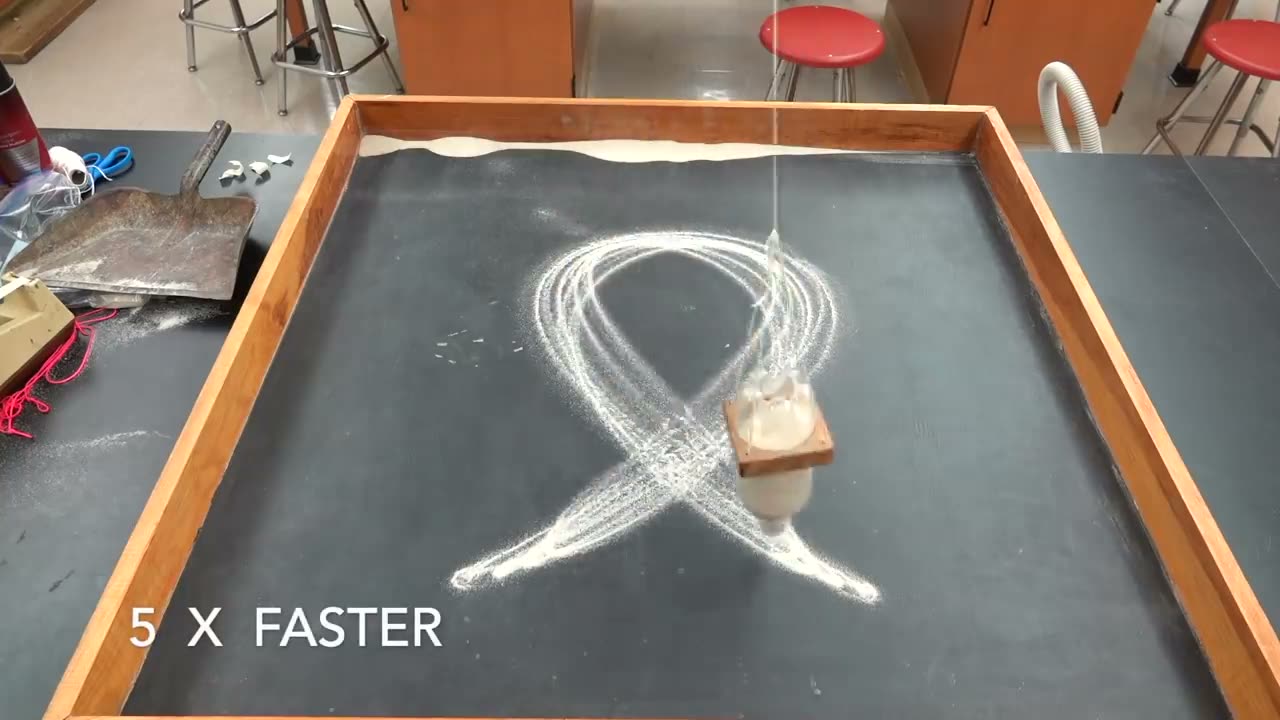
Hang a leaky bottle of sand from a Y of string, give it one push, and it draws a swirling pattern all by itself.
Based on Bruce's demonstration in the video below.
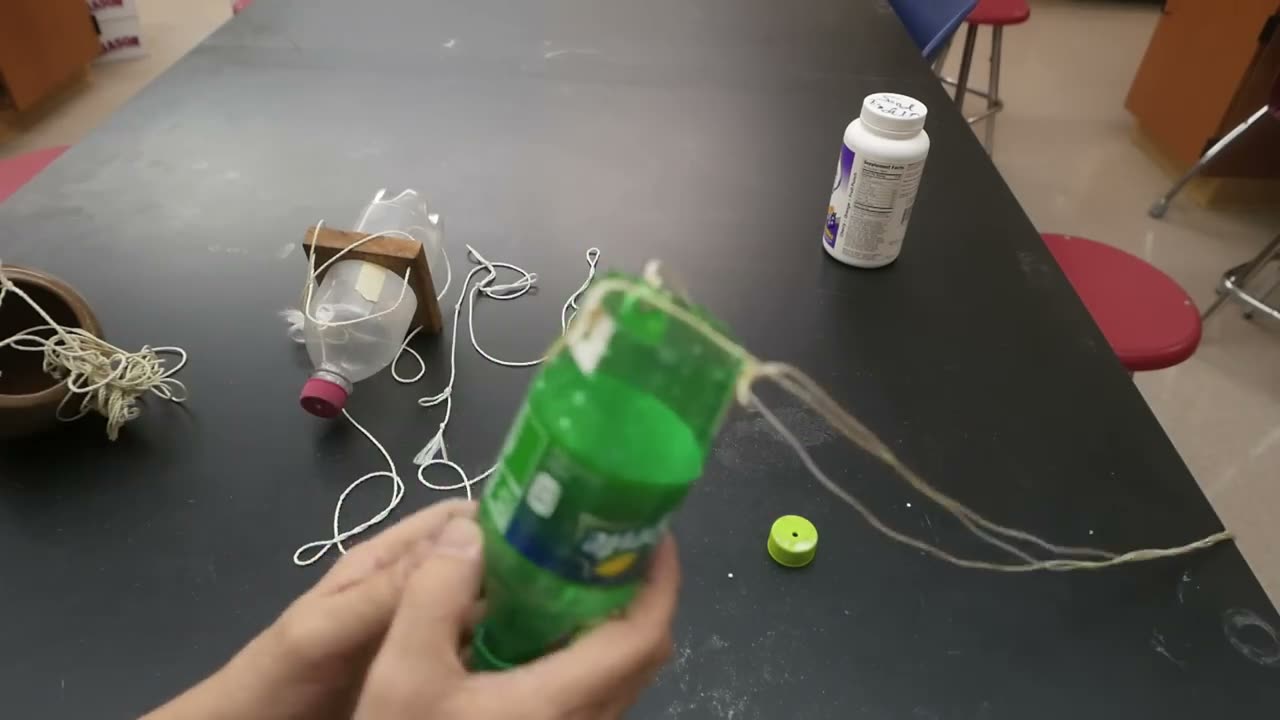
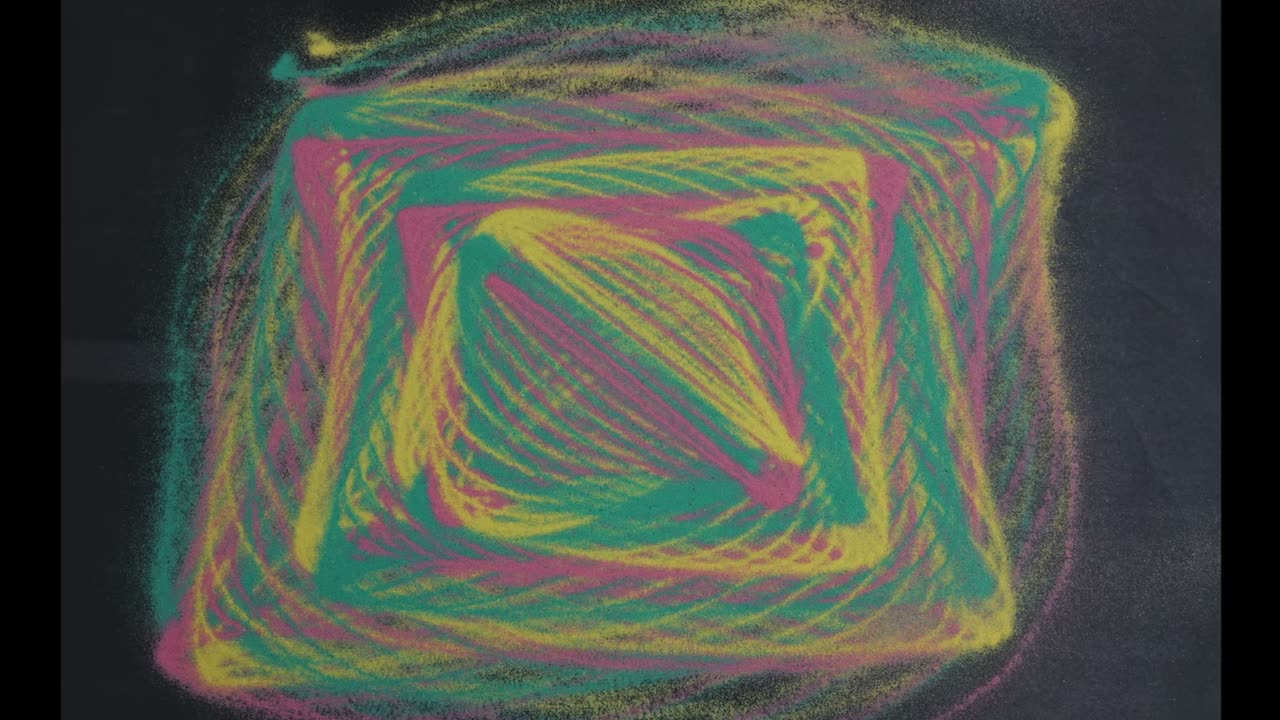
You'll turn an empty soda bottle into a pendulum that trickles a thin line of sand as it swings. Hung from a Y-shaped string, it swings at two different speeds in two directions, and the sand lines pile up into loops, figure-eights and woven squares that no hand could draw this neatly.
“Now how would it be possible for one pendulum to have two separate periods?”
Build it
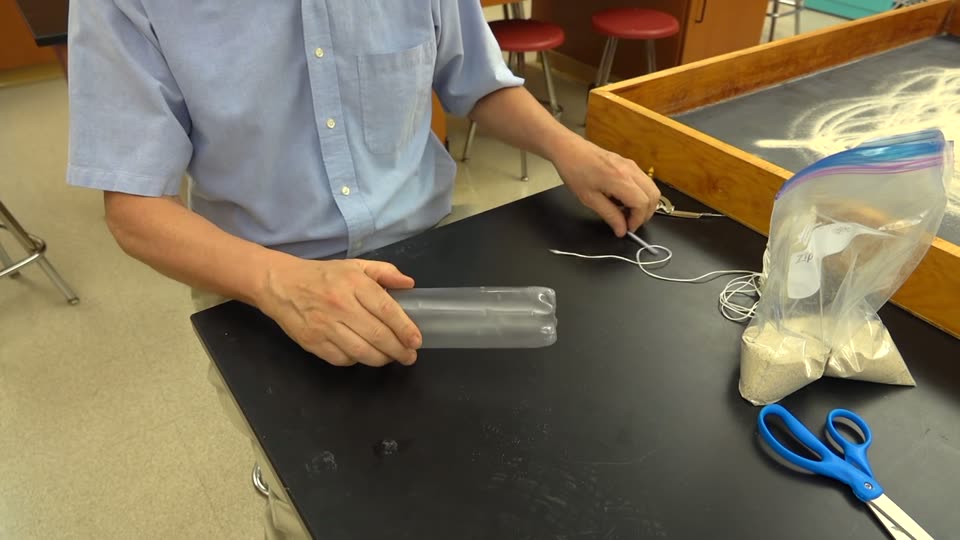
Grown-up: Poke three small holes, evenly spaced, around the bottle about 1 inch (2-3 cm) up from its bottom. Twist a small screw into each hole to make it a little bigger. These holes are for the hanging strings.
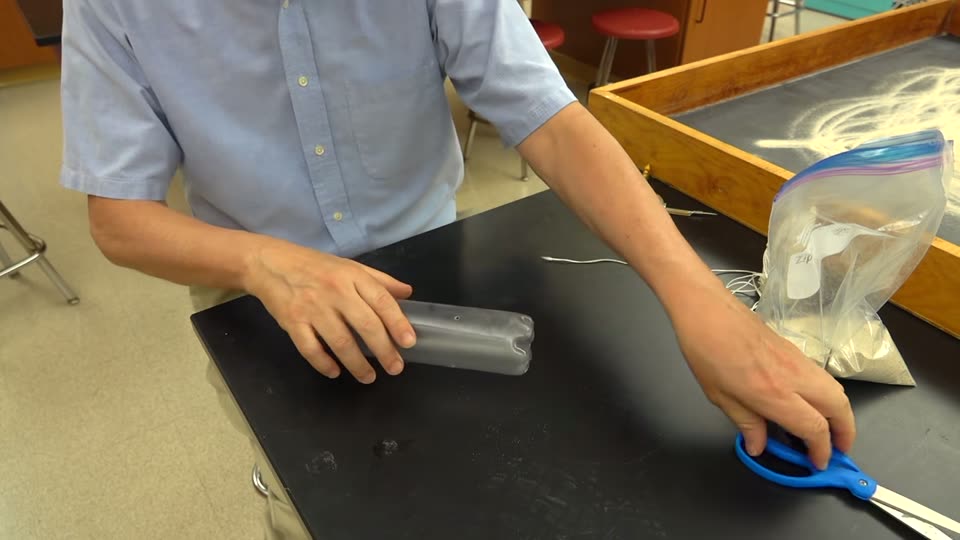
Grown-up: Cut the bottom off the bottle with scissors, just below the holes. Turn the bottle upside down: the open end is now the top, where the sand goes in.
Grown-up: Poke a hole about 1/8 inch (3 mm) wide in the middle of the cap, then screw the cap back on. The sand will trickle out of this hole.
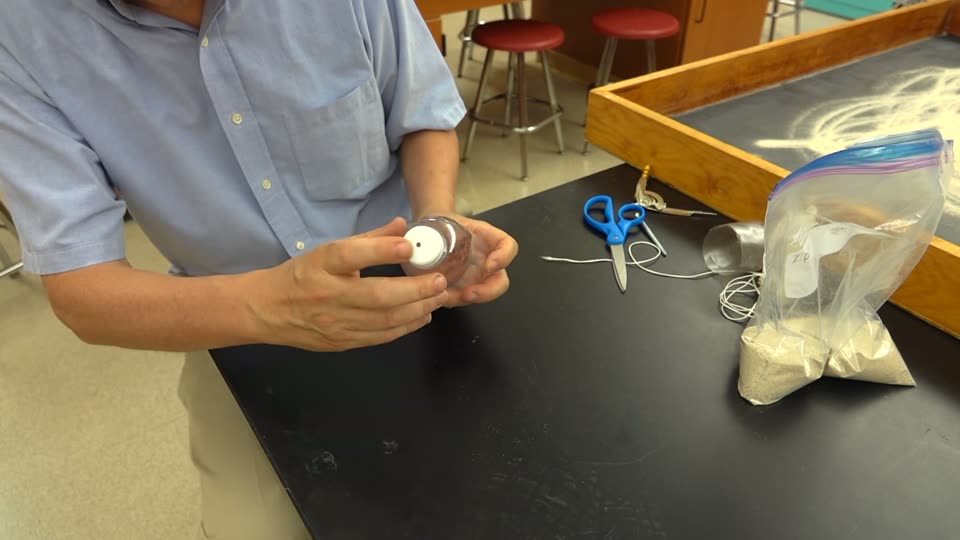
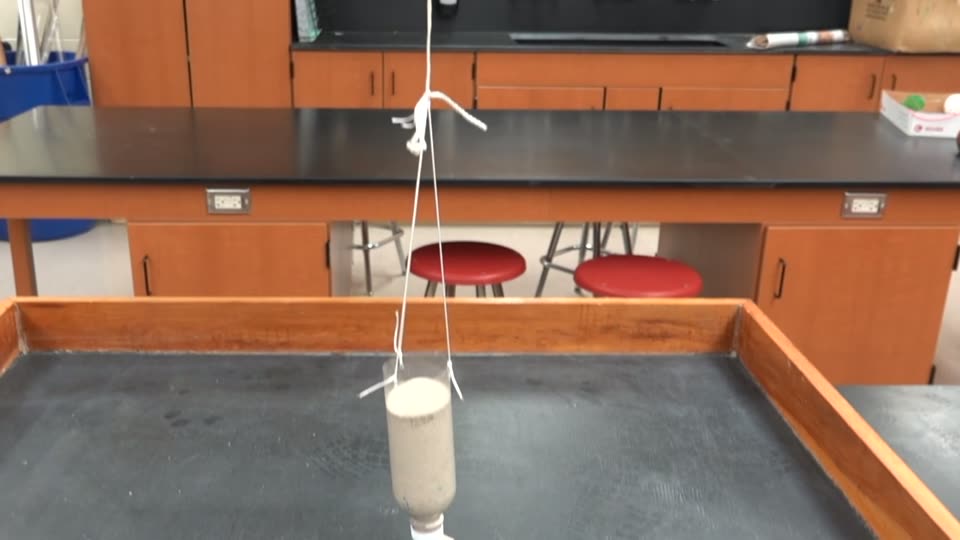
Tie a short string through each of the three holes. Pull the three strings together above the bottle and knot them so the bottle hangs straight, cap pointing down.
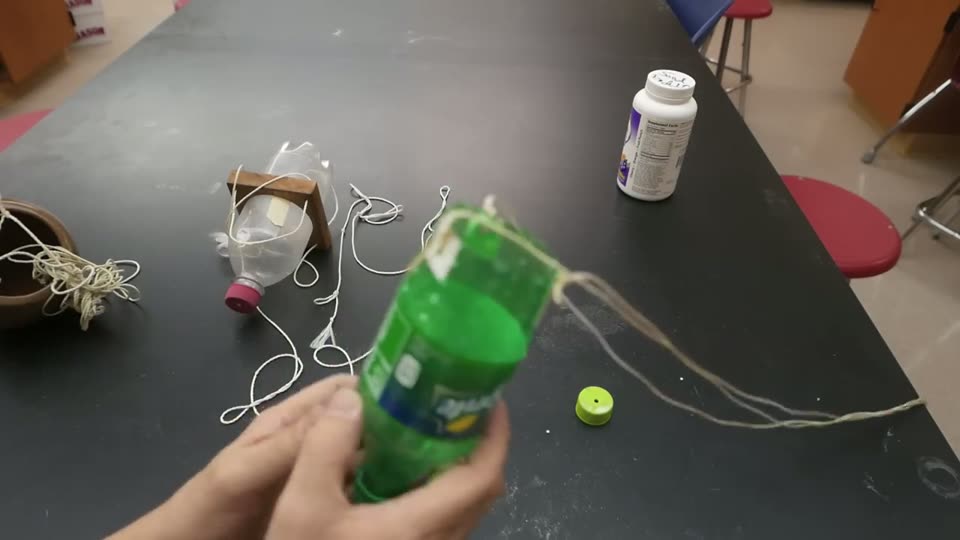
Grown-up: Tie two long strings to two hooks in the ceiling, a few feet apart, and knot their lower ends together. Tie the third long string to that knot so it hangs straight down. Now you have a Y. For your first try, put the knot about halfway between the ceiling and where the bottle will hang.
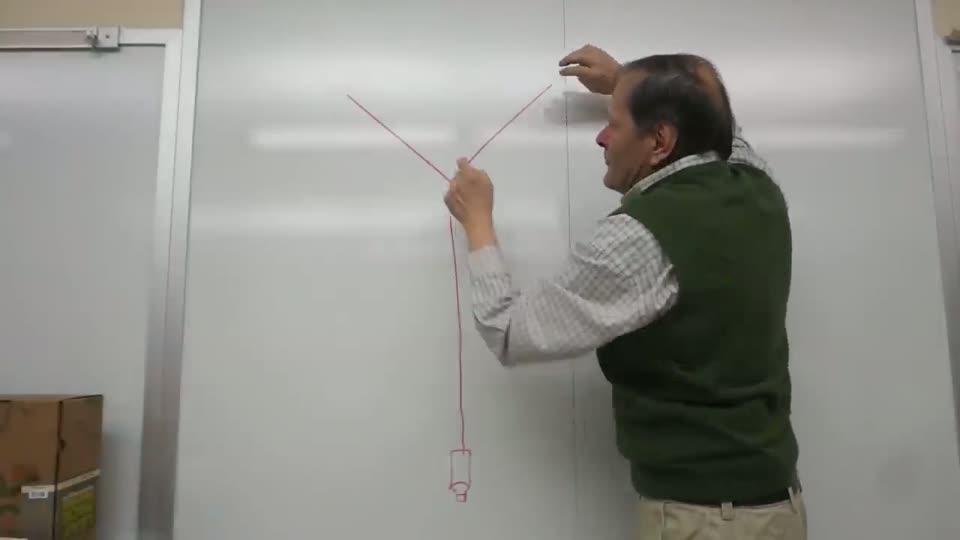
Tie the knot on top of your bottle to the bottom of the Y's single string.
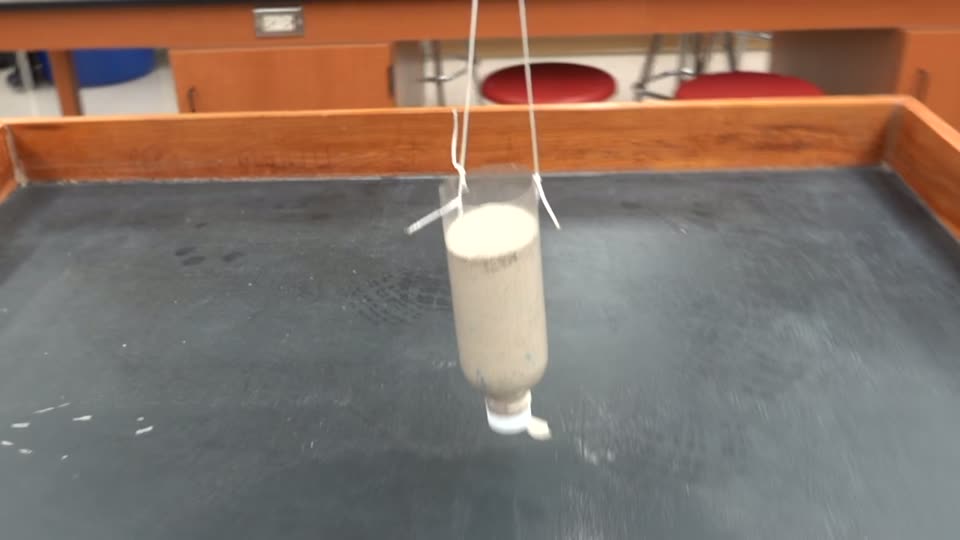
Put your box or dark paper under the bottle. Change the length of the bottom string until the cap hangs just above the surface, about a finger-width up.
Optional colored sand: put some sand in a zip-top bag, add about a dozen drops of food coloring, seal it and shake. Add more drops for a darker color, or mix red and yellow for orange.
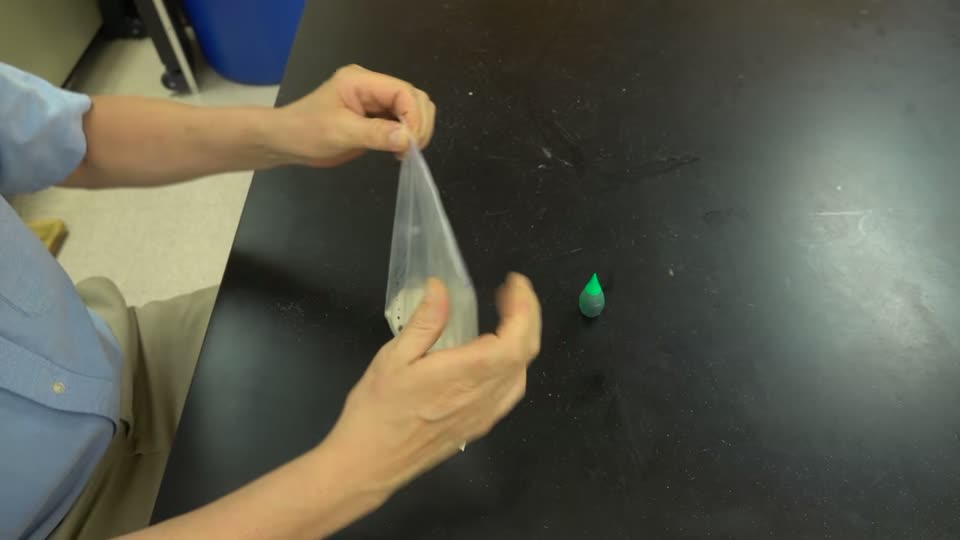
Cover the cap hole with a piece of tape, then pour sand into the open top until the bottle is nearly full. Pour different colors one after another to make layers.
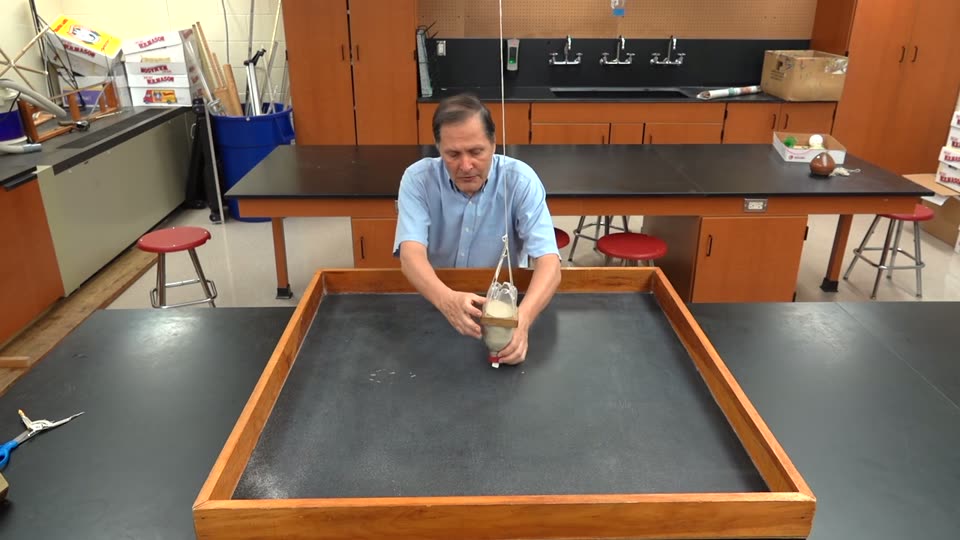
Pull the bottle back toward a corner of the box, peel off the tape, and let go with a gentle sideways nudge. Step back and let it draw. A full pattern can take 3 to 5 minutes.
Try it & notice
What's going on?
For young scientists
A pendulum is anything that hangs and swings back and forth. Its period is the time for one full swing, over and back. Longer pendulums have longer periods: they swing more slowly.
The Y-string gives your bottle two periods. Swinging across the line between the hooks, the whole thing swings from the ceiling, like a long, slow pendulum. In Bruce's classroom that swing took about 2.5 seconds. Swinging along the line between the hooks, the top of the Y stays still and only the bottom string swings. That is a shorter pendulum, so it's quicker: about 2 seconds.
Push the bottle at an angle and it does both swings at once, at two different speeds. The sand keeps a record of where it went, so the two swings mix into loops and woven shapes. Friction (rubbing against the air and the strings) slowly steals its energy, so each loop gets smaller and the picture fills in toward the middle.
For grown-ups & teachers
The traces are Lissajous figures: the sum of two perpendicular oscillations. A pendulum's period depends on its length (T = 2π√(L/g)), not its mass. On a single string the length is the same in every direction. Bruce times it at about 2.5 s both ways, so it draws an ellipse that spirals inward as friction drains energy. It takes about five minutes to stop in the center.
The Y suspension (often called a Blackburn pendulum) gives one bob two periods. Swinging perpendicular to the plane of the two ceiling strings, the whole V hinges at the ceiling and the effective length is bob to ceiling (about 2.5 s in Bruce's room). Swinging in that plane, the V can't move, so only the lower strand swings, from the bob up to the knot (about 2 s). Because frequency goes as 1/√L, the frequency ratio is √(L_total/L_lower).
Moving the knot changes the ratio. A short upper V brings the two periods close together. With the knot halfway, the ratio is about 1.4:1. When the lower strand is about one quarter of the total length, the ratio gets close to 2:1: the bob moves twice as fast one way as the other, and the trace is a figure-eight, as on a standard Lissajous chart. Near-miss ratios, plus the shrinking amplitude, make the pattern slowly drift and fill in.
Misconception: the heavy, sand-filled bottle doesn't swing at a different rate than a lighter one. Mass doesn't set the period, though draining sand shifts the bob's center of mass slightly. Extensions: time 10 swings each way and compare the measured ratio to √(L_total/L_lower); predict the shape before release; or record the motion with paint, or with light, as Bruce mentions for his next episode.
NGSS performance expectations
- 3-PS2-2 Make observations and/or measurements of an object's motion to provide evidence that a pattern can be used to predict future motion.
- 5-PS2-1 Support an argument that the gravitational force exerted by Earth on objects is directed down.
Science words
Tips from 41 years of teaching it
Bruce taught pendulums to his 8th graders with a whole lab of stations, and the sand pendulum was the payoff he showed at the end. Here's what he learned.
- Length sets the timing: Bruce's rule of thumb is that a pendulum about 24.8 cm (10 in) long takes 1 second to swing over and back, one 4 times as long takes 2 seconds, and one 9 times as long takes 3 seconds. Use it to predict the two timings of your Y before you measure.
- Don't pull the bottle back too far. Bruce found the swing time stays the same from 0 up to about 30 degrees and only gets longer past that, and it was the station his students most often got wrong.
- For an accurate period, time 10 full swings and divide by 10, the way Bruce's students did at his pendulum stations.
- Before his lab had support bars, Bruce's classes hung pendulums from a desktop or from a meter stick laid across two desks; for the longest pendulum they used a stairwell, swinging it alongside the wall without letting the string touch.
- In Bruce's energy unit, students first tested length, mass and swing angle on simple pendulums, then he showed the sand pendulum, so they already knew why the two directions swing at different speeds.
Bruce used the clock on his classroom wall as an example: its pendulum was a little too short, so the clock ran fast. He told students that early people surely noticed this easy link between length and time, and that Galileo made two discoveries about pendulums, starting with this one.
More to try
- Hang the bottle from one string and time it swinging east-west, north-south, then in a clockwise circle and a counterclockwise circle. Is the time the same every way?
- Draw with light: Bruce taped an LED to a bowling ball bouncing and swinging on a screen-door spring and photographed it in a dark room with the camera shutter open for 10 to 15 seconds. The bounce and the swing add up to a Lissajous pattern, just like the sand. Try an LED on a smaller spring-and-weight pendulum.
Make it a challenge
Hunt for the figure-eight
Move the knot down until the bottom strand is only about a quarter of the whole length. Bruce found this gives close to a 2:1 ratio and a figure-eight pattern.
Two or three bottles
Tape two or three sand bottles together side by side, each with a different color, and hang them as one bob. Tape over the holes while you fill and hang them so the sand doesn't leak early.
Make a sand poster
A grown-up sprays a big sheet of paper with spray adhesive (outdoors or with good airflow), then you run the pendulum over it. Let it dry for a while, then tip off the loose sand and hang your art.
Paint pendulum
Swap the sand for paint thinned with water in a squeeze bottle with a small nozzle, and let it swing over a big sheet of paper on the floor.
More from Bruce