Teachers / Lesson plans / Solar Motor
Lesson plan · Grades 4-8Is this a free energy motor?
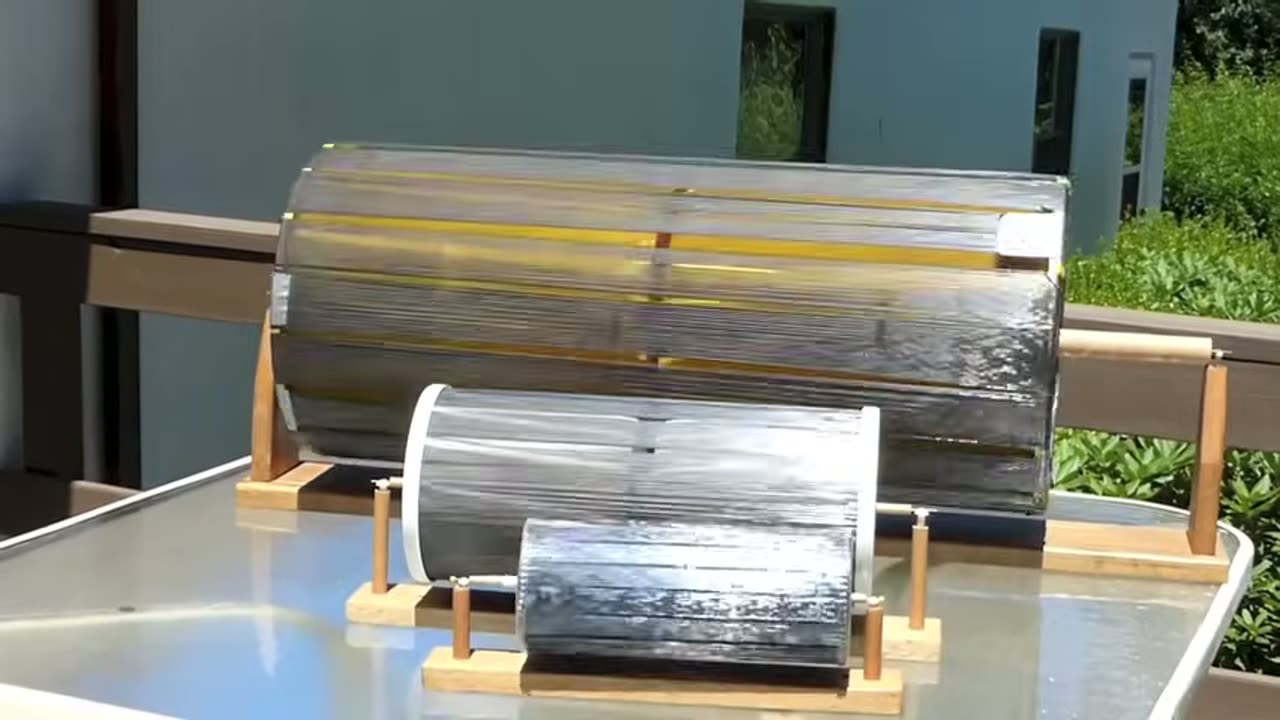
Students investigate a sun-powered motor made from cups and stretched trash-bag strips and figure out that it is not 'free energy' but a tiny heat engine. They test stretched polyethylene near a heat source, model the top-heavy imbalance with a paper clip, measure RPM under different conditions, and older students calculate the motor's power output.
A drum of plastic cups and trash-bag strips spins by itself in the sun with no batteries, wires or solar cells. Is it free energy, and where does the energy come from?
Learning objectives
- Students will be able to describe the energy chain in the motor: light to thermal energy to motion.
- Students will be able to explain, using center of gravity, why shrinking strips on the sunny side make the drum turn.
- Students will be able to measure the motor's speed in RPM and compare it under different light conditions in a fair test.
- Students will be able to evaluate the claim that the device is a 'free energy motor' using evidence.
Lesson flow (5E)
Day 1. Show the opening of Bruce's solar motor video (or a real motor in the sun) without explanation. Ask: is this a free energy machine? Students write a first idea about where the energy comes from.
Groups take turns at the motor: count turns in 15 seconds and find RPM, stop it and release it, cover the top with cardboard and time how long it takes to stop. At their tables, they stretch strips and, with the teacher holding the lamp, watch a warmed strip get shorter. Tape a paper clip to the top of a balanced drum to see what 'top heavy' does.
Day 2. Build the explanation together: polymer chains line up when stretched and pull shorter when warmed; the shrinking strips on top make the drum top heavy; gravity rolls the heavy side down and new strips move into the light. Introduce the term heat engine and the energy chain light -> thermal -> motion.
Groups design a fair test of one variable (mirrors, partial shading, black versus clear strips near the lamp). Older classes work the power problem: weight of lifted paper clips times height, divided by time, then compare with the roughly 1.5 millionths of a horsepower Bruce measured.
Students revisit their Day 1 answer and write a short claim-evidence-reasoning paragraph: is it a free energy motor? Collect the worksheets.
Discussion questions
- What did you see that tells you sunlight is needed for the motor to run?
- Most materials expand when heated. What did the stretched strip do, and why might that be?
- Why does a top-heavy drum turn? What force is doing the turning?
- Why are the strips black? Would clear plastic work as well?
- Why would the motor stop if every strip were warmed equally?
- If the motor makes so little power, why is it still a useful idea to study?
Common misconceptions
Assessment
- Exit ticket: draw the drum and label where the strips are warm, where it is top heavy, and which way it will turn.
- Use the 8-10 or 11-14 worksheet; check the energy chain and the explanation using center of gravity.
- Claim-evidence-reasoning paragraph answering 'Is it a free energy motor?'
- Older students: correct power calculation in joules and watts from their own or given data.
Differentiation
Support: Focus on observing and counting: stretch a strip, watch it shrink near the lamp, count turns, and use the 8-10 sheet with sentence starters such as 'The motor needs ___ because ___.'
Extend: Calculate power and horsepower from measured data, estimate efficiency by comparing with the sunlight falling on the drum (about 1000 watts per square meter at the ground), and research how real solar heat engines and radiometers work.