Experiments / Solar Motor
Solar Motor
Is this a free energy motor?
Set two plastic cups wrapped in black trash-bag strips in the sun and they start spinning on their own, with no batteries, wires or solar cells. Free energy? Not quite.
Based on Bruce's demonstration in the video below.
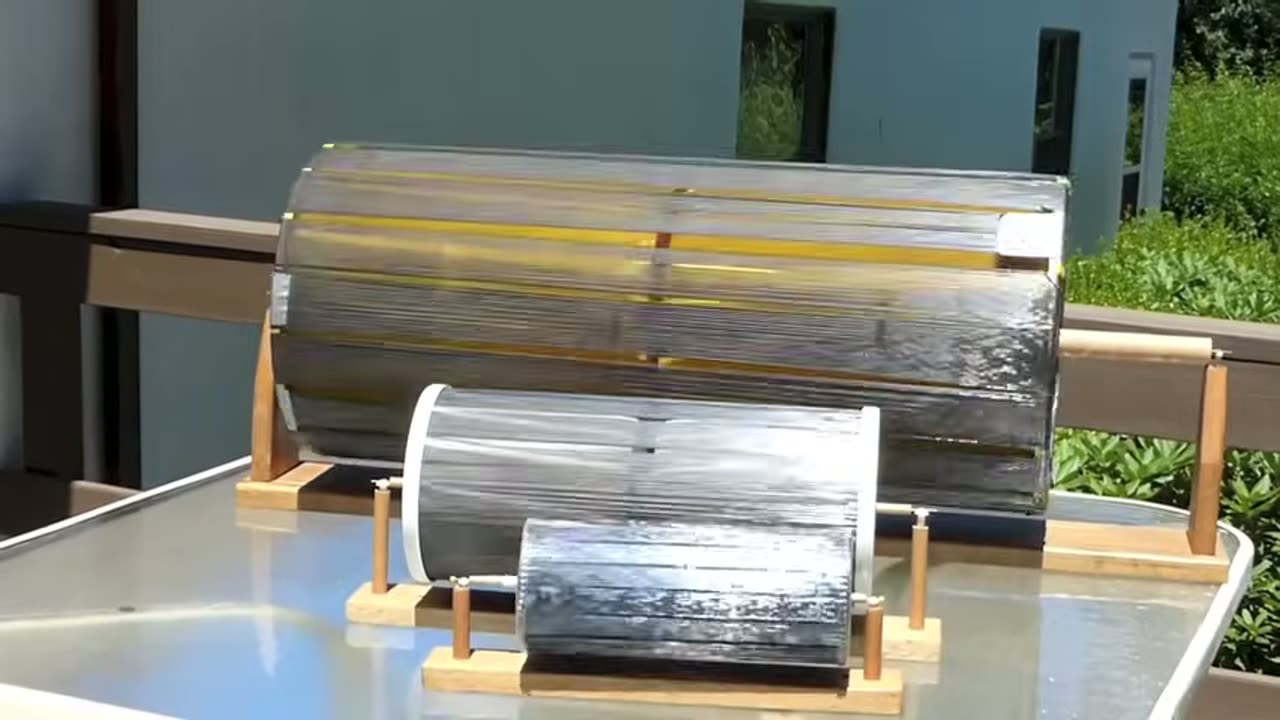
You'll build a drum from two plastic cups and sixteen strips of stretched black trash bag. Put it in bright sunshine and it turns by itself, about one turn every second. It looks like free energy, but it isn't: the sunlight warms the black strips, and that heat is what turns the drum. A detailed workshop plan for the same motor is also on the site.
“This particular one is about as close as we can get to a direct conversion of solar radiant energy into motion energy.”
Build it
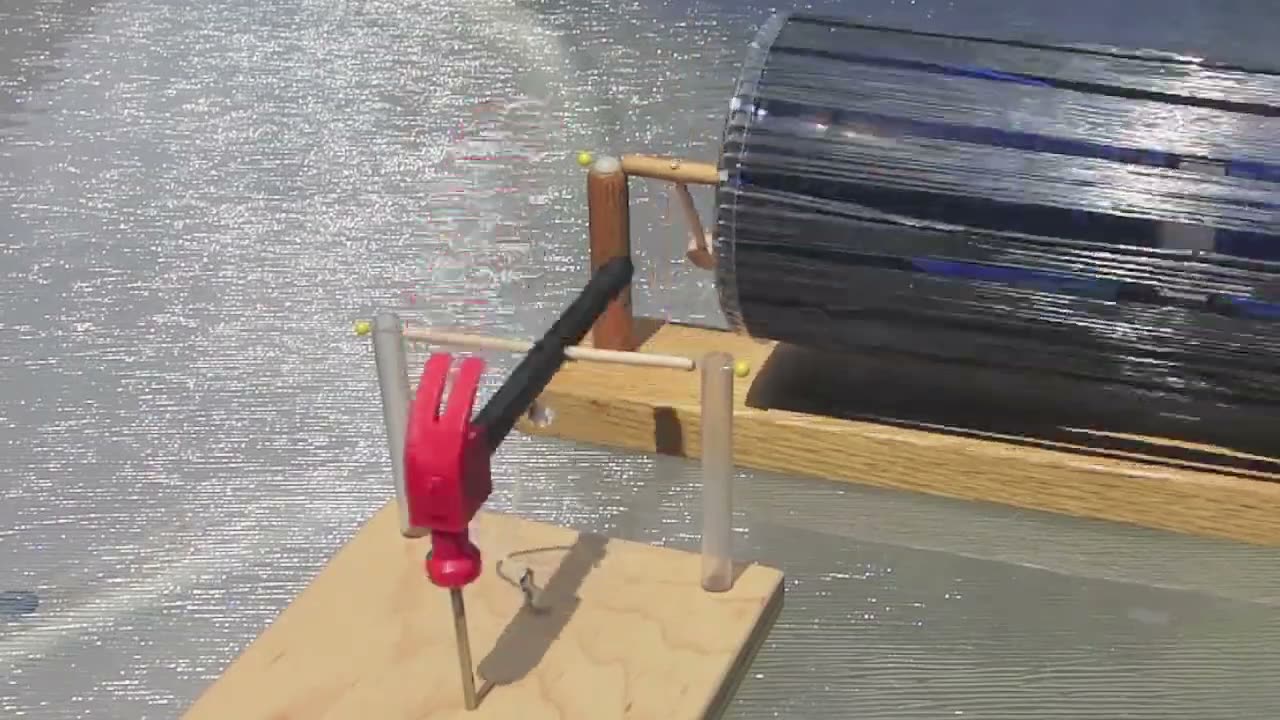
Grown-up: Make the stand. Drill two holes about 1/2 inch (1 cm) deep and 11 1/4 inches (29 cm) apart in the board, stand a straw in each hole, and file a small notch in the top of each straw.
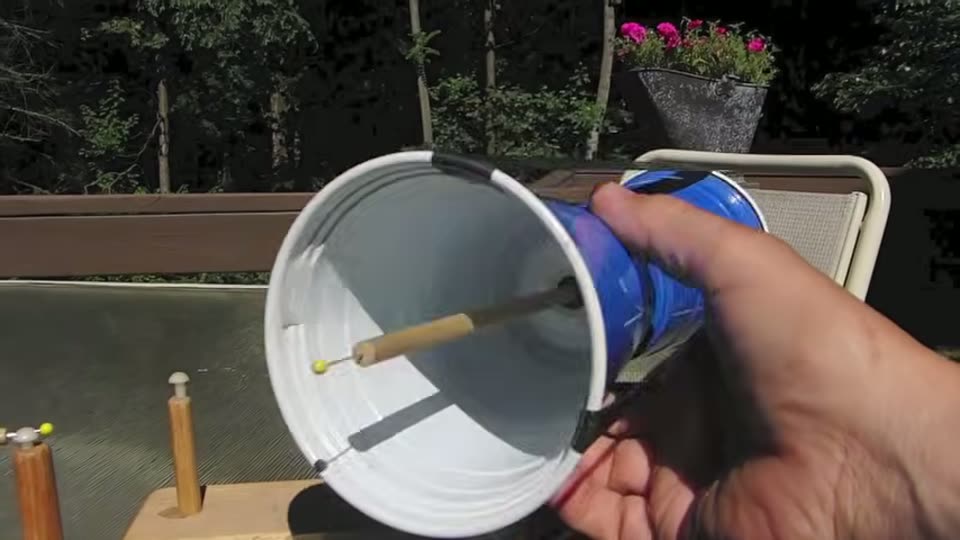
Grown-up: Melt a 1/4 inch (6 mm) hole in the center of each cup bottom with a hot nail held in pliers. Then cut a 1 inch (2.5 cm) circle of foam with a 1/4 inch hole in its middle. This is the spacer.
Slide a push nut and a washer onto the dowel, then the first cup, the foam spacer and the second cup, so the cups sit bottom to bottom. Move the cups until the dowel sticks out about 1/2 inch (1 cm) past each cup's mouth.
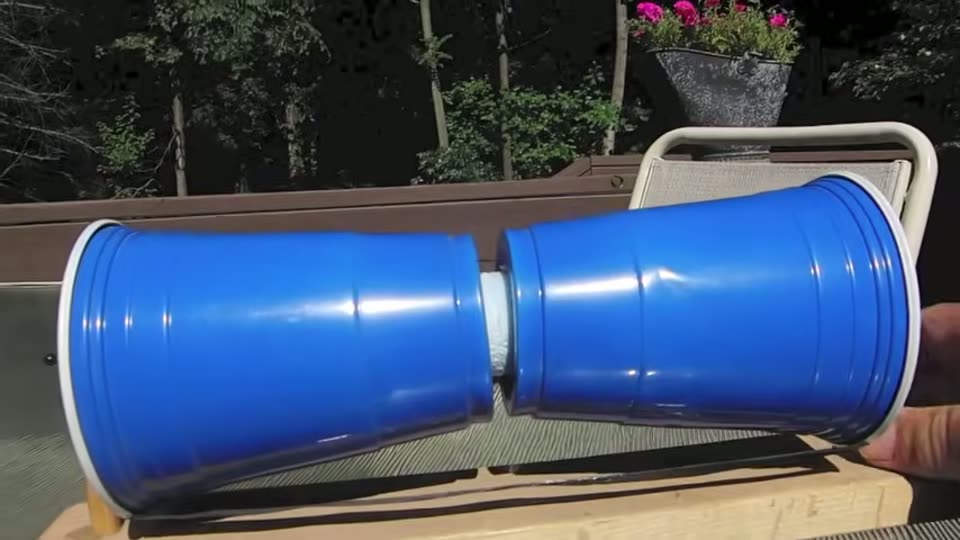
Lock the cups: slide on the second washer and push nut, then press the nut tight against the cup with 6 pencils held around the dowel by a rubber band. Push nuts only slide one way, so get the position right first.
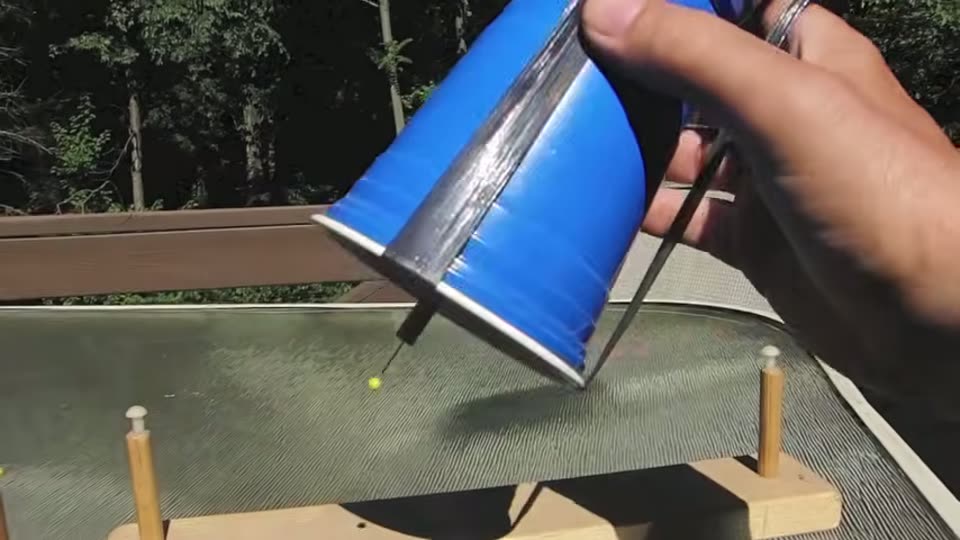
Grown-up: Drill a tiny hole in each end of the dowel, push in a straight pin, and clip off the extra. Rest the pins in the notches. The cups should spin freely without the dowel rubbing the straws.
Cut about 20 strips across the trash bag, 1 1/2 inches (4 cm) wide and about 4 inches (10 cm) long. Cut smooth edges: nicks make the strips tear. The extras are for practice.
Stretch each strip by pulling its ends slowly and firmly, like taffy, until it is 4 to 5 times longer and very thin. Stop before it breaks.
Tape one end of a strip about 1 inch (2.5 cm) inside the rim of one cup, run it across to the other cup, and tape it inside, snug but not tight. Put the next strip directly opposite, then keep filling the gaps in opposite pairs until there are 16.
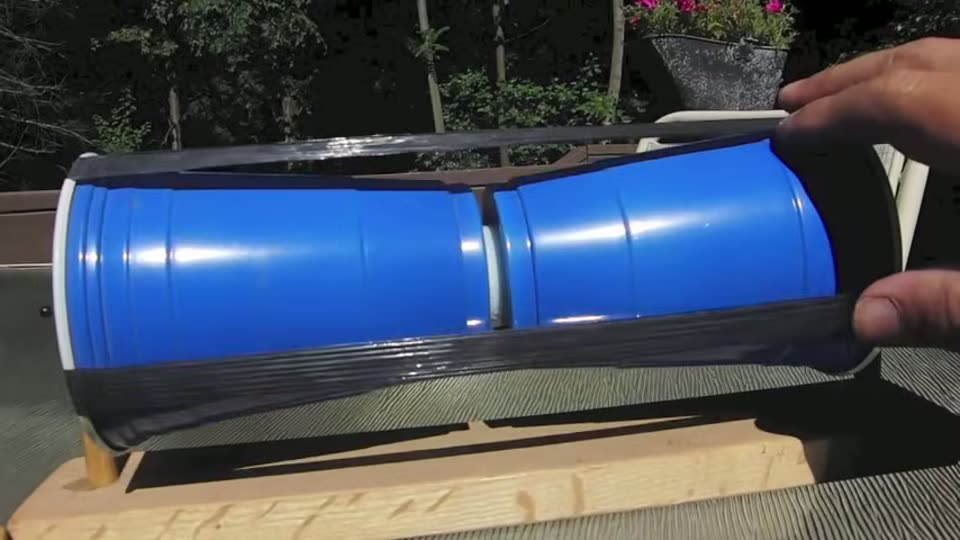
Cut the middle out of each lid, leaving a ring about 1 inch (2.5 cm) wide, and press the lids onto the cups over the taped ends.
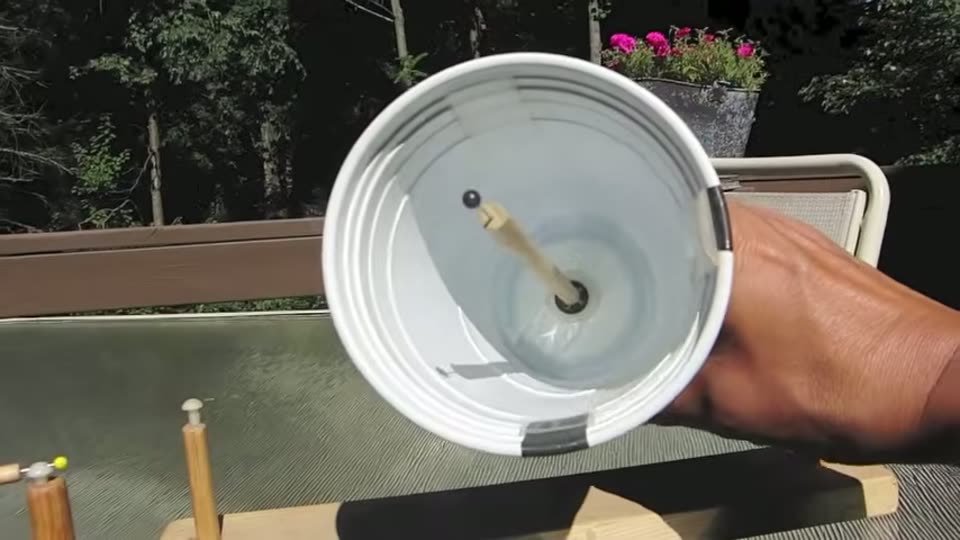
Balance the drum: set it on the stand, turn it, and let go. If the same side always ends up at the bottom, stick tiny bits of foil inside the cups on the side that ends up on top. Keep going until the drum stays wherever you leave it.
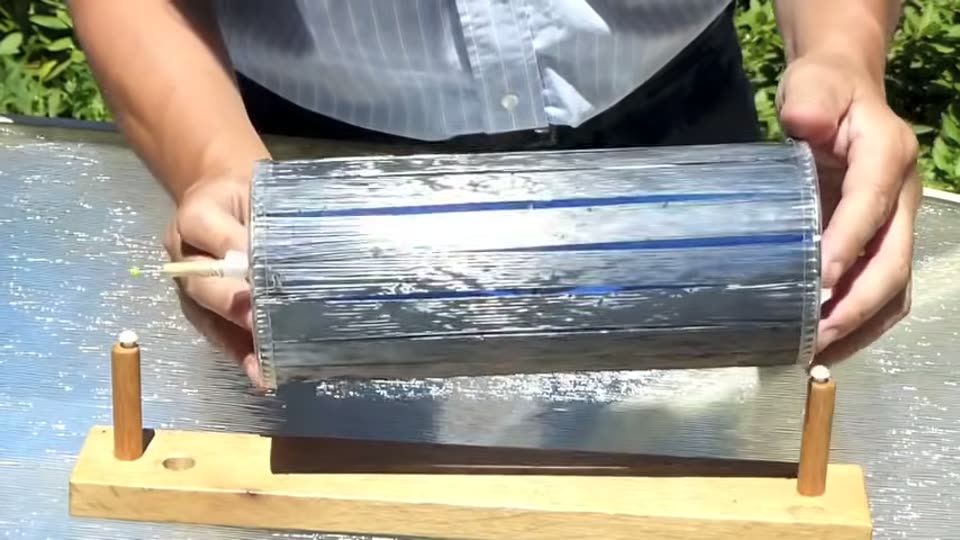
Try it & notice
What's going on?
For young scientists
Most things get a little bigger when they warm up. Your stretched trash-bag strips do the opposite: warm them and they pull shorter. Trash bags are made of a plastic called polyethylene, built from very long, chain-shaped molecules. Stretching lines the chains up, and warming makes them try to curl back up, so the strip shrinks.
The black strips on top of the drum soak up sunlight and get warm. As they shrink, they pull the cups very slightly out of shape on that side, so the drum gets a tiny bit top heavy. A top-heavy drum rolls until its heavy side is at the bottom. That brings new, cool strips up into the sun, they warm and shrink, and the drum keeps rolling.
So is it free energy? The sunshine is free, but the energy isn't coming from nowhere. Light is changed into heat in the black plastic, and some of that heat is changed into motion. Take the sunlight away and the motor slows and stops. Machines that turn heat into motion are called heat engines, and this is a very gentle one.
For grown-ups & teachers
The working material is drawn polyethylene. Stretching a strip to four or five times its length aligns its long polymer chains. Along the stretch direction, oriented polyethylene contracts when warmed rather than expanding, because the aligned chains tend to return to a more tangled, higher-entropy arrangement (a cousin of the way a stretched rubber band shortens when heated). In the motor the change is tiny and reverses as the strips cool on the shaded side; strong heating near a bulb makes a strip shrink permanently, which is why a stalled motor should never sit under a lamp.
The strips on the sunny top shorten and pull the rims of the two flexible cups toward each other on that side. The cups pivot slightly at their bottoms, which lifts the drum's center of mass a hair above the axle on the warm side. Gravity then produces a torque that rolls the heavy side down, bringing cool strips into the light. Once it is turning, the warmest strips are the ones just past the top, so the imbalance keeps pulling in the same direction; that is why the first start can need a push, why it can run either way, and why a well-balanced drum restarts itself after being stopped. Fine balance matters because the imbalance created by the strips is very small.
It is a true heat engine: it needs a hot side (strips in the light) and a cold side (strips in shade). Heat the whole drum evenly and nothing turns. That is the honest answer to 'free energy': the input is sunlight, which is free to use but not free of physics. Bruce's measurements put the output at about 1.5 millionths of a horsepower (roughly one thousandth of a watt), while the sunlight falling on the drum carries on the order of 20 watts, so the efficiency is well under one hundredth of one percent. Like a Crookes radiometer, it turns light into motion by way of temperature differences, not by light 'pushing' on it, and unlike a solar cell, no electricity is involved.
Extensions: test strip color (clear versus black), thickness, width and brand; use mirrors to add light to the top strips (Bruce reached about 86 RPM this way); compare sunlight with incandescent bulbs; or measure power by letting the motor wind up a string that lifts a few paper clips, then compute work divided by time. The detailed build plan covers the power setup, a flywheel, a sunshine bell alarm and larger bucket versions.
NGSS performance expectations
- 4-PS3-4 Apply scientific ideas to design, test, and refine a device that converts energy from one form to another.
- 3-PS2-1 Plan and conduct an investigation to provide evidence of the effects of balanced and unbalanced forces on the motion of an object.
- MS-PS3-5 Construct, use, and present arguments to support the claim that when the kinetic energy of an object changes, energy is transferred to or from the object.
Science words
Tips from 41 years of teaching it
Bruce used this motor for years in his physical science classes, from the energy unit to power problems. Here's what his own notes add.
- Before teaching the motor, Bruce shows the two ideas separately: he stretches a strip, passes samples around, and holds a long one near a 100-watt bulb so students see it contract; then he tapes a paper clip to the top of a balanced drum to show that the heavy side rolls to the bottom.
- Under an electric lamp, Bruce gives the drum a gentle push to start it. Getting it moving also keeps any one strip from overheating and melting.
- The motor works in summer or winter and runs for most of the day in direct sun, indoors through a window or outdoors on calm days.
- Adding a heavy ring to a lid as a flywheel does not make the motor spin faster, but it helps it do small jobs. The catch: it becomes fussier to balance.
- If students ask whether cooling would make the strips shrink, Bruce's answer is no: it's warming that makes stretched polyethylene pull tighter.
- Bruce's discussion questions include 'Why are the ribs black?' and 'Would this device work if clear plastic were used?', good prompts to ask before showing the answer.
In Bruce's 8th-grade power unit, the solar motor shared a worksheet with an electric drill, the school elevator and the class trebuchet. Students calculated its work, watts and horsepower, then answered one more question: 'What is supplying the energy?' One of his fact cards gives the sunlight figure: about 1366 watts for every square meter (that is the value above the atmosphere; roughly 1000 watts reaches the ground on a clear day).
More to try
- Design a new use for the shrinking plastic itself, beyond turning a drum.
- Bruce was building a giant motor from trash cans in the hope of turning a small DC motor as a generator. Could a motor like this ever make measurable electricity? Estimate it from the power you measure.
Make it a challenge
Go bigger
Bruce built rotors from two half-gallon food containers and from two 5-gallon buckets with 16 strips about 3 inches wide. Bigger ones work just as well, only a little slower. This is a grown-up build; see the build plan.
Bring it inside
Put your motor on a sunny windowsill. Does it run through the glass? On a cloudy day, a grown-up can set it under two incandescent bulbs, as Bruce does.
Give it more sun
Use small mirrors to bounce extra sunlight onto the top strips. Count the RPM before and after. Bruce's motors reached about 86 RPM this way.
Put it to work
In Bruce's second video, a little arm on the axle lifts a toy hammer and lets it drop with every turn. Can you design a small job for your motor, like tapping a bell or flicking a paper flag?
Color test
Make a few strips from a clear or white bag and hold them near a lamp next to a black strip (grown-up helps). Which shrinks first? What does that tell you about why the strips are black?