Teachers / Lesson plans / Echo Speed of Sound
Lesson plan · Grades 4-8How fast does sound travel?
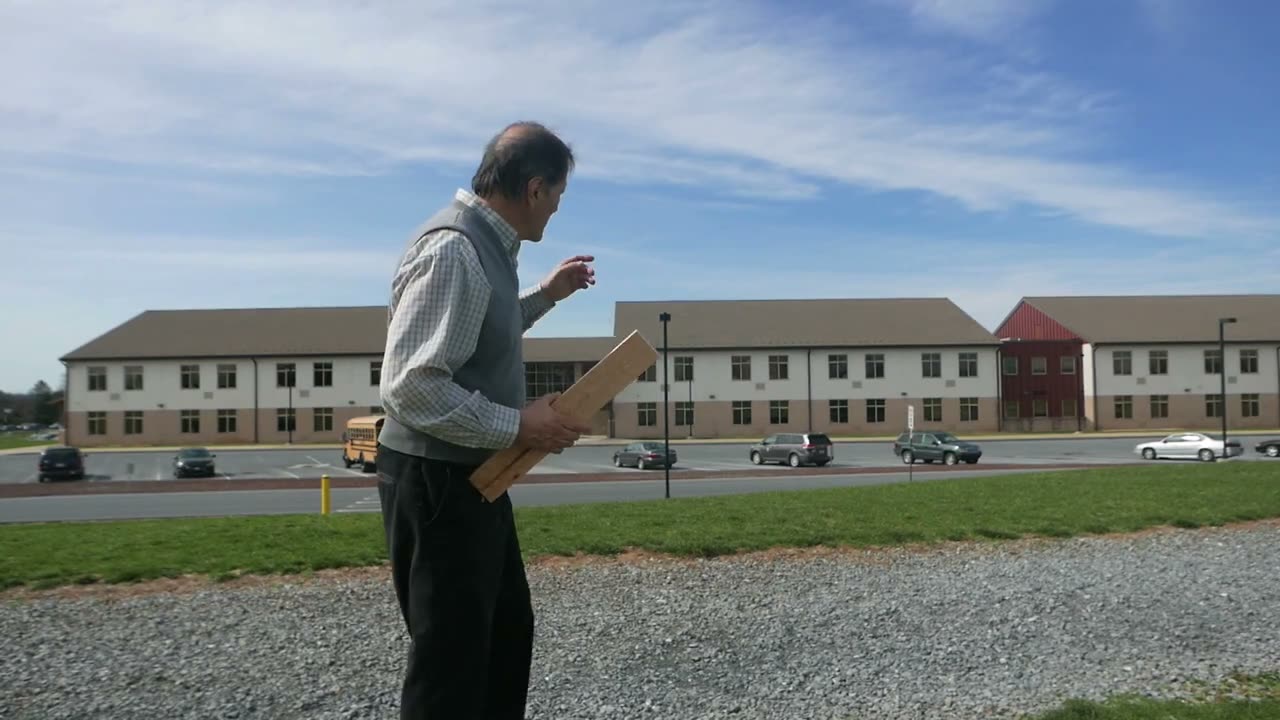
Students go outside in front of a large building, measure the distance to the wall, and time an echo made by slapping two wooden blocks. Because a single echo is too fast to time, they clap in rhythm with the echo and time ten claps, then calculate the speed of sound and compare it with the accepted value for the day's temperature.
When you slap two blocks of wood in front of a building, the echo comes back almost instantly. How could we ever time something that fast with a stopwatch, and what does it tell us about how fast sound travels?
Learning objectives
- Students will be able to measure a distance and a time and calculate speed using speed = distance / time.
- Students will be able to explain why the round-trip distance is used for an echo.
- Students will be able to explain how timing ten echoes and averaging many timers reduces error.
- Students will be able to compare their result with the accepted value, calculate percent error, and identify sources of error.
Lesson flow (5E)
Indoors, ask: how fast is sound? Students write a guess. Write speed = distance / time on the board and ask how we could measure the speed of sound with what's in the room.
Outside, students measure the distance to the wall. The teacher slaps the blocks once; students try to time a single echo and see how scattered their times are. The teacher then builds a rhythm of clapping on the echo, and every student times ten claps. Record all times and the temperature; repeat for two or three trials.
Back inside, list all the times and find the average. Discuss why the distance is doubled and why ten claps beat one. Each student calculates the speed in feet per second and converts to mph (divide by about 1.47).
Compare with the accepted speed for the measured temperature and calculate percent error. Show Bruce's results (within 2-4%) and his slow-motion video method.
Exit ticket: list two sources of error and explain one way to make the measurement more accurate.
Discussion questions
- Why was it so hard to time one echo?
- Why do we double the distance to the wall?
- Everyone timed the same claps. Why are the times different, and what should we do with them?
- Did a louder clap come back faster? What does that tell us about sound?
- Why did we measure the air temperature?
- How could we make this measurement even better?
Common misconceptions
Assessment
- Exit ticket: two sources of error and one improvement.
- Check the worksheet calculations: round-trip distance, time per echo, speed in ft/s and mph.
- Older students: correct percent error compared with the temperature-adjusted accepted value.
- Quick oral check: explain in one sentence why the clapping rhythm makes timing easier.
Differentiation
Support: Give students the distance and do the averaging as a class on the board. Provide a fill-in calculation frame: distance x 2 = ___; time for 10 / 10 = ___; speed = ___ / ___.
Extend: Have students record the clapping and time it in slow motion, compare the two methods, convert their results to meters per second, and estimate how much a 10-degree temperature change should change the speed.