Teachers / Lesson plans / String Shooter
Lesson plan · Grades 3-8How can you make a loop of string fly?
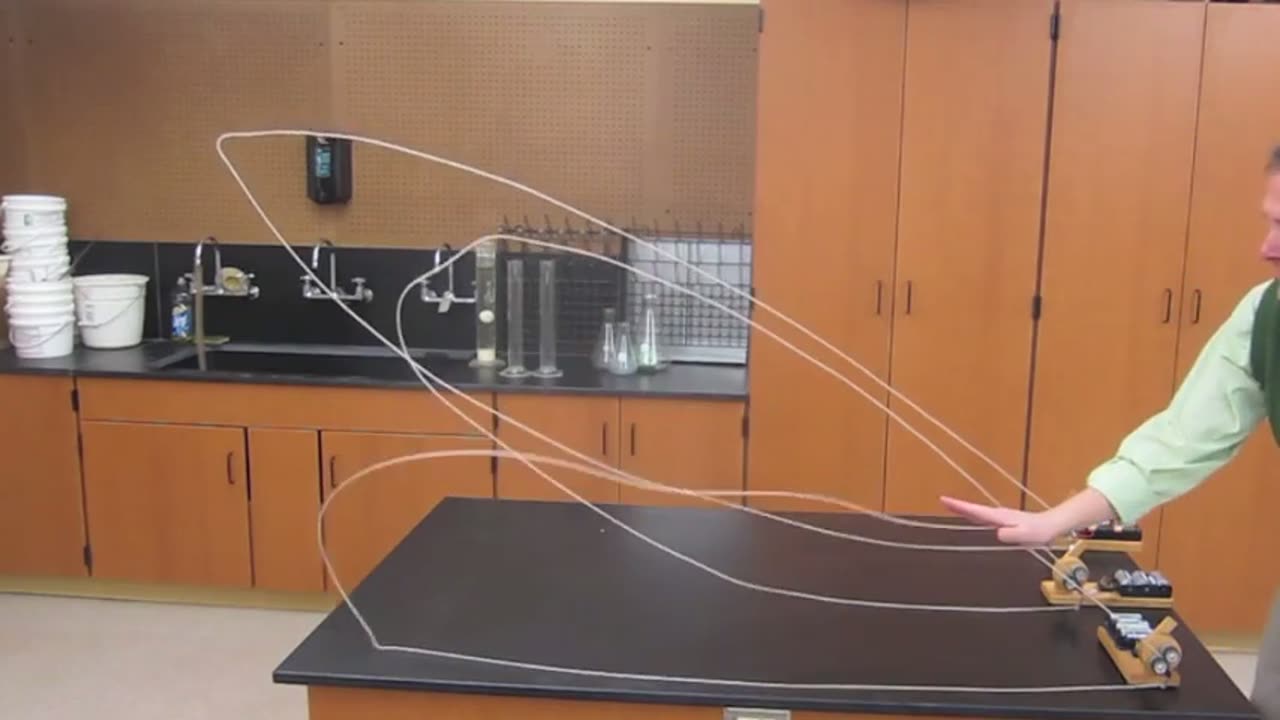
Students build a breath-powered straw string shooter and discover that a small dent at the back edge of a side hole decides whether air leaks out or yarn gets drawn in. They use drag, inertia and Bernoulli's principle to explain why a limp loop of yarn flies through the air and holds its shape while moving.
How can a floppy loop of yarn stand up in the air like a stiff wire, and why does air go into a hole in the side of a straw instead of blowing out?
Learning objectives
- Students will be able to build a working straw string shooter and identify the constriction as the key feature.
- Students will be able to explain, using air pressure and Bernoulli's principle, why air enters the side hole instead of escaping.
- Students will be able to describe how drag and inertia keep the loop moving and in the air.
- Students will be able to compare string types in a fair test and explain the results in terms of drag and weight.
Lesson flow (5E)
Shoot the demo loop without explaining it, pointing it up, sideways and down. Ask students how string, which is usually limp, can hold a shape in the air, and have them predict whether air will go in or out of the side hole.
Students poke and dent the hole, thread their yarn and bring it to the adult glue station to be joined. They test their shooters, first with the dent and then (on a second hole or by pressing the dent back out) without it, and record what happens.
Sketch the straw on the board: uniform airflow, air leaking from a plain hole, then the constriction speeding the air and lowering pressure at the hole. Introduce drag (air pushing the yarn along), inertia (the yarn keeps moving outside) and lift on the moving loop.
Groups compare a smooth string, a sandpaper-roughed string and a fuzzy yarn, keeping loop length and blowing the same. Show a clip of Bruce's shop-vac loops or wheel launcher for scale.
Exit ticket: draw the straw with arrows showing airflow and the yarn path, and explain in one sentence why the dent matters.
Discussion questions
- What did the loop do when you blew harder or softer?
- What changed when the dent behind the hole was removed?
- Why would fast-moving air near the hole let outside air push in?
- Once the yarn leaves the straw, what keeps it going, and what pulls it back?
- Why does fuzzy yarn fly better than rope or smooth string?
- There's an old saying that you can't push string. Is that true here?
Common misconceptions
Assessment
- Exit ticket diagram with labeled airflow, constriction and yarn path.
- The age-appropriate worksheet, especially the prediction and fair-test items.
- Performance task: each student's shooter keeps a loop flying for at least a few seconds.
- Short written explanation using the words pressure, drag and inertia.
Differentiation
Support: Pre-poke and dent the holes, pre-thread the yarn, and focus younger students on drawing the loop and the direction of motion.
Extend: Older students compare loop lengths or string types quantitatively, research venturi devices, or analyze Bruce's lift-and-drag diagrams for the moving loop.