Teachers / Lesson plans / Toy Motor Speaker
Lesson plan · Grades 3-8Can a toy motor play music?
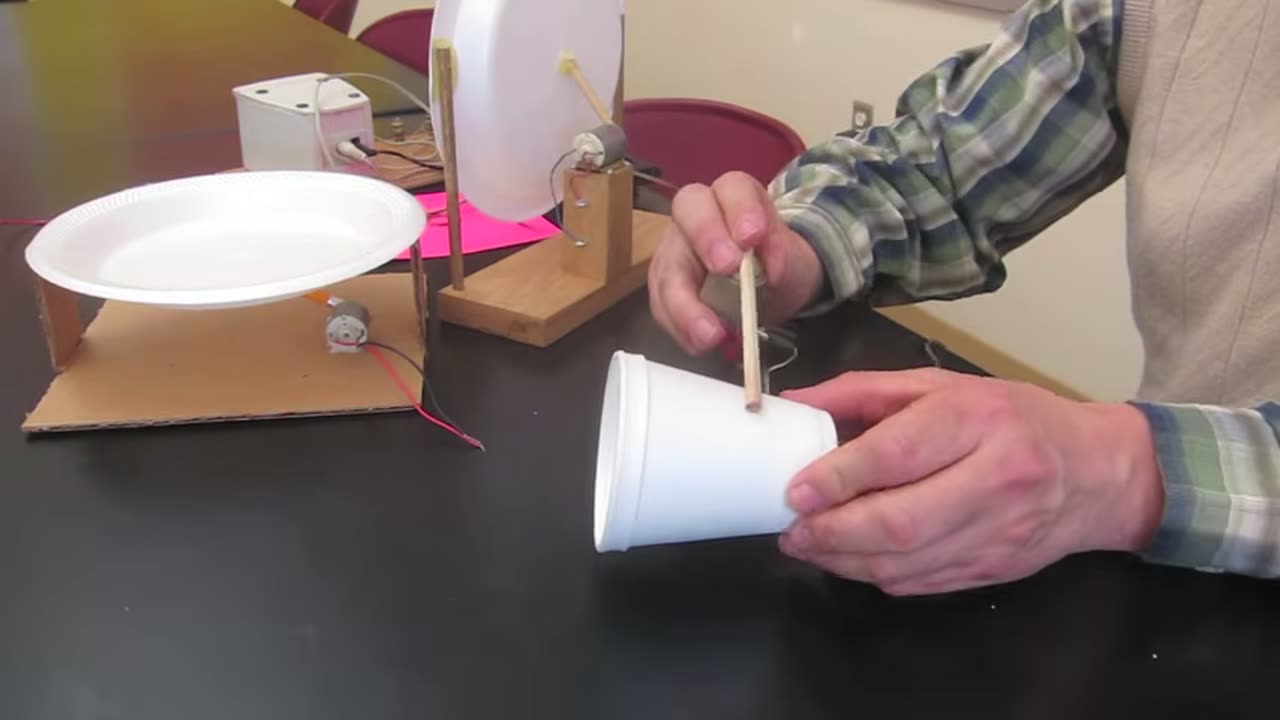
Students connect a toy DC motor to a music source and discover that, instead of spinning, the motor vibrates in time with the music. By pressing a pencil on the motor shaft against cups, boxes and foam plates, they find that a large, light surface turns those small vibrations into loud sound, which is how every loudspeaker works.
A toy motor that spins on a battery doesn't spin at all when it is connected to music, yet a cup touching it starts to play the song. What is the motor doing, and why does the cup make it louder?
Learning objectives
- Students will be able to explain that sound is produced by vibrating objects.
- Students will be able to compare how a motor behaves with a steady current (battery) and with an alternating current (music signal).
- Students will be able to measure and compare the loudness produced by different surfaces in a fair test.
- Students will be able to describe the energy changes in a speaker: electrical to motion to sound.
Lesson flow (5E)
Show a toy motor spinning on a AA battery, then reverse the battery. Ask students to predict what the motor will do when it is connected to music. Connect it to the amplifier: the shaft does not spin, and a faint buzz of music comes from the motor. Then touch the pencil to a cup.
Groups connect their own motors, keep the volume fixed, and test each surface, rating loudness from 1 to 5 on the worksheet. They feel the cup vibrate with a fingertip and try squeezing it.
Groups share their rankings. Guide them to the idea that the coil inside the motor becomes an electromagnet; a steady current pushes it one way so it spins, while the music signal keeps reversing so it only vibrates. Large, light surfaces move more air, making stronger sound waves. Introduce vibrate, coil, amplify and sound wave.
Groups design one fair test of their own, such as cup size, cup material or pressing angle. Volunteers can try the bone-conduction bite test with a fresh straw over a dowel at low volume. Show the foam plate speaker as the permanent version.
Students answer an exit ticket: describe the energy changes in the motor speaker and explain why the cup makes it louder.
Discussion questions
- What did the motor do on a battery? What did it do on music?
- Which surface was loudest? What do the loud surfaces have in common?
- Why did squeezing the cup make the sound quieter?
- How is the music signal different from a battery's current?
- Where does the energy for the sound come from? Does the cup add energy?
- Bruce hears the music through his jaw when he bites the stick. How can sound reach your ear without going through the air?
Common misconceptions
Assessment
- Exit ticket: "List the energy changes in the motor speaker and explain in one sentence why the cup makes it louder."
- Check the 8-10 worksheet table for one variable changed and volume kept the same, or the 11-14 fair-test design.
- Performance task: give a group a new object (paper plate, plastic bowl) and ask them to predict and then test whether it will be louder than the cup, explaining their reasoning.
Differentiation
Support: Pre-connect the motors and cables, use the 5-7 worksheet, and limit testing to the bare motor versus one cup. Focus on 'it shakes, it doesn't spin' and 'touching the cup makes it louder.'
Extend: Compare the toy-motor speaker with Bruce's coil-and-magnet foam plate speaker, investigate why the motor speaker sounds buzzy at high volume, and research how bone-conduction headphones and hearing aids work.