Experiments / Toy Motor Speaker
Toy Motor Speaker
Can a toy motor play music?
Clip a tiny toy motor to a phone and it won't spin at all; it hums your song, and a paper cup makes it loud.
New home version. Bruce's original demonstration is in the video; these home instructions were adapted for this site and are still being test-built.
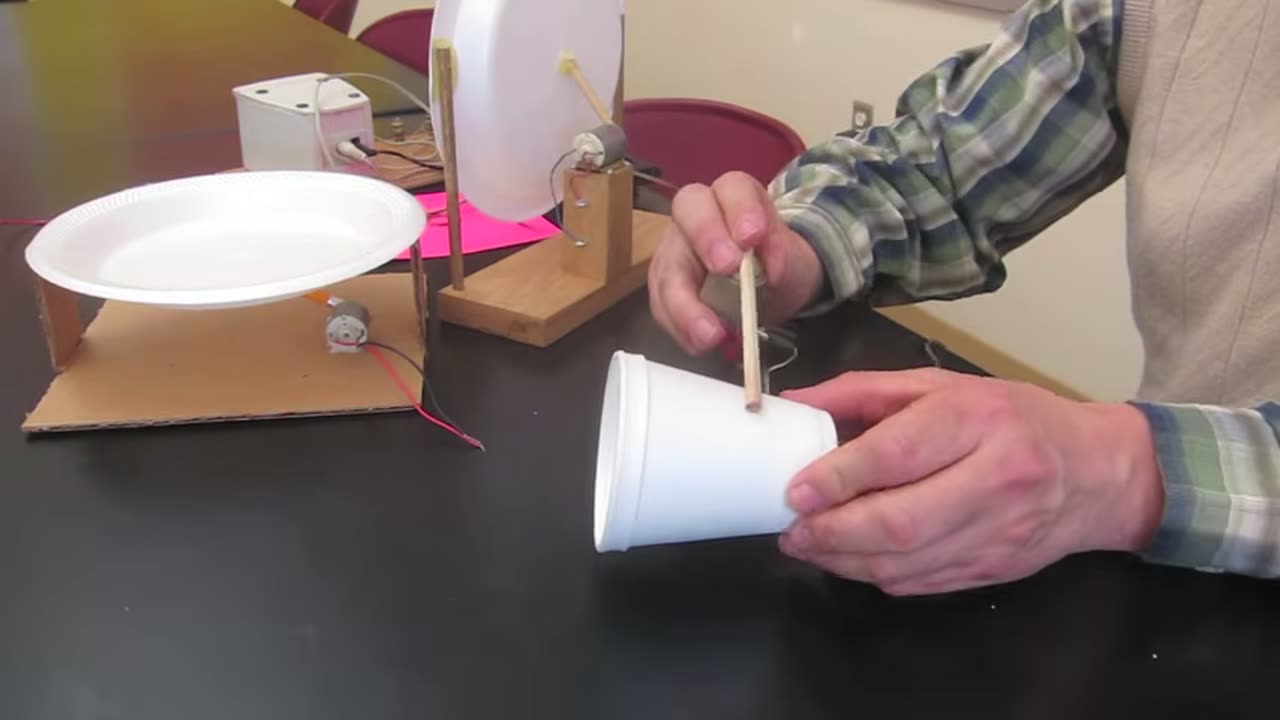
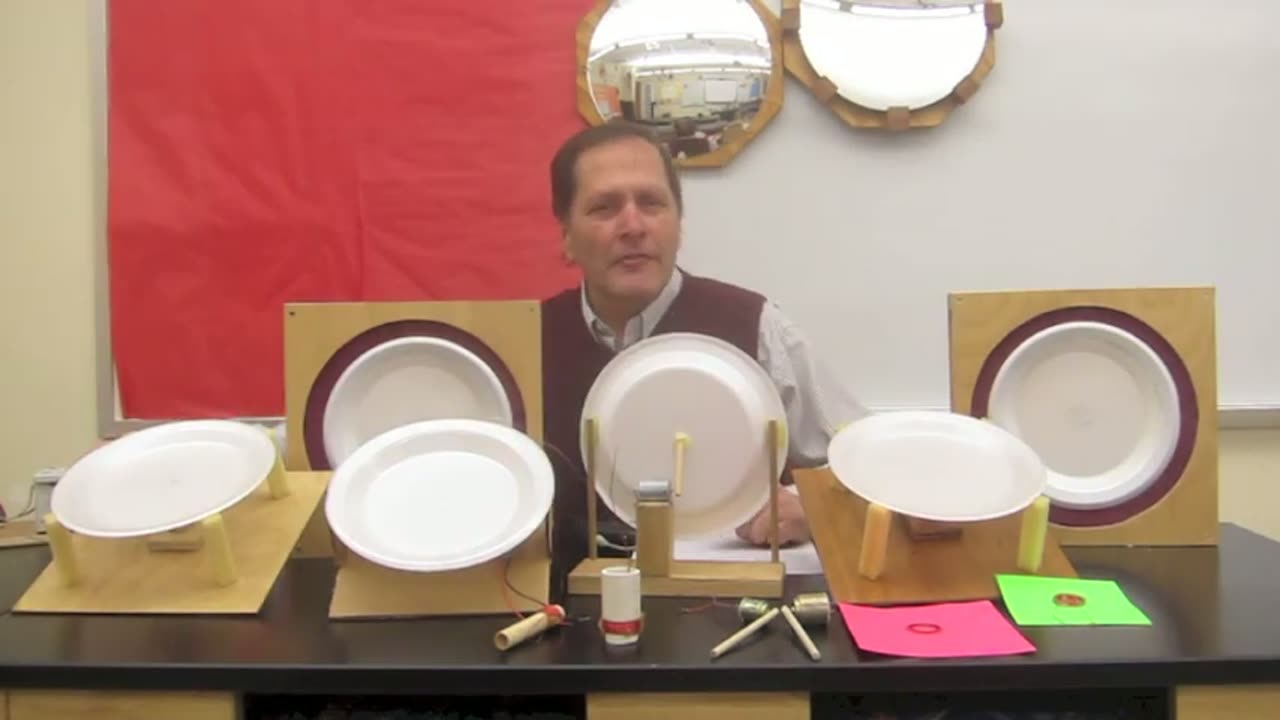
You'll turn a small toy motor into a speaker. Hook it to a phone's headphone output and the motor doesn't spin; its shaft shivers in time with the music. On its own you can barely hear it, but press a pencil on the shaft against a cup or a box and the music suddenly fills the room. If you want a speaker that stays put, there are detailed workshop plans (a cardboard or wooden stand with a foam plate) linked below.
“If I were to take the wire from my amplifier and plug it onto this little motor, it's not going to make it spin around. It's going to make the shaft vibrate.”
Build it
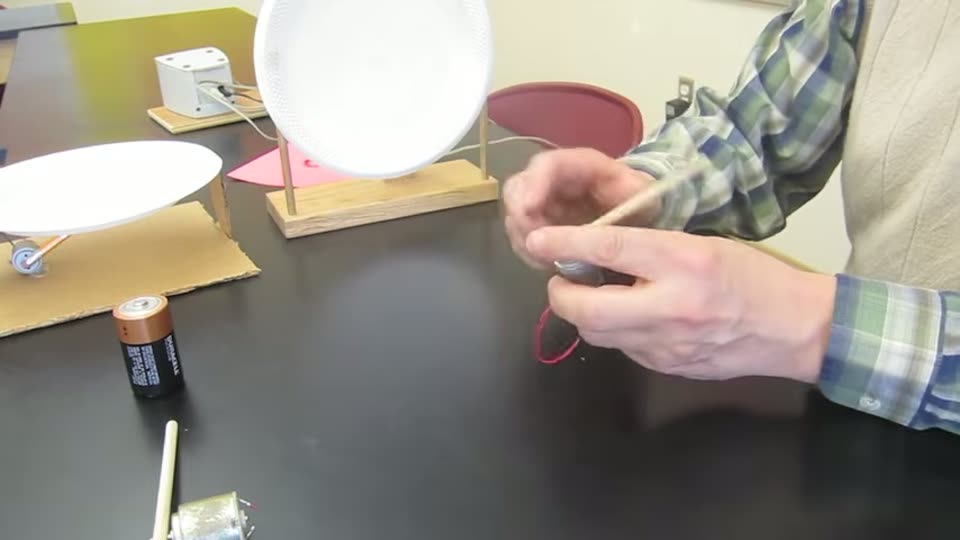
Grown-up: Twist a small nail into the middle of the pencil's eraser to make a starter hole, so the eraser won't split.
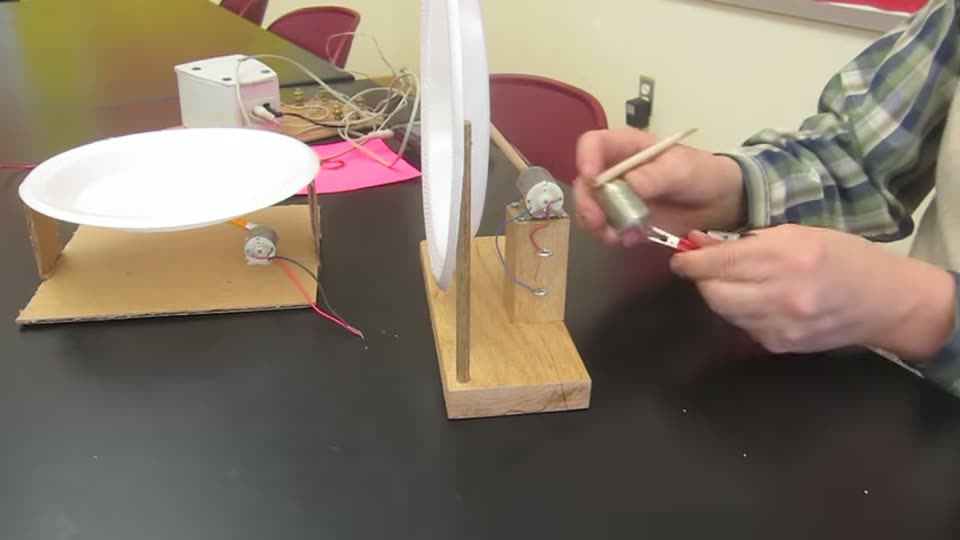
Push the motor's shaft firmly into the hole in the eraser. The pencil should stick straight out and not wobble.
Grown-up: Clip one wire of the headphone cable to each metal tab on the motor. (If you cut an old cable, use the tip wire and the ground wire.)
Turn the phone's volume all the way down, plug in the cable, and start a song.
Hold the motor near your ear and turn the volume up slowly until you hear a tiny, buzzy version of the music. Touch the pencil to feel it shiver.
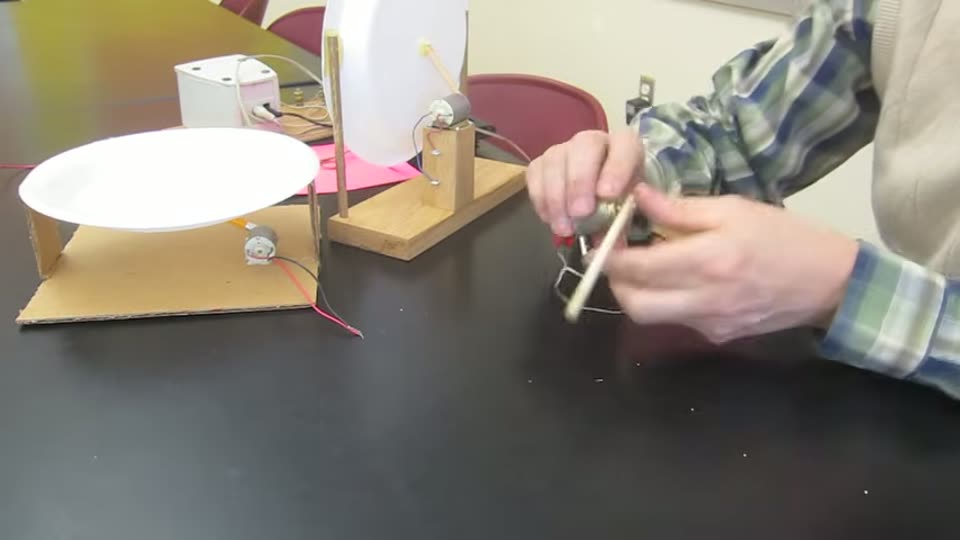
Press the end of the pencil against the bottom of a foam or plastic cup and listen.
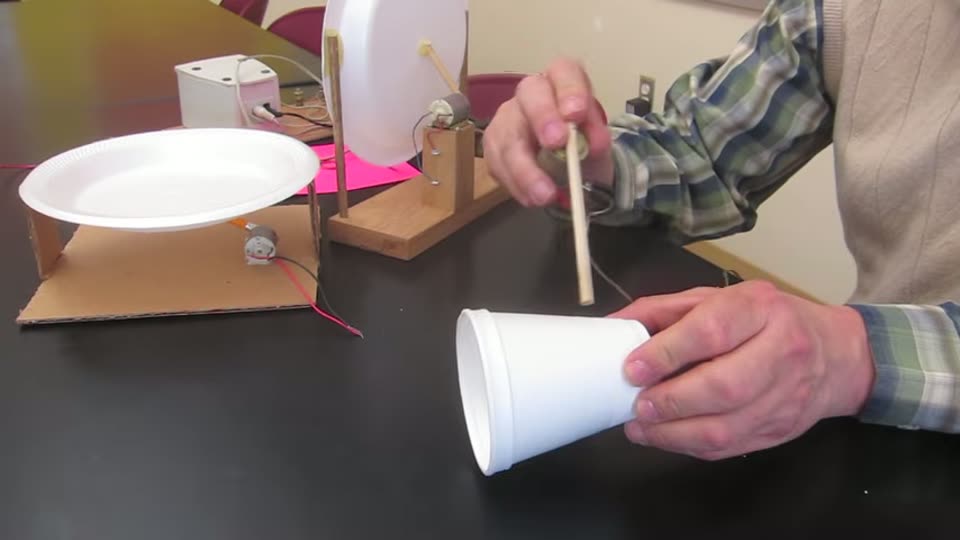
Press the pencil against a cardboard box, a foam plate and a tabletop, one at a time. Listen for which one is loudest.
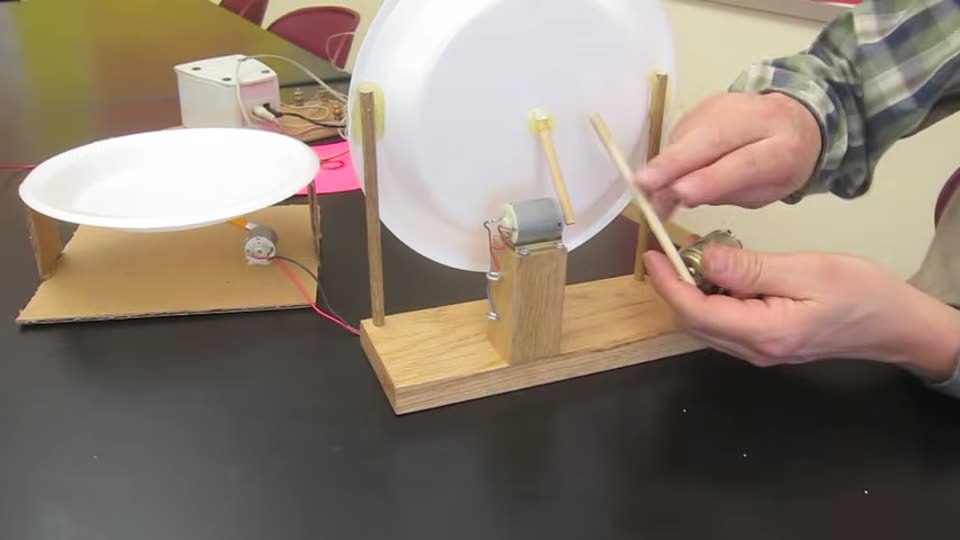
If the music is still too quiet, a grown-up can plug the phone into a small ready-made amplifier and clip the motor to its speaker output instead.
Try it & notice
What's going on?
For young scientists
A toy motor has a coil of wire and magnets inside. When a battery pushes electricity one way through the coil, it turns into a magnet that pushes and pulls on the other magnets, and the shaft spins round and round.
Music from a phone is different. It is electricity that flips back and forth hundreds of times every second, in the pattern of the song. The coil gets pushed one way, then pulled the other way, so fast that the shaft never gets to spin. It just shivers, or vibrates, in time with the music.
The tiny motor can only shake a tiny bit of air, so it sounds quiet. When the pencil touches a cup, the whole cup shakes too. A big, light surface pushes on lots of air at once, and those pushes travel to your ears as sound. That's exactly what the cone in a real speaker does.
For grown-ups & teachers
A toy DC motor contains a wound armature (the coil) between permanent magnets. A steady current produces a steady torque, so the rotor spins. An audio signal is an alternating current whose direction and size change thousands of times per second, so the torque on the armature keeps reversing. The rotor can only twitch a tiny angle back and forth, and those twists are transmitted by the pencil or dowel as vibration. This is the same electromagnetic push-pull that drives a normal moving-coil loudspeaker, just in a rotary form.
The motor alone is a poor sound source because its small surfaces move very little air. Pressing the stick on a cup, box or foam plate couples the vibration into a large, light surface (a soundboard) that moves more air and radiates far more sound energy. Stiff, light, thin materials such as foam and thin cardboard usually work best; heavy or soft objects soak the energy up. Squeezing the cup damps it and the sound drops. The sound is rough and buzzy rather than high-fidelity, because the motor is built to spin, not to vibrate evenly at all frequencies.
A common misconception is that the phone or the motor 'makes' the louder sound. The input energy is the same; the cup just converts more of it into sound waves in the air. Phone headphone outputs supply only a few thousandths of a watt, so the cup speaker is quiet-room loud at best. That's why Bruce, and the build plans, use an amplifier for a speaker the whole room can hear.
Extend it with energy-conversion ideas: the motor turns electrical energy into motion and then sound, and a speaker run backwards is a microphone. Compare with the coil-and-magnet foam plate speaker in Bruce's second video, or with bone conduction: Bruce bites a straw-covered stick on the motor and hears the music through his jaw and skull while nobody near him can hear it.
NGSS performance expectations
- 1-PS4-1 Plan and conduct investigations to provide evidence that vibrating materials can make sound and that sound can make materials vibrate.
- 4-PS3-4 Apply scientific ideas to design, test, and refine a device that converts energy from one form to another.
- 4-PS4-1 Develop a model of waves to describe patterns in terms of amplitude and wavelength and that waves can cause objects to move.
Science words
Tips from 41 years of teaching it
Bruce built motor speakers for years for classes and teacher workshops. Here's what he learned.
- Bruce compares the motor speaker's sound to an old tube radio with a little static. It sounds best when it isn't pushed too loud.
- For a foam-plate version, Bruce found the stick works best when it meets the middle of the back of the plate at a slant of roughly 20 to 30 degrees, though it's worth experimenting.
- Bruce's handouts warn that iPods and radios with headphone jacks can barely drive a speaker. For a speaker the whole room can hear, he connects to the speaker outputs of a stereo or a small amplifier.
- For hookup, Bruce cut an old cord that had the right plug for his stereo and put alligator clips on the cut ends.
- When students try the bite stick, Bruce slips a plastic straw over the dowel and each student throws theirs away afterward. It's cleaner than washing the stick between turns.
- Bruce points out that some hearing aids use this same bone conduction to help people whose eardrums don't work well.
When Bruce was growing up, he and his friends made 'church speakers': a stick wired to a transistor radio that you bit down on, so only you could hear the music, even sitting in church. As Bruce notes, there was nothing subtle about having a dowel sticking out of your mouth with a wire attached.
More to try
- Wind a coil of wire and hold a strong magnet on a whiteboard or a steel door: Bruce's surface speaker turns the whole surface into the speaker (see the foam plate speaker build plan for the coil, and handle strong magnets with a grown-up).
Make it a challenge
Make it stay
With a grown-up and a hot glue gun, glue the motor to a piece of cardboard and glue the end of the pencil to the middle of the back of a foam dinner plate. Bruce's cardboard and wooden versions are in the build plans linked below.
Hear it through your bones
Use a 3 inch dowel or an unsharpened pencil and slide a fresh drinking straw over it. With the volume low, gently bite the straw and put your fingers in your ears. Bruce hears the music clearly through his jaw while people next to him hear almost nothing.
Spin or shiver
Unclip the phone and touch the motor's tabs to a single AA battery: it spins. Flip the battery and it spins the other way. Music flips that push back and forth so fast that the shaft can only shiver.