Build plans / Falling Weight and Wrap-Around Stopper
Falling Weight and Wrap-Around Stopper
A heavy weight and a light weight hang on one string looped over a bar. When the light one is released, the heavy one falls, the light one spirals around the bar faster and faster, and the wraps of string grip the bar and stop the fall. It packs energy, circular motion and friction into a cheap, surprising demo that also makes a strong student inquiry.
Written from Bruce's original workshop handout. Bruce's final review of this plan is in progress.
What it shows
Let go of a tiny weight and it whips around a bar so fast it catches a weight fourteen times heavier before it hits the table.
Key ideas: centripetal force, friction, potential and kinetic energy, circular motion, spirals
Build it
Tie on the weights
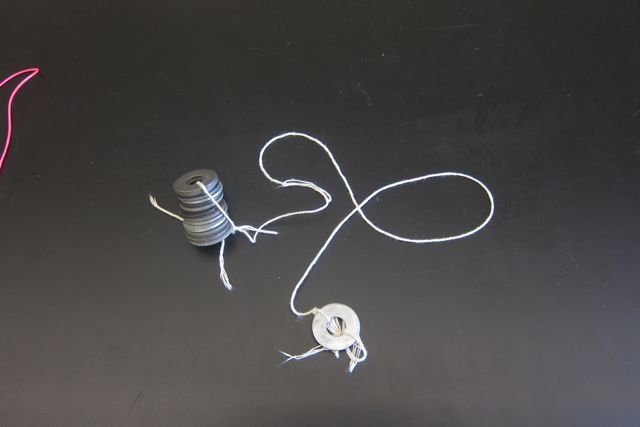
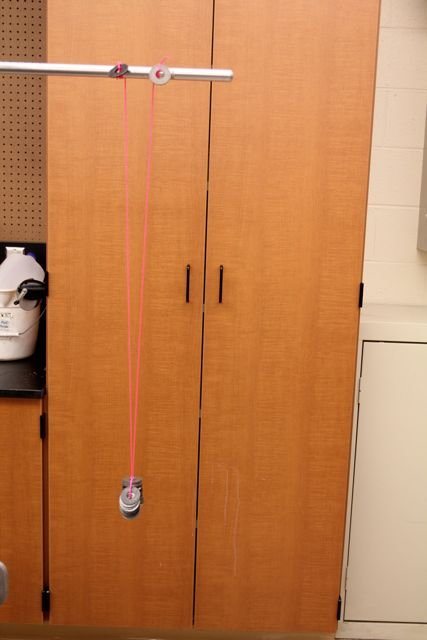
Tie 14 washers together on one end of a 1 m string and a single washer on the other end. Bruce finds the heavy weight works best at about 14 times the light one.
Set up the support
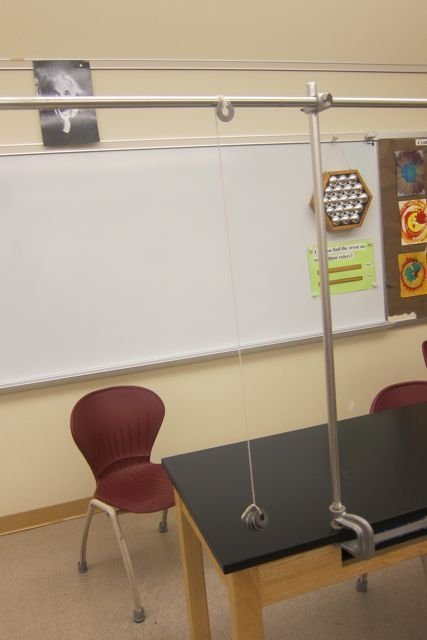
Clamp a smooth bar level, with enough clear space below it for the heavy weight to fall freely.
Hang it over the bar
Loop the string over the bar. Hold the single washer so the heavy stack hangs just below the bar.
Pull back and release
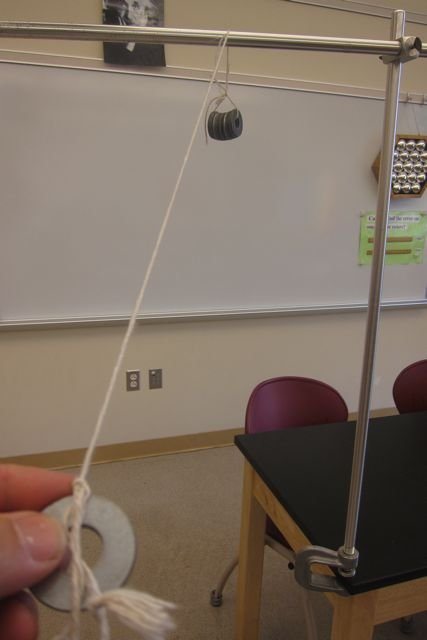
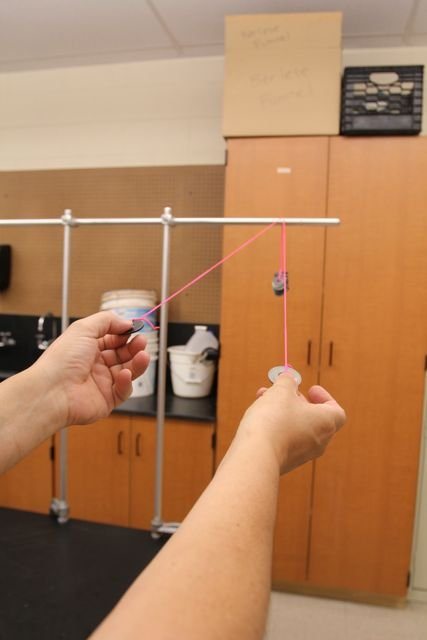
Pull the light washer out to the side, about 60 degrees from vertical, with the string straight. Let go, like releasing a pendulum.
Watch the wrap
The heavy stack drops while the light washer swings up and around the bar, wrapping the string tighter and tighter. The wraps grab the bar and stop the heavy stack, often 3-5 turns, and usually well before it reaches the table.
Adjust
If the heavy weight hits the table, add a little weight to the light end or release from a different angle or height; if the light weight cannot wrap all the way around, make it lighter. Record what works.
Try two light weights
Tie 28 washers on one string and a single washer on each of two separate strings, and loop them all over the bar. Released together they act much like one light weight; released from opposite sides, they can wrap in opposite directions (keep them small so they do not collide).
Photograph the path (optional)
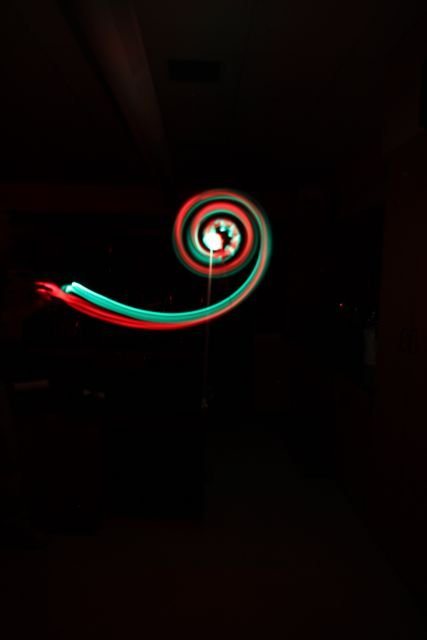
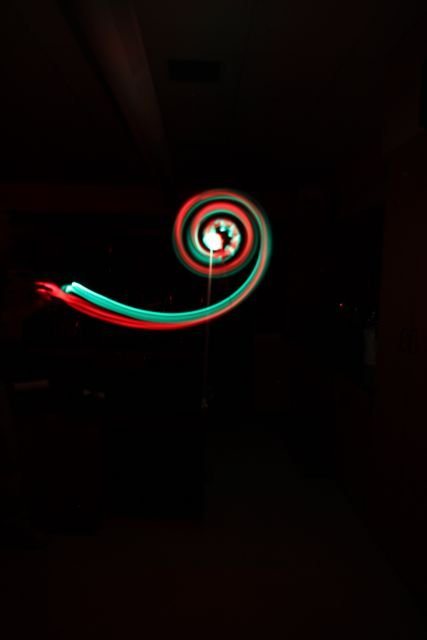
Tape a small LED to each weight, darken the room, set a camera to a 3-5 second exposure, and release. The light weight draws a spiral closing in on the bar.
How it works
As the heavy weight falls, it pulls string over the bar and drags the light weight toward the bar. The string's pull, plus the bar it presses against, keeps bending the light weight's path into a curve: that pull toward the center is a centripetal force.
The light weight's swing gets shorter as string wraps onto the bar, so its path is a spiral closing in on the support. Its speed stays roughly the same while the radius shrinks, so it goes around faster and faster, which looks a lot like a spinning skater pulling in their arms.
Each wrap rubs against the bar and against the string already there. Friction from a rope wrapped around a post grows very quickly with each extra turn (sailors use this to hold big loads with a few wraps around a post), so after a few turns the grip is enough to stop the heavy weight.
The ratio matters. If the light weight is too light, it cannot make enough wraps to stop the fall. If it is too heavy, it swings too slowly to get all the way around the bar.
Using it
- Inquiry: What weight ratio works best? What is the smallest and largest release angle that still works?
- Does string length matter? Try a very short string and a very long one.
- Challenge: adjust the variables to stop the heavy weight as close to the table as possible without touching.
- Trace the energy: potential energy of the raised weight becomes motion, and friction at the bar finally turns it into heat.
- Try other objects with a big-small pair, such as an apple tied by its stem against a single grape.
Variations
- Make a pair of flat wooden figures as a 'story' version: a large character that falls and a small object that saves it, cut from 1/2 in wood, with a small screw eye in each and a printed or painted picture varnished on. Draw your own designs, or have students design pairs (a frog and a fly, a piano and its stool, a big fish and a dragonfly). Weigh them and sand the small one until the ratio is near 14 to 1.
- The classic version of this demo uses a wineglass and a napkin ring; Bruce does not recommend glass.
- Use blinking LEDs for the long-exposure photo to see how the speed changes along the path.
Troubleshooting
More build plans
Balancing Nails Challenge
Twelve big nails balanced on one nail head looks impossible. Then Bruce doubles it.
Bar Pendulum vs. Simple Pendulum
A swinging meterstick keeps the same beat whether it hangs from its end or from a point a third of the way down. Why?
Block Stacking Challenges
How few blocks does it take to make the top block hang completely past the edge of the bottom one?
© Bruce Yeany · Homemade Science with Bruce Yeany · youtube.com/@YeanyScience
Free for personal and classroom use. Please don't resell or republish. Build and use at your own risk; follow the safety notes and supervise children.