Build plans / Bar Pendulum vs. Simple Pendulum
Bar Pendulum vs. Simple Pendulum
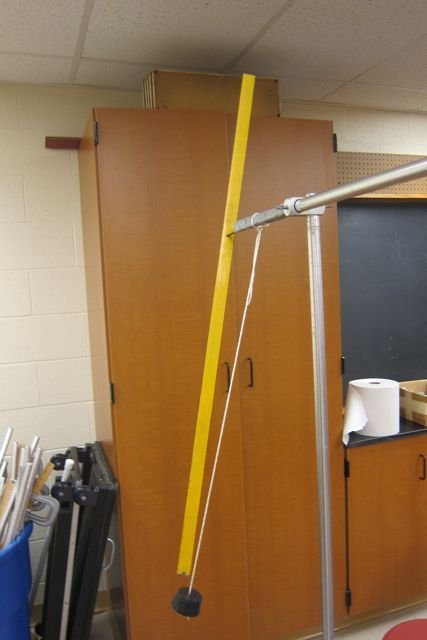
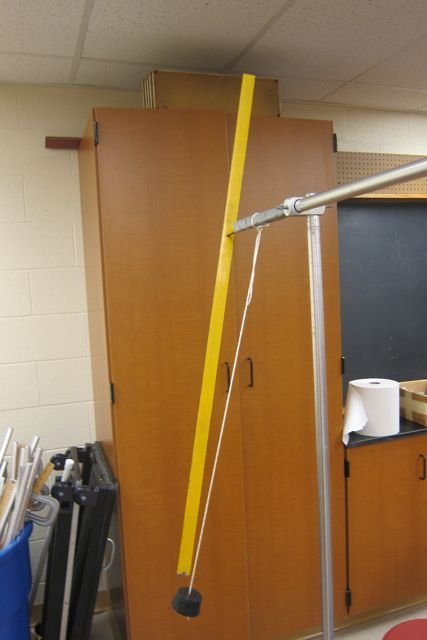
A meterstick hangs on a thin rod next to a string pendulum. A series of three comparisons shows that a bar does not swing like a simple pendulum of the same length, that it matches a simple pendulum two-thirds as long, and that it keeps that same period when re-hung from a hole two-thirds of the way down. The setup takes minutes and leads to rich discussion of how mass distribution affects motion.
Written from Bruce's original workshop handout. Bruce's final review of this plan is in progress.
What it shows
A swinging meterstick keeps the same beat whether it hangs from its end or from a point a third of the way down. Why?
Key ideas: pendulum period, physical pendulum, center of mass, moment of inertia, torque, center of oscillation
Build it
Drill the bar
Drill a small hole for the pivot rod near one end of the meterstick, and a second hole two-thirds of the way along the stick, measured from the far end (the 1/3 point from the first end).
Clamp the supports
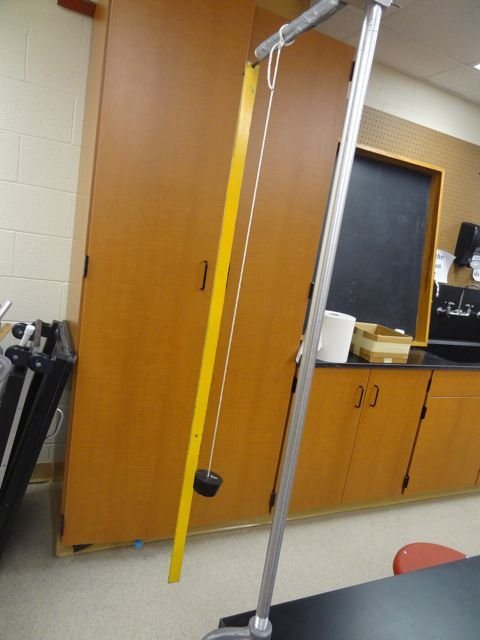
Clamp two vertical rods to a table about 1/2 to 3/4 m apart, then clamp a horizontal cross bar near their tops so one end extends past the table edge, giving a clear swinging space.
Add the pivot rod
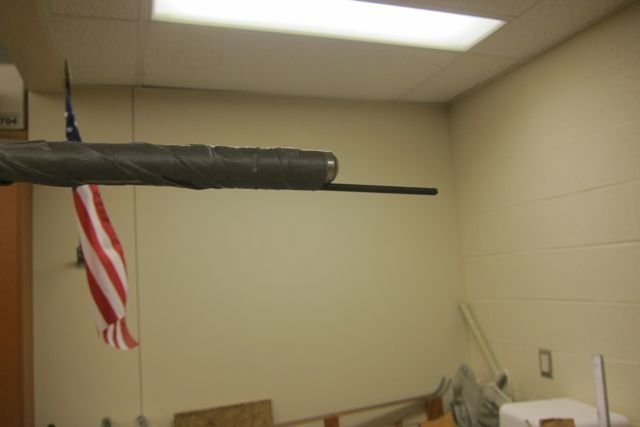
Tape or rubber-band the thin 1/8 in rod to the end of the cross bar so a few inches stick out. Both pendulums will hang from this rod.
Comparison 1: same length
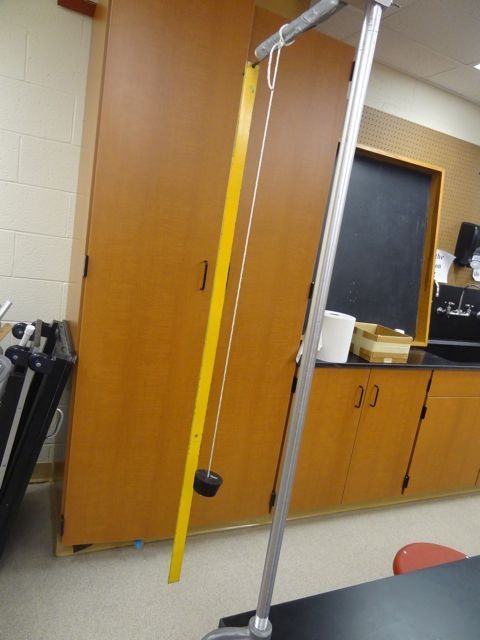
Hang the meterstick from its end hole and hang a simple pendulum whose length (pivot to center of the bob) is also 1 m. Pull both back a short distance, release together, and watch the bar pull ahead.
Comparison 2: matching period
Challenge students to find the string length that keeps time with the bar. Shorten the string to about 66.7 cm (two-thirds of the bar) and release them together again.
Comparison 3: re-hang the bar
Move the meterstick to its second hole, so one-third of it is above the pivot and two-thirds below. Keep the 66.7 cm simple pendulum and compare again: they still swing together.
How it works
For small swings, a simple pendulum's period is T = 2 pi sqrt(L / g). A 1 m pendulum has a period of about 2.0 s.
A bar's mass is spread along its whole length. The parts near the pivot act like short pendulums that want to swing faster, and they hurry the whole bar along. Using T = 2 pi sqrt(I / (m g d)), where I is the moment of inertia about the pivot and d is the distance from the pivot to the center of mass, a 1 m bar hung from its end has a period of about 1.64 s, the same as a simple pendulum 2/3 m long. That length is called the equivalent length, and the point 2/3 m below the pivot is the center of oscillation.
The surprise in comparison 3 is a general rule discovered by Christiaan Huygens: the pivot and the center of oscillation can trade places without changing the period. Hung from the 1/3 point, the bar has its center of mass only 1/6 m below the pivot, so gravity's twist (torque) is much smaller, but its moment of inertia is also smaller, and the two changes balance exactly. Any bar has many such matching pairs of pivot points.
Using it
- After each comparison, stop and ask students to predict and then explain the result before revealing the next step.
- Time 10 swings of each pendulum and compare with the calculated periods (2.0 s and 1.64 s).
- Try other pivot points on the bar and plot period against pivot position; the period is longest near the center and has a minimum near 29 cm from the center.
- Follow up with simple-pendulum investigations: does the bob's mass matter? does the length? does the size of the swing? (Galileo is said to have timed a swinging chandelier with his pulse.)
- Contrast with a mass on a spring, whose period does change with mass.
Variations
- Use an iron bar or a metal meterstick instead of wood for a steadier swing.
- Hang the bar on a nail or knitting needle if you do not have lab stands.
Troubleshooting
More build plans
Balancing Nails Challenge
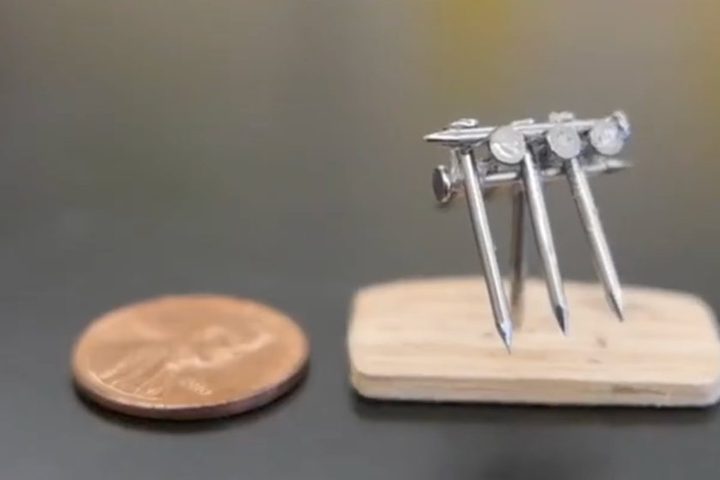
Twelve big nails balanced on one nail head looks impossible. Then Bruce doubles it.
Block Stacking Challenges
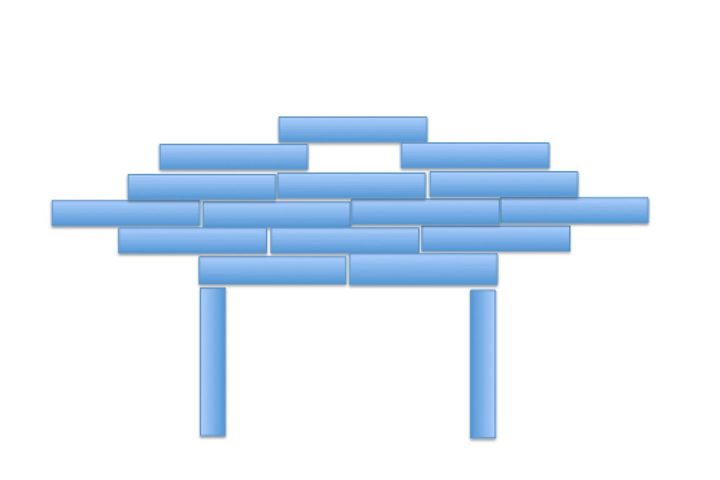
How few blocks does it take to make the top block hang completely past the edge of the bottom one?
Centrifugal Bottles
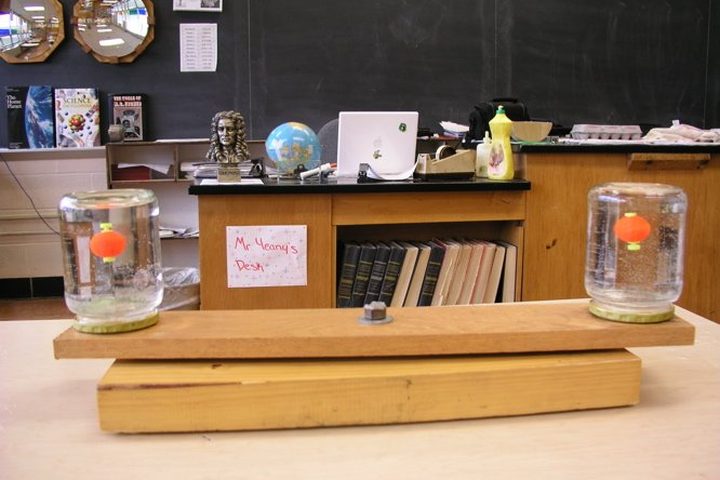
Spin two jars of water and everyone expects the floats to fly outward. They move inward instead.
© Bruce Yeany · Homemade Science with Bruce Yeany · youtube.com/@YeanyScience
Free for personal and classroom use. Please don't resell or republish. Build and use at your own risk; follow the safety notes and supervise children.