Build plans / Block Stacking Challenges
Block Stacking Challenges
A set of identical wooden blocks and a few drawn challenge designs turn center of gravity into a hands-on puzzle. Students copy bridges, towers and overhanging stacks, then tackle Bruce's question: what is the minimum number of blocks needed so the top block's edge is out past the edge of the bottom block? Dominoes work too, so it can be ready in minutes.
Written from Bruce's original workshop handout. Bruce's final review of this plan is in progress.
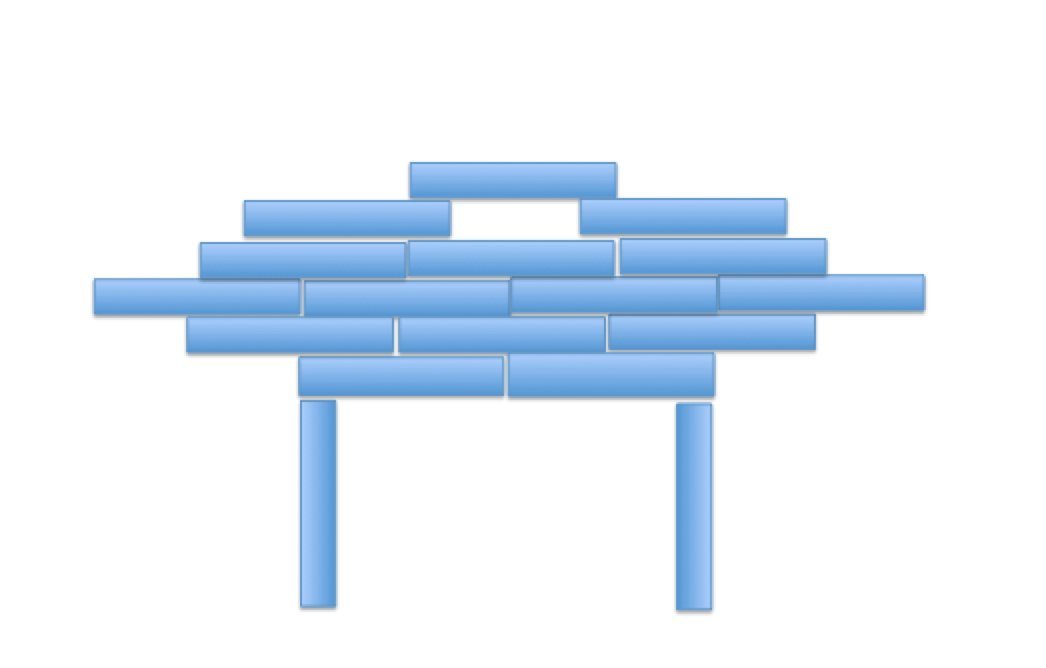
What it shows
How few blocks does it take to make the top block hang completely past the edge of the bottom one?
Key ideas: center of gravity, balance, stability, counterweights, engineering design
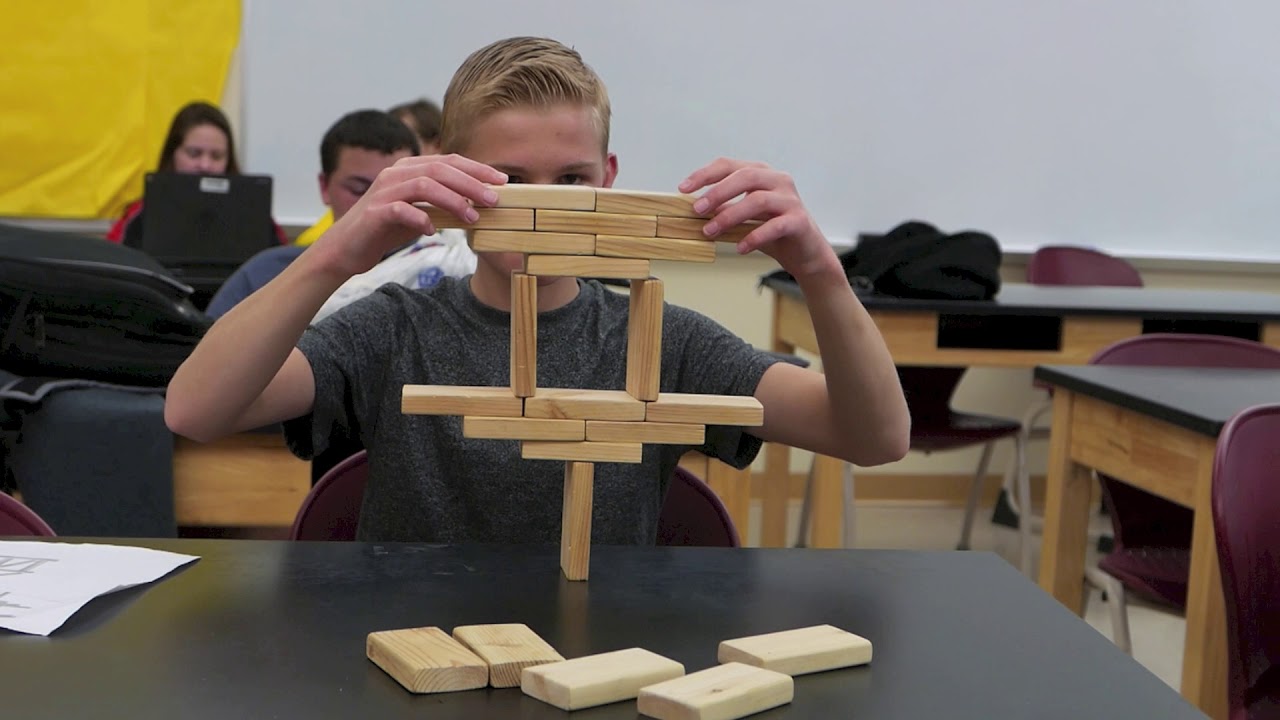
Build it
Cut the blocks
Cut the strip into identical blocks, about 6 in long. They must all be the same size and weight, so measure carefully.
Sand them
Sand every face and edge smooth so the blocks sit flat and are splinter-free.
Make the challenge cards
Draw or print side-view designs for students to copy, starting with simple towers and bridges.
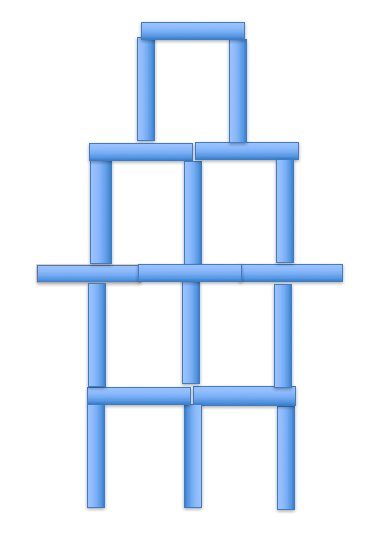
Add counterweight designs
Include designs where blocks reach out on both sides of a support and balance each other.
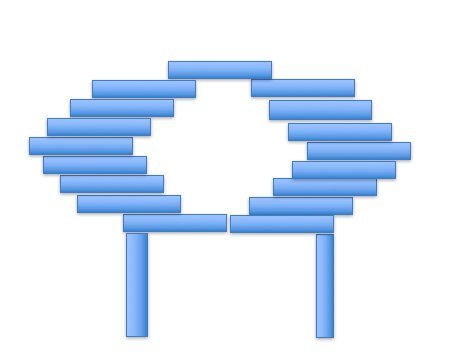
Add overhang designs
Include designs where the stack leans out far past its base.
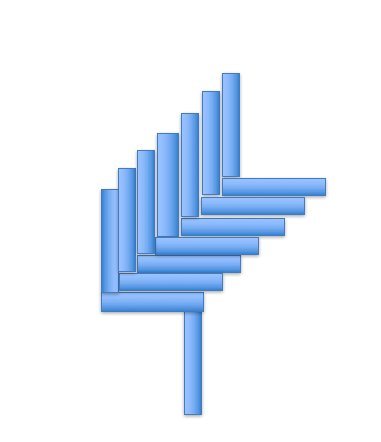
Pose the big question
Finish with the overhang challenge: find the minimum number of blocks so the top block's edge is out past the edge of the bottom block.
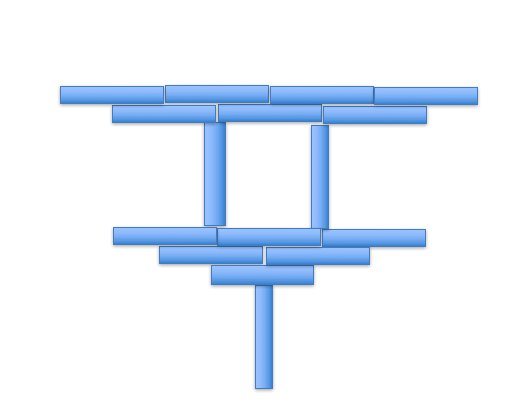
How it works
A stack stays up as long as the combined center of gravity of every block above any level lies over the block (or blocks) supporting it. If it moves past the edge, that part tips over.
In a simple one-block-per-level stack, each block can stick out only so far. Working from the top down, the best overhangs are 1/2, 1/4, 1/6, 1/8 ... of a block length. These add up slowly, but they never stop growing, so with enough blocks the top can reach as far out as you like. With four blocks stacked on a base block, the total overhang (1/2 + 1/4 + 1/6 + 1/8 of a block) is just over one full block length, so the top block clears the base completely.
Counterweights change the game. A block reaching back over the support balances one reaching forward, which lets builders get more overhang from fewer blocks than a simple stack.
Using it
- Give pairs a set of blocks and a challenge card to copy, then let them invent new designs.
- Pose Bruce's question and have groups compete for the fewest blocks.
- Ask students to mark where they think the center of gravity is on a finished design.
- Measure overhangs in a simple stack and compare with the 1/2, 1/4, 1/6, 1/8 pattern.
- Use dominoes for small-scale versions on a desk.
Variations
- Use larger blocks (such as 2 x 4 offcuts) for a floor-scale challenge.
- Time trials: who can build a given design fastest without it collapsing?
Troubleshooting
More build plans
Balancing Nails Challenge
Twelve big nails balanced on one nail head looks impossible. Then Bruce doubles it.
Bar Pendulum vs. Simple Pendulum
A swinging meterstick keeps the same beat whether it hangs from its end or from a point a third of the way down. Why?
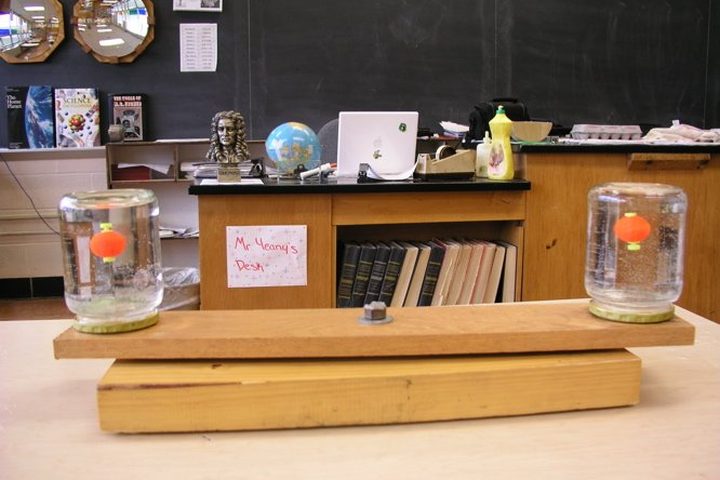
Centrifugal Bottles
Spin two jars of water and everyone expects the floats to fly outward. They move inward instead.
© Bruce Yeany · Homemade Science with Bruce Yeany · youtube.com/@YeanyScience
Free for personal and classroom use. Please don't resell or republish. Build and use at your own risk; follow the safety notes and supervise children.