Build plans / Giant Newton's Cradle
Giant Newton's Cradle
A row of pool balls hangs on nylon string from a wooden frame. Lift and drop one ball and one ball flies out the far end; drop two and two fly out. Bruce's favorite large version uses arcade pool balls, which are easy to drill, and a simple tack-in-the-hole trick for adjusting each string.
Written from Bruce's original workshop handout. Bruce's final review of this plan is in progress.

What it shows
Swap the desk toy's tiny steel balls for billiard balls and the whole class can see momentum pass down the line.
Key ideas: conservation of momentum, conservation of energy, elastic collisions, Newton's third law
Build it
Drill the balls
Drill a small (1/8 in) hole about 1/2 in deep into each ball, aimed at the center.
Glue in the strings
Glue the middle of a length of nylon string into each hole, so two ends come up from every ball. Let the glue cure fully.
Build the frame
Build a sturdy frame with two parallel top rails. The rails should be far enough apart that each ball hangs from a V of string, which keeps it swinging in one plane.
Drill the rails
Drill a row of small holes through each rail, spaced exactly one ball diameter apart, so the hanging balls just touch.
Hang the balls
Bring each string end up through its hole in the rail and push a thumbtack into the hole to pinch the string in place.
Align them
Adjust each string (pull the tack, slide the string, push the tack back) until all the balls hang at the same height in a straight, touching line.
Test
Lift one end ball and let it drop. Fine-tune until a single ball leaves the far end cleanly.
How it works
When the moving ball strikes the row, it stops and its momentum (mass times velocity) is passed through the touching balls as a compression wave to the last ball, which swings out.
Two quantities are conserved in a nearly elastic collision like this: momentum and kinetic energy. The only way to satisfy both with identical balls is for the same number of balls to leave as arrived, at the same speed. That is why one ball in sends one ball out, not two balls at half speed.
Each collision loses a little energy to sound, heat and slight deformation, so the swings slowly die away. Harder, more elastic balls keep it going longer.
Using it
- Drop one ball, then two, then three, and ask students to predict how many will fly out each time.
- Ask why two balls at half speed never come out. Work through momentum and energy to show why.
- Lift one ball on each end and release them together.
- Compare balls of different materials and discuss which collisions are closer to elastic.
Variations
- Croquet balls for an even larger version.
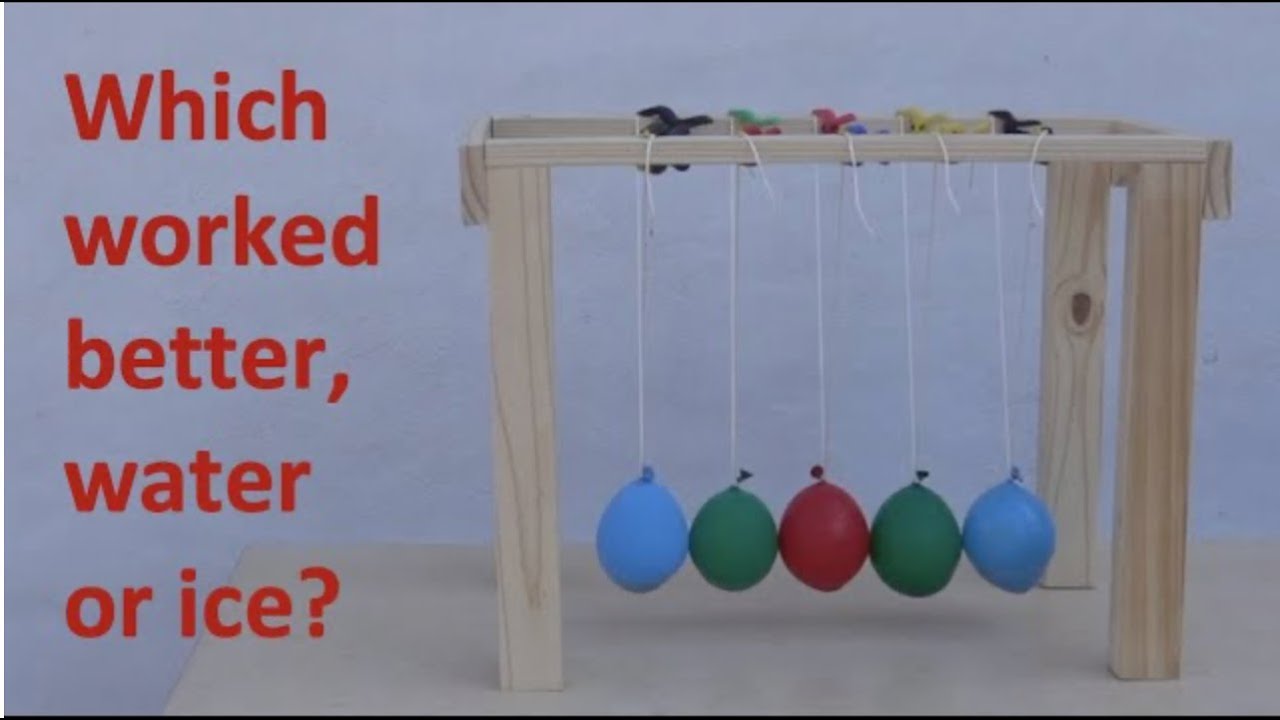
- Bruce has also experimented with water balloons and frozen water balloons in place of hard balls.
Troubleshooting
More build plans
Balancing Nails Challenge
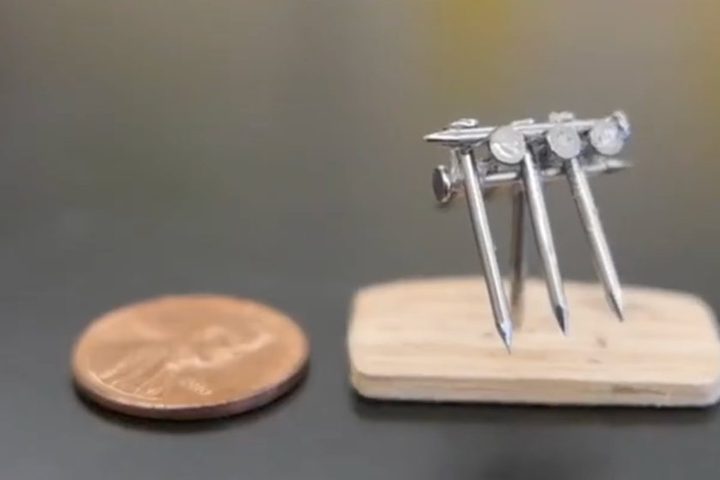
Twelve big nails balanced on one nail head looks impossible. Then Bruce doubles it.
Bar Pendulum vs. Simple Pendulum
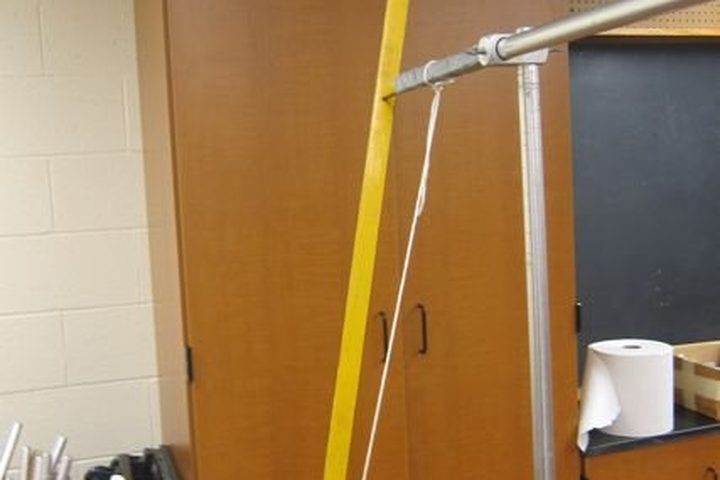
A swinging meterstick keeps the same beat whether it hangs from its end or from a point a third of the way down. Why?
Block Stacking Challenges
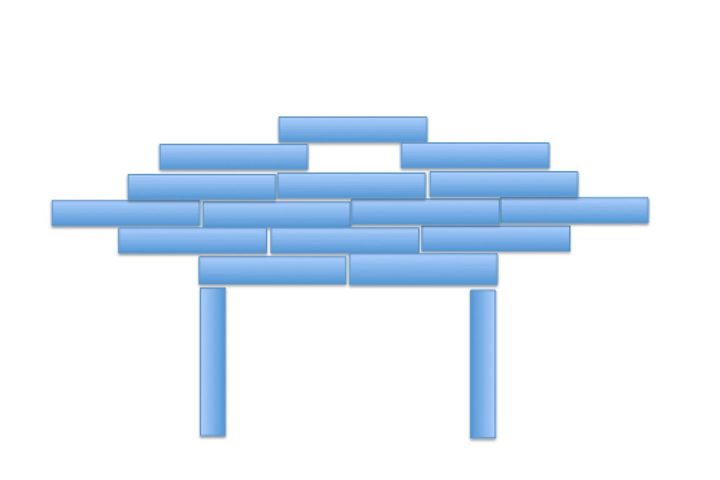
How few blocks does it take to make the top block hang completely past the edge of the bottom one?
© Bruce Yeany · Homemade Science with Bruce Yeany · youtube.com/@YeanyScience
Free for personal and classroom use. Please don't resell or republish. Build and use at your own risk; follow the safety notes and supervise children.