Build plans / Spinning Chain and Rope Loops
Spinning Chain and Rope Loops
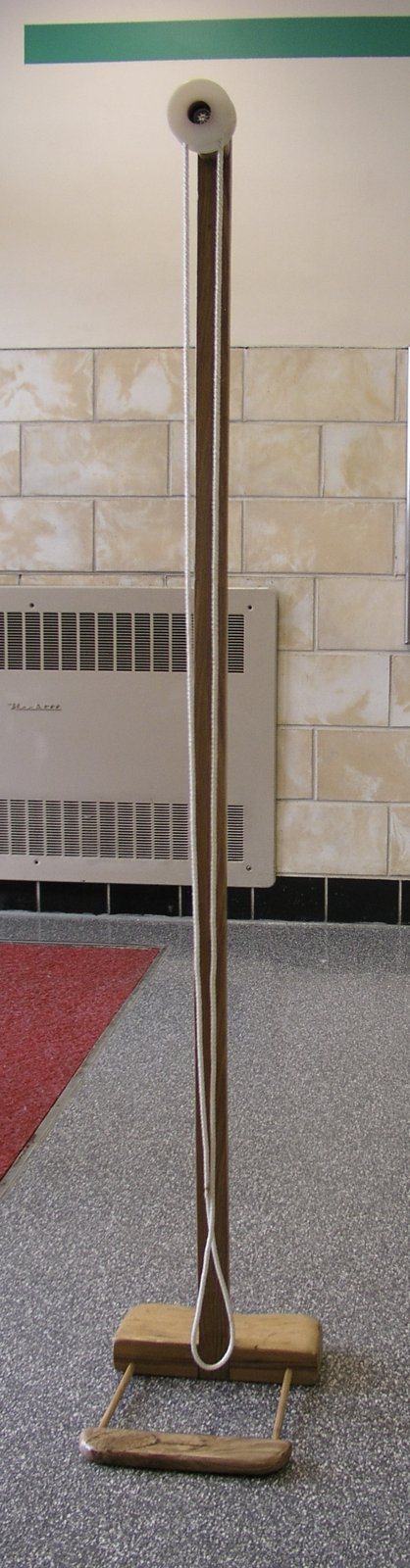
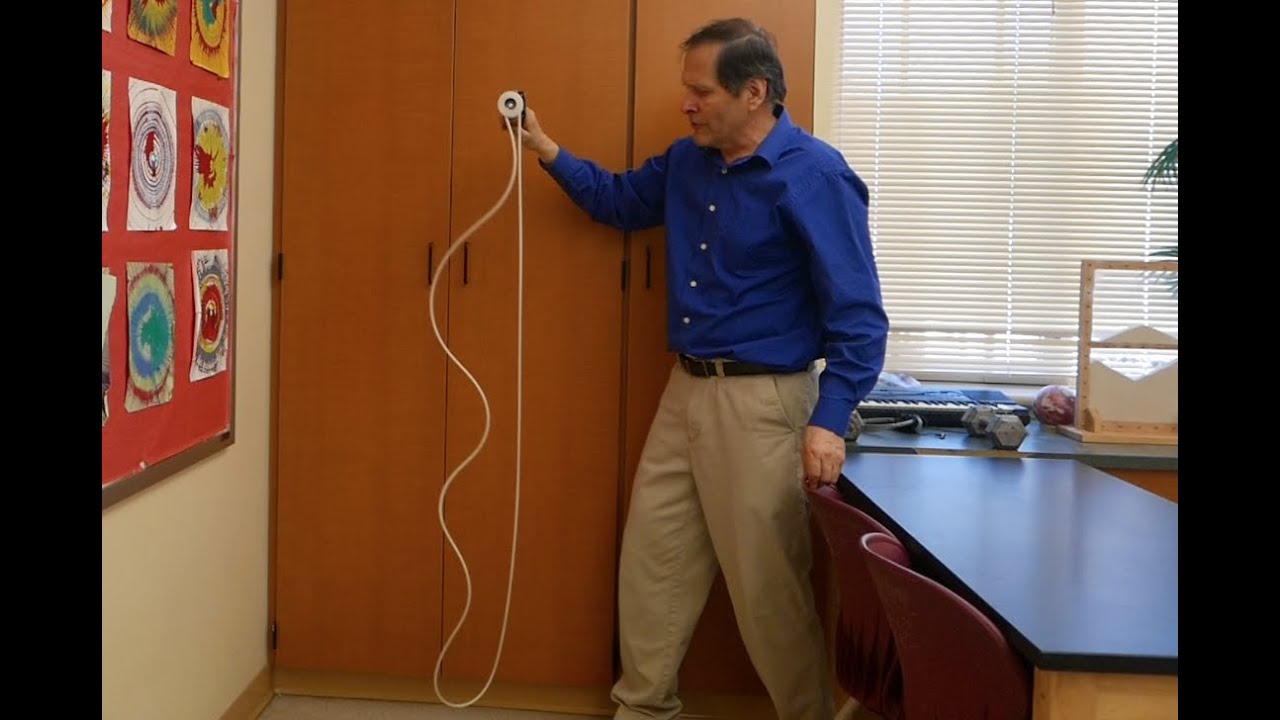
A toy motor in a wooden handle spins a soft foam wheel. A loop of light chain spun on the wheel and flicked off keeps its round shape and rolls away like a rigid wheel; a long loop of rope, ribbon or chain hung from a spool on the same motor shows eerie, slow-moving waves that behave nothing like waves on a still rope. The soft foam wheel can be touched while it runs, and the light chain will not hurt anyone it bumps into.
Written from Bruce's original workshop handout. Bruce's final review of this plan is in progress.
What it shows
Flick a spinning loop of chain off a foam wheel and it rolls across the floor like a solid hoop.
Key ideas: inertia, centripetal force, angular momentum, rolling and sliding friction, wave speed, frames of reference
Build it
Drill the motor socket
Drill a 15/16 in hole in one end of the 2 x 4, about 3/4 in deeper than the motor is long. If you only have a 1 in bit, wrap tape around the motor later so it fits snugly.
Shape the handle
Draw a comfortable handle on the 2 x 4, leaving enough wood on the side to mount the battery holder. Saw it out and sand the edges smooth.
Drill the wire hole
Mark the bottom of the motor socket on the outside, then drill a small side hole into the bottom of the socket, placed so it will not be covered by the battery holder.
Wire the motor
Mount the battery holder on the side with its wires toward the hole. Connect one battery lead to the switch, and run a wire from the switch and the other battery lead through the hole to the motor terminals. Solder or twist the joints, then cover them with hot glue or tape.
Fit and test the motor
Push the motor into the socket (tape it if loose), add batteries and check that the switch runs the motor.
Cut the foam wheels
With a compass, draw a 5-6 in circle on the 1/2 in foam and a slightly larger one on the thinner foam. Cut them out and sand the edges smooth, then drill a 7/16 in hole through the center of each.
Make the axle
Cut a piece of 1/2 in dowel about as long as the two foam pieces are thick. Hold it upright in a 1/2 in hole in scrap wood and drill a 1/16 in hole straight down its center for the motor shaft. Test it on the motor; if it wobbles, make another.
Glue the wheel
On a sheet of plastic wrap, glue the thick foam disk onto the axle, then glue the larger thin disk against it so it forms a flange. Weight it while it dries.
Balance the wheel
Press the wheel onto the motor shaft and run it. Sand away foam wherever needed until it spins smoothly with no vibration, then trim off any extra axle.
Make the chain loop
Size a piece of chain to fit around the wheel, snug but not tight. Open and close the end links with needle-nose pliers to join it into a loop.
Make a long loop
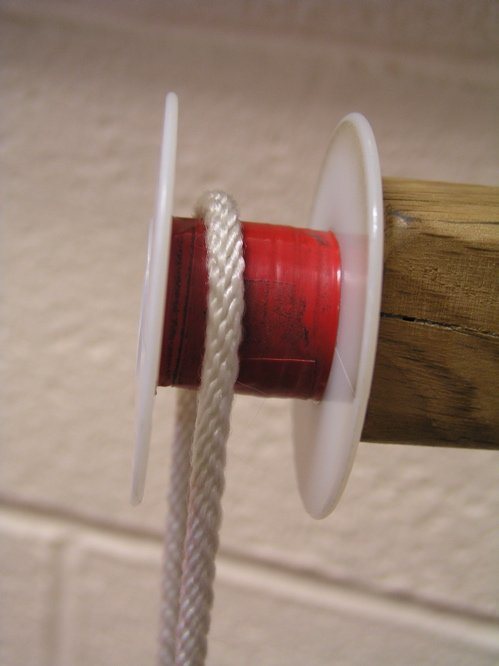
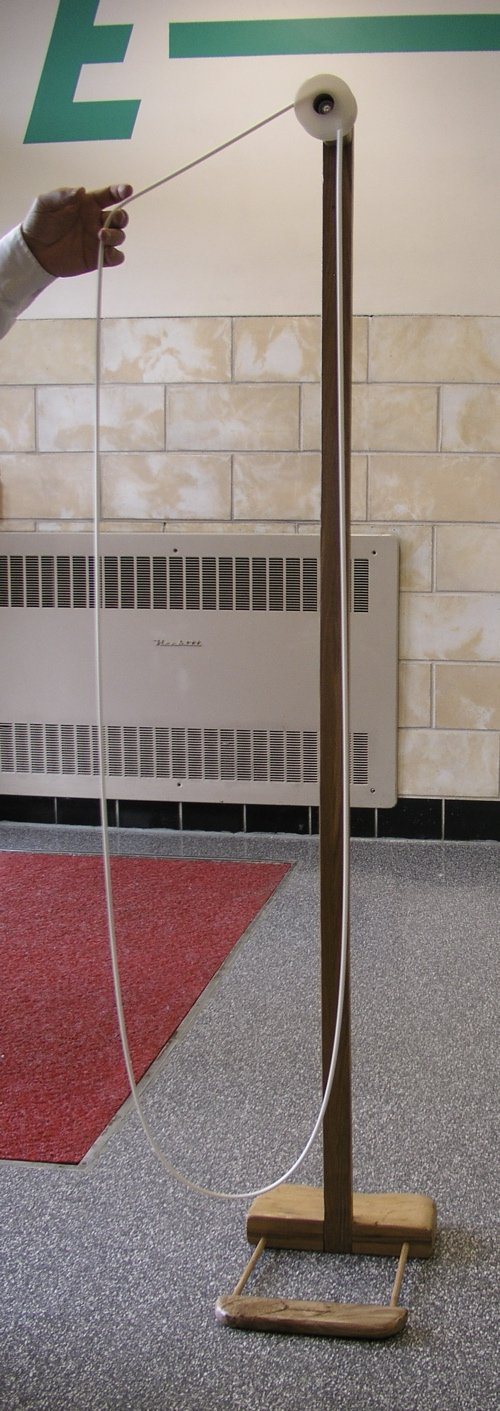
For the wave version, mount a flanged wire spool on a hub that fits the motor shaft. Make a long loop of nylon rope by melting the two ends with a small flame and pressing them together until cool, or glue or sew a ribbon into a loop.
Run the long loop
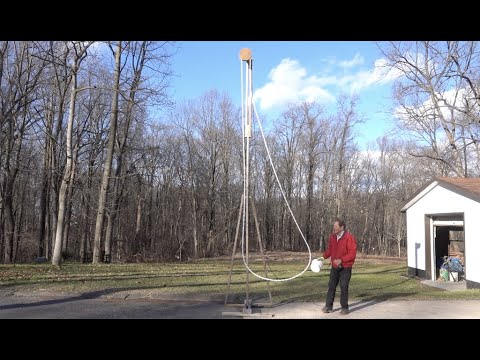
Hold the spinner up high (or mount it on a tall stand) with the loop hanging over the spool. Switch it on, then poke the moving loop to start a wave.
How it works
Each link of the spinning chain is trying to travel in a straight line, tangent to the circle. The chain's own tension pulls every link toward the center: that inward pull is the centripetal force. The so-called centrifugal force is not a real outward push; it is just the links' inertia. Because the tension is the same all the way around, the loop keeps its circle shape after it leaves the wheel.
When the loop hits the floor it is spinning far faster than it is moving forward, so at first it skids in place. Sliding friction slows the spin and speeds up the forward motion until the loop grips and rolls without slipping, just like a solid wheel. It keeps rolling, conserving angular momentum, until friction finally brings it to a stop.
On a long moving loop, a wave travels through the rope at its usual speed, but the rope itself is also moving. A wave heading against the rope's motion is carried backward, so to a watcher it creeps along slowly; a wave heading with the motion is fast and hard to see. Bruce's rule of thumb is that the slow wave's speed is the difference between the normal wave speed and the rope speed. You can measure the rope speed by measuring the loop's length and timing 10 revolutions (the joint clicks as it passes the spool).
Using it
- Spin up the chain, then flick the spinner slightly down and back up to throw the loop off. Watch it skid, grab, and roll away like a hoop.
- Roll the loop up a ramp and see how far it jumps.
- Tip the spinner so the chain spins horizontally, then flick it down and up so it drops flat and spins in a circle on a waxed table.
- Compare a chain loop, a rope loop, and a rigid hoop of aquarium tubing joined with a short dowel plug.
- With a long loop, compare its shape and waves when the motor is running with how it hangs when the motor is off.
- Lift a long loop off the spool with a pencil while it runs: it holds its shape for a moment before collapsing.
Variations
- Bruce's original long-loop stand put the batteries in the base and the motor at the top of a tall wooden post, which meant splitting and regluing the post to hide the wiring. He now recommends keeping the battery and motor together in a handheld spinner like the one above.
- Ribbon, rope and light-switch pull chain all work for the long loops; Bruce prefers nylon rope.
Troubleshooting
More build plans
Balancing Nails Challenge
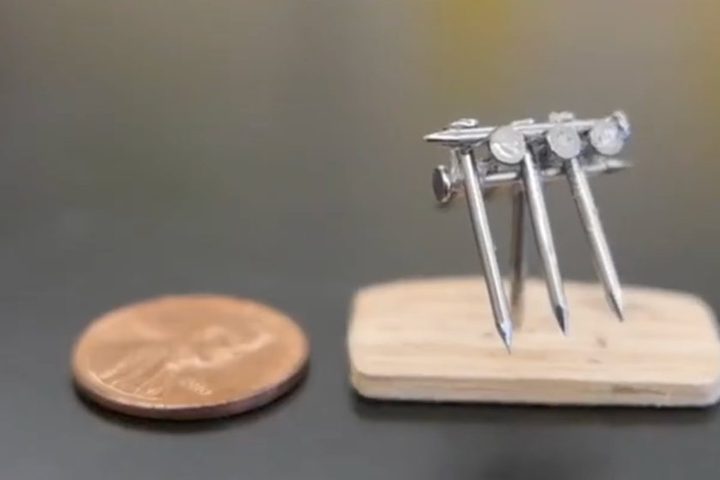
Twelve big nails balanced on one nail head looks impossible. Then Bruce doubles it.
Bar Pendulum vs. Simple Pendulum
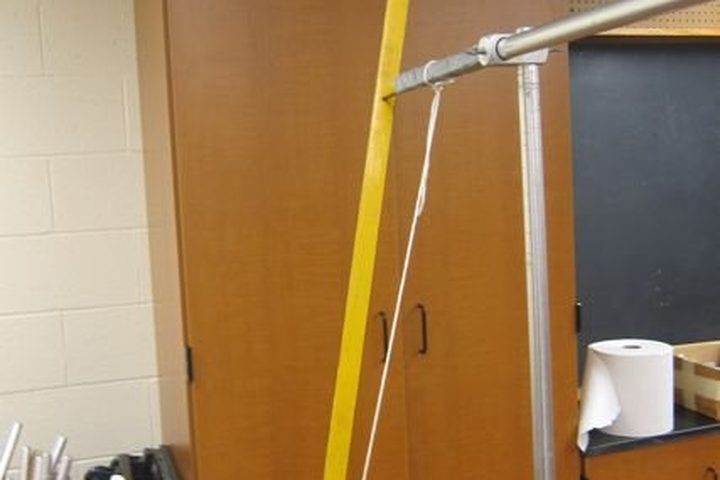
A swinging meterstick keeps the same beat whether it hangs from its end or from a point a third of the way down. Why?
Block Stacking Challenges
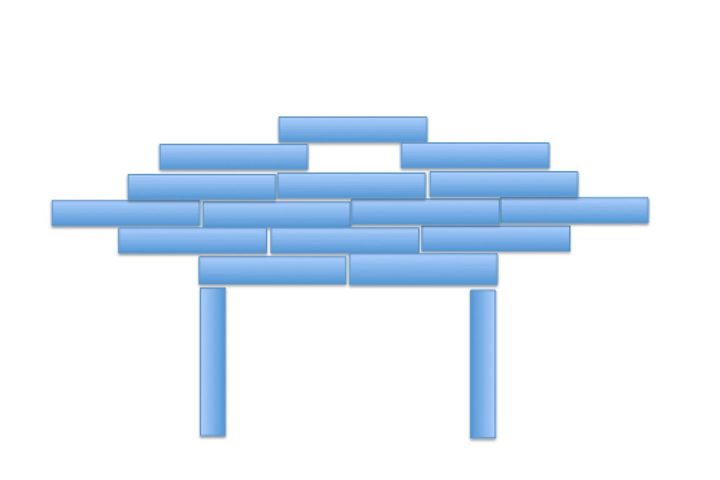
How few blocks does it take to make the top block hang completely past the edge of the bottom one?
© Bruce Yeany · Homemade Science with Bruce Yeany · youtube.com/@YeanyScience
Free for personal and classroom use. Please don't resell or republish. Build and use at your own risk; follow the safety notes and supervise children.