Build plans / Chemical Dice
Chemical Dice
Wooden cubes cut from a 2x4 are labeled on every face with ions and their charges: one set of dice carries positive ions, the other negative ions. Students roll a pair and use the crisscross method to write the formula, then name the compound. Turning drill into a game makes practice far less painful.
Written from Bruce's original workshop handout. Bruce's final review of this plan is in progress.
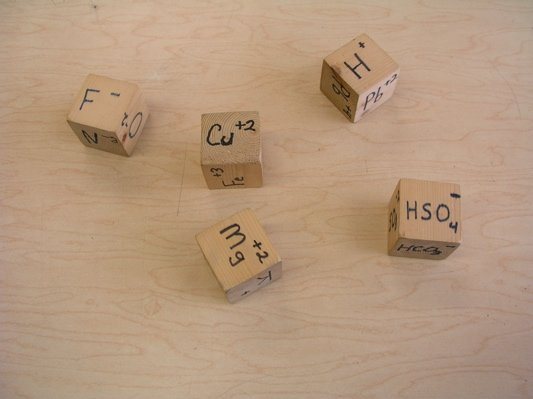
What it shows
Roll a positive die and a negative die, and whatever comes up, write the compound's formula and name.
Key ideas: ions, oxidation numbers, chemical formulas, naming compounds, polyatomic ions
Build it
Cut the cubes
Rip a strip of 2x4 to 1 1/2 in wide, then cut it into 1 1/2 in pieces to make cubes. Make an equal number of positive and negative dice.
Sand them
Sand all faces and soften the edges. Do not varnish yet; marker writes best on bare wood.
Choose the ions
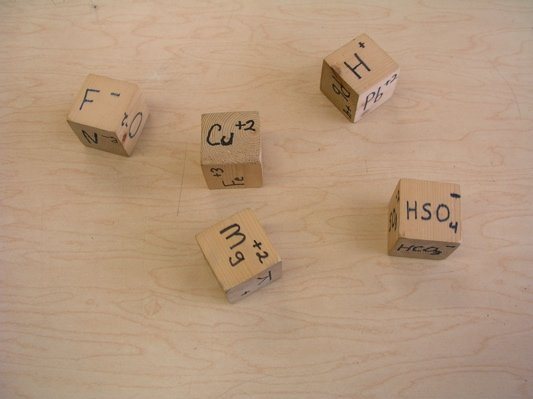
List positive ions such as H+, Na+, K+, NH4+, Mg2+, Ca2+, Cu2+, Zn2+, Pb2+, Fe3+ and Al3+, and negative ions such as F-, Cl-, OH-, NO2-, NO3-, HSO4-, SO4 2-, CO3 2-, O2- and PO4 3-.
Label the dice
Write one ion on each face, with its charge as a superscript. Every face of a positive die carries a positive ion and every face of a negative die a negative ion. Mix charges of 1, 2 and 3 on each die.
Seal them
Once all faces are labeled, varnish the dice if you like, so the writing does not rub off.
Play
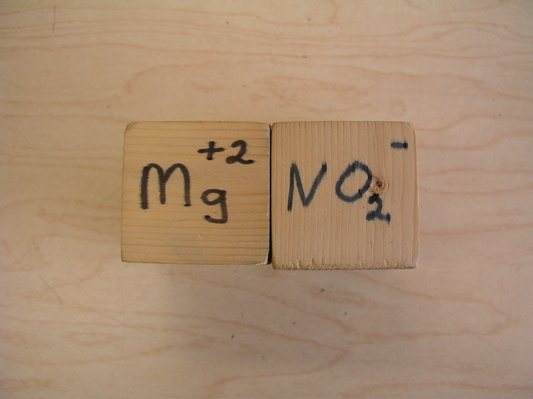
Roll one positive and one negative die. Write the formula using the crisscross method, then write the compound's name.
How it works
Ionic compounds are electrically neutral, so the total positive charge must equal the total negative charge.
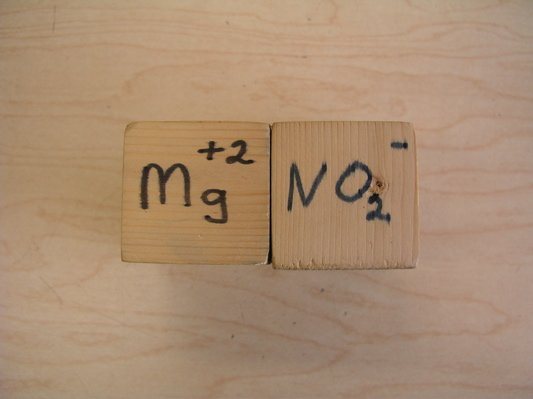
The crisscross method is a shortcut: the number of each charge becomes the subscript of the other ion. For Mg2+ and NO2-, the 2 from magnesium goes to nitrite and the 1 from nitrite goes to magnesium, giving Mg(NO2)2, magnesium nitrite.
Subscripts are always reduced to the simplest ratio, so Ca2+ and O2- give CaO, not Ca2O2. Polyatomic ions stay together in parentheses when more than one is needed.
Using it
- Pairs of students take turns rolling and writing formulas; their partner checks and names the compound.
- Score points: one for the correct formula and one for the correct name.
- Roll several pairs and have students sort the results by type, such as binary compounds or compounds with polyatomic ions.
- Advanced: ask which rolled combinations would form a precipitate in water, or which are acids.
Variations
- Make color-coded sets, for example red dice for positive ions and blue for negative ions.
- Make a beginner set with only single-charge ions, then add 2+ and 3- ions later.
Troubleshooting
More build plans
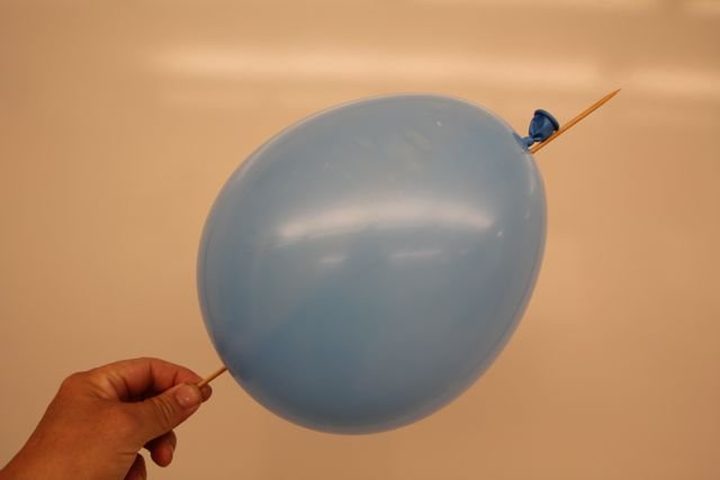
Poke a Polymer
Slide a sharp stick right through a balloon, or a dozen pencils through a bag of water, and nothing pops or leaks.
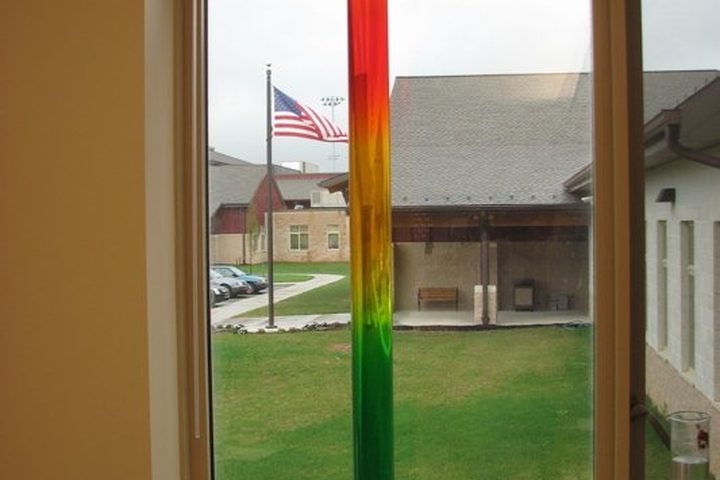
Rainbow Density Column
Six cups of colored salt water, poured carefully, stack themselves into a rainbow that holds its stripes.
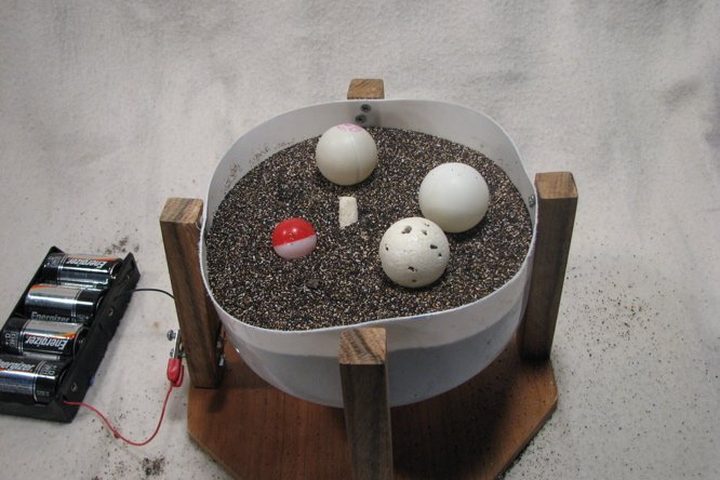
Buoyancy of Sand Vibrating Tub
Switch on the motor and buried ping-pong balls pop up through solid sand while steel balls on top sink out of sight.
© Bruce Yeany · Homemade Science with Bruce Yeany · youtube.com/@YeanyScience
Free for personal and classroom use. Please don't resell or republish. Build and use at your own risk; follow the safety notes and supervise children.