Build plans / Sneaky Pendulums (Coupled Pendulums)
Sneaky Pendulums (Coupled Pendulums)
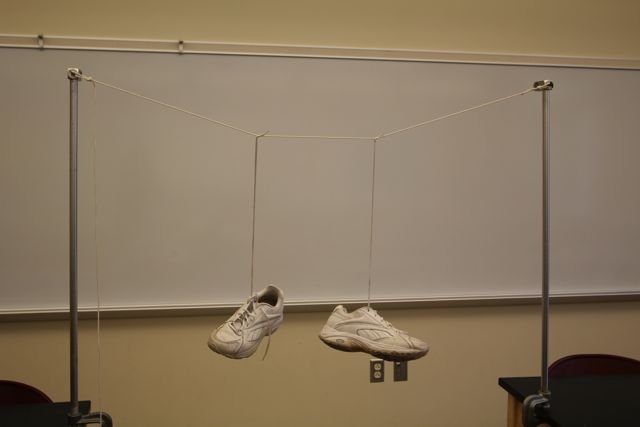
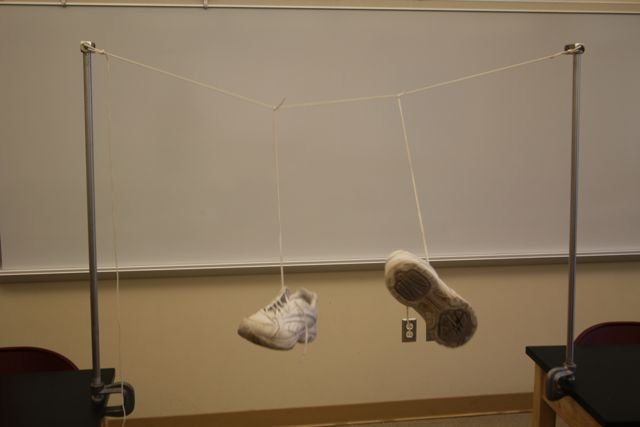
Two equal pendulums hang from a shared, slightly slack support string. Set one swinging and the energy gradually flows through the string into the other, back and forth, until both stop. Bruce starts with a student's sneakers for a laugh, then turns it into a lab where groups test the variables that control resonance.
Written from Bruce's original workshop handout. Bruce's final review of this plan is in progress.
What it shows
Tie two sneakers to a string, swing one, and watch the other slowly steal all its motion, then give it back.
Key ideas: resonance, coupled oscillators, energy transfer, natural frequency, pendulum period
A version of this device appears in If You Build It, They Will Learn (NSTA Press).
About the bookBuild it
Tie the support string
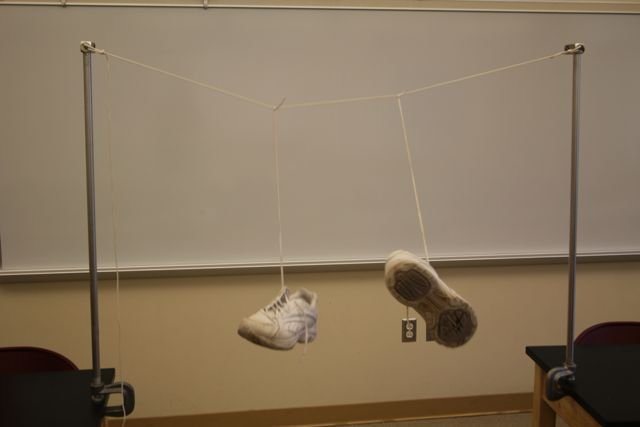
Stretch a string between two clamped stands, chairs or posts. Leave it a little slack; a sagging string couples the pendulums more strongly.
Hang two equal pendulums
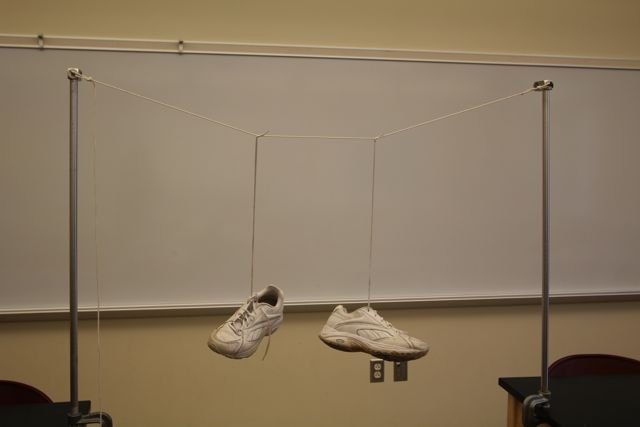
Tie one sneaker's lace to the support string and the other a short distance away, far enough apart that they cannot collide. Make the two lengths equal.
Start one swinging
Pull one sneaker back, perpendicular to the support string, and release it. Leave the other hanging still.
Watch the transfer
Over several swings the first sneaker slows and stops while the second builds to a full swing. Then the process reverses.
Build the lab version
Replace the sneakers with nuts, washers or sinkers on shorter strings so groups can change one variable at a time.
Try a vertical double pendulum
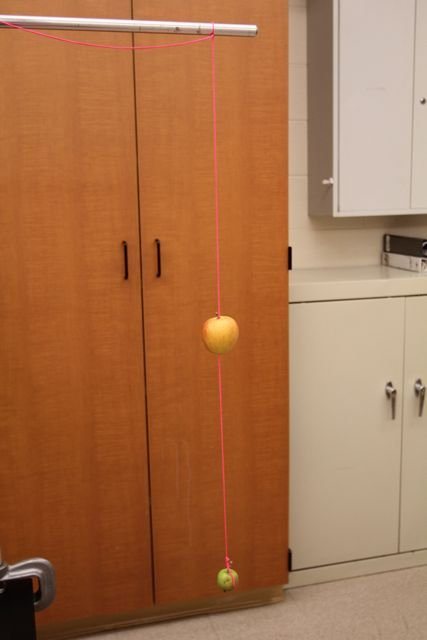
Tie about 18 in of string to a support, then a heavy weight, then another 18 in of string and a much lighter weight (about one-tenth the mass). Pull the bottom weight back and release.
How it works
Two pendulums of the same length have the same natural frequency. Each time the swinging one moves, it tugs the support string a little, and the string passes that tug to the other pendulum.
Because the frequencies match, each tug arrives at the right moment to add to the second pendulum's swing, like a well-timed push on a playground swing. Energy steadily flows across until the first pendulum is still. Then the roles reverse and the energy flows back.
If both start together in step, or exactly opposite, there is no back-and-forth exchange: those are the two 'normal modes' of the pair. Starting just one pendulum is a mixture of both modes, and the slow beat between them is what you see as the energy sloshing back and forth.
Using it
- Have the sneakers' owner try to copy the motion with their own feet: easy when both swing together or opposite, nearly impossible during the energy transfer.
- Ask: what will happen if we pull one sneaker back and let go? Collect predictions first.
- Lab variables to test: support-string tightness, heavier or lighter pendulums, unequal masses, pulling both back together, adding more pendulums of the same length, spacing between pendulums, and the length of the support string.
- Barton's pendulums: hang five pendulums of different lengths plus a sixth that matches one of them, and drive with the odd one out. Only its match responds strongly.
- List other examples of resonance from sound, electricity, chemistry and atomic physics.
Variations
- Vertical double pendulum with fruit: thread string through an apple and tie it to a strawberry or cherry stem below.
- Hang a pendulum from the bottom of a second, heavier pendulum of about the same length (for example, a weight hanging from a bar that itself swings on cords) and watch the energy pass between them.
- Use fun bobs: Bruce has used apples, bananas and all sorts of everyday objects.
Troubleshooting
More build plans
Balloon Fog Horn
Blow into a little plastic bottle and it lets out a deep, buzzing honk like a ship in the fog.
F.A.K.E.D. Resonance Pendulums
Ask the class to move just the orange ball with their minds, and watch it swing while the other three hang nearly still.
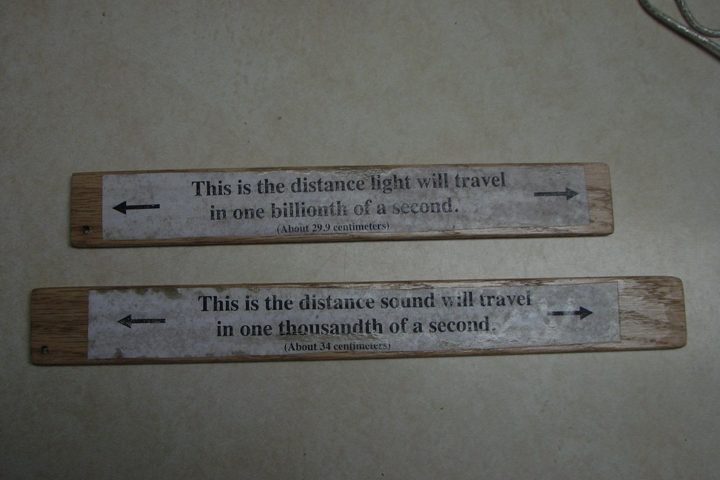
Nanosecond of Light and Millisecond of Sound Sticks
Two sticks of almost the same length: one shows a billionth of a second of light, the other a thousandth of a second of sound.
© Bruce Yeany · Homemade Science with Bruce Yeany · youtube.com/@YeanyScience
Free for personal and classroom use. Please don't resell or republish. Build and use at your own risk; follow the safety notes and supervise children.