Build plans / Fruit Racers
Fruit Racers
Students build gravity-powered racers using a piece of fruit as the body, then race them down an inclined table. Bruce ran it as a Night of Science event for all ages: builders get basic materials, bring their own fruit and decorations, and have one to two hours to build and test before the race-off.
Written from Bruce's original workshop handout. Bruce's final review of this plan is in progress.
What it shows
Pick a fruit, add wheels, and race it down a tilted table in a family-night challenge built on potential energy.
Key ideas: potential and kinetic energy, friction, mass, engineering design
Build it
Set up the track
Use a long table as the track. Raise one end by placing blocks under two legs, and decorate the table like a racetrack with lanes and a finish line.
Prepare the kits
Set out basic construction materials for each team. Builders bring their own fruit and any extra decorations.
Explain the rules
Each racer must have at least three wheels and the fruit must be the body. Racers start from rest at the top of the track with no pushing.
Build the axles
Push straws through the fruit or tape them underneath as bearings, then slide skewers through the straws as axles.
Add the wheels
Fasten wheels to the ends of each axle so they turn freely and run straight. Trim sharp skewer ends.
Test and improve
Give teams one to two hours to build and run test races. Encourage them to change one thing at a time and see what helps.
Race-off
Release racers two at a time from the top of the track and time them or judge the finish. Run heats until a champion emerges.
How it works
Raising one end of the table gives each racer gravitational potential energy at the top. As it rolls down, that energy turns into kinetic energy of motion.
Some energy is lost to friction at the axles, rubbing between wheels and body, and air resistance, and some goes into spinning the wheels. The fastest racers waste the least.
In an ideal frictionless world all racers would reach the bottom at the same speed regardless of mass. In real racers, a heavier fruit helps overcome the fixed losses from friction, which is why mass often helps, as long as the wheels and axles stay free and straight.
Using it
- Ask builders before the race: Will a heavy fruit or a light fruit win? Then compare results.
- Measure the track length and race time to calculate each racer's average speed.
- Have teams list every change they made and whether it helped, as an engineering design log.
- Award prizes for more than speed: best design, best decoration, straightest run.
- Try three-wheel and four-wheel versions and discuss stability versus friction.
Variations
- Use vegetables instead of fruit.
- Measure how far racers roll across the floor after leaving the table, rather than timing them.
Troubleshooting
More build plans
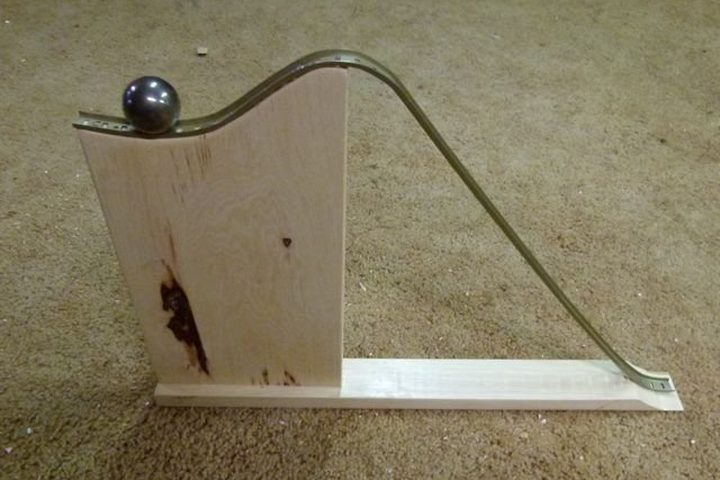
Activation Energy Track
The ball sits up high, full of potential energy, yet it can't go anywhere until you lift it a little higher.
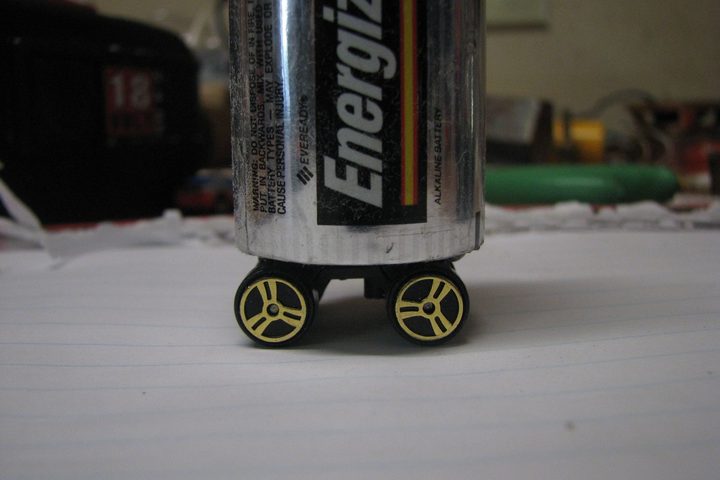
Rolling vs. Sliding Batteries
Two identical batteries race down a gentle slope: one rolls, one rides on tiny toy-car wheels. Most people bet on the wrong one.
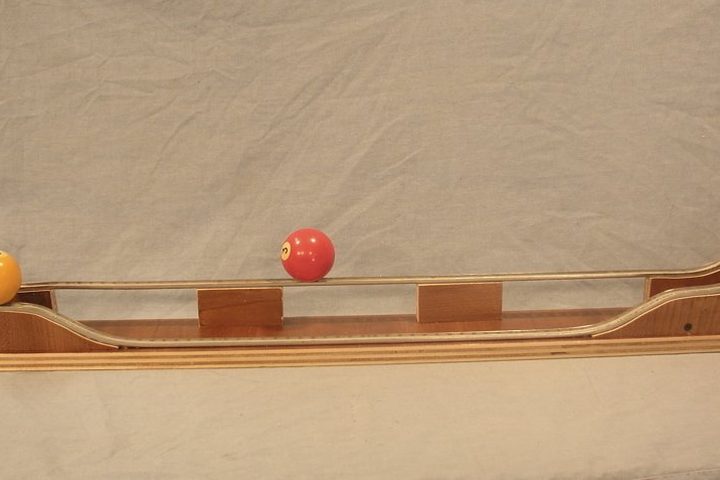
High Road, Low Road Tracks
Two balls race across side-by-side tracks, and the one that takes the longer road through a dip wins every time.
© Bruce Yeany · Homemade Science with Bruce Yeany · youtube.com/@YeanyScience
Free for personal and classroom use. Please don't resell or republish. Build and use at your own risk; follow the safety notes and supervise children.