Build plans / Hydraulic Syringe Pairs
Hydraulic Syringe Pairs
Two syringes joined by a length of plastic tubing make the simplest working hydraulic system. With equal syringes the force and travel match; with a large and a small syringe you can feel the force multiply; filled with air instead of water, the system goes spongy. A 30-foot version shows how fluids carry pressure across a room almost instantly.
Written from Bruce's original workshop handout. Bruce's final review of this plan is in progress.
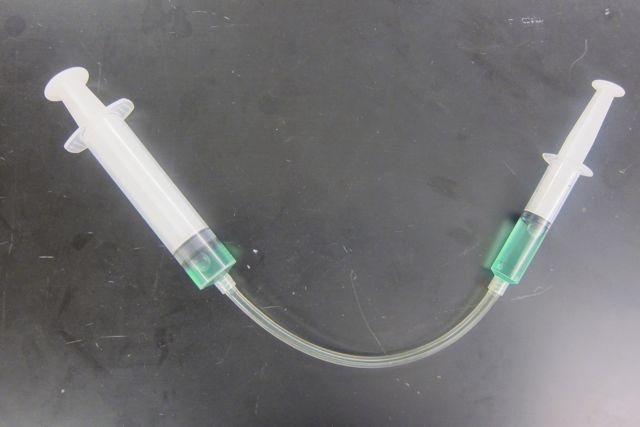
What it shows
Push one plunger and feel the other one push back, multiplied.
Key ideas: Pascal's principle, hydraulics, force and area, incompressibility of liquids, mechanical advantage
Build it
Cut the tubing
Cut tubing into a few lengths: a short piece of about 6 inches to a foot for handheld sets, and a long piece (up to 30 feet) for the long-distance set.
Fill the large syringe and tubing
Attach the tubing to the larger syringe. Put the free end of the tube in colored water and pull the plunger out to draw water through the tubing and into the syringe.
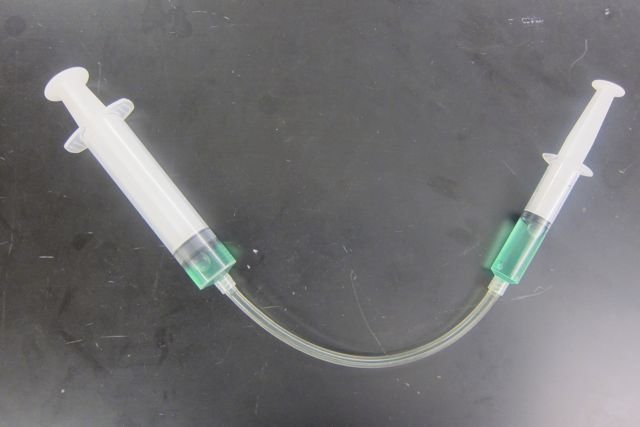
Push the large plunger all the way in
Press the large plunger fully in, leaving the tube full of water. Point the free end into the cup so any air bubbles escape.
Fill and connect the small syringe
Fill the smaller syringe with water, tap out any air, and push its tip into the free end of the water-filled tube. Try to trap as little air as possible.
Try a same-size pair
Build a set with two syringes of the same size. Push one plunger and the other moves out the same distance, with the same force.
Try a large-and-small pair
Push the small plunger and the large one moves out with more force but a shorter distance. Push the large one and the small one shoots out farther with less force.
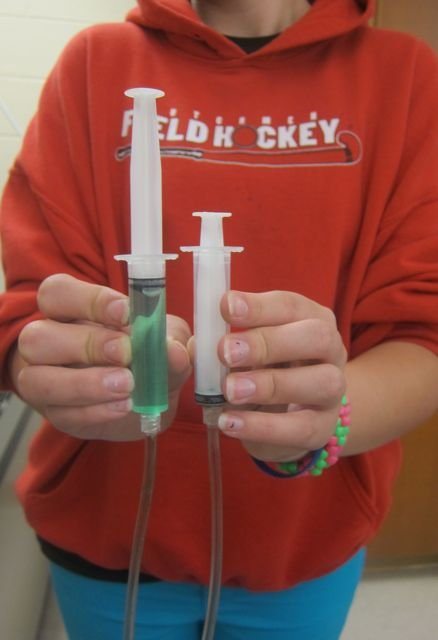
Make an air-filled pair
Connect two same-size syringes with air instead of water. Pushing one plunger compresses the air first, so the other one lags behind and never moves the full distance.
Build the long-distance set
Join two same-size syringes with about 30 feet of water-filled tubing. Stretch it across the room and push: the far plunger moves almost instantly.
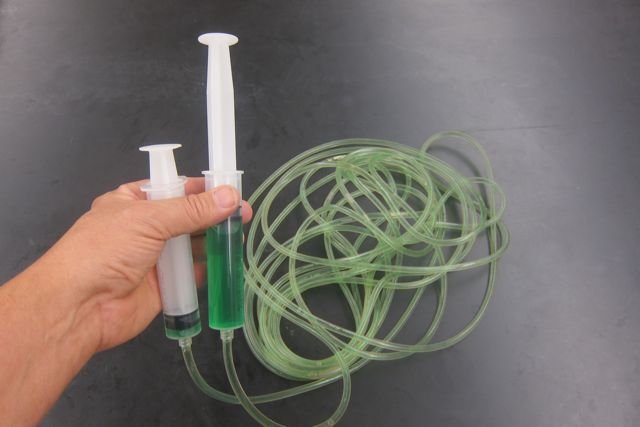
How it works
Pascal's principle says that pressure applied to a fluid in a closed container is transmitted equally to every part of the fluid. When you push one plunger, the pressure rises everywhere in the water, including against the face of the other plunger.
Pressure is force divided by area. The same pressure acting on a larger plunger produces a larger force, in proportion to its area. Because plunger area depends on diameter squared, a syringe twice as wide has four times the area and pushes with about four times the force.
There is no free lunch: the water pushed out of the small syringe spreads across the wide one, so the large plunger moves a shorter distance. Force times distance (the work) stays roughly the same on both sides, minus friction.
Water is nearly incompressible, so it transfers motion directly. Air compresses, so an air-filled pair feels spongy and loses travel. This is why car brakes must be free of air bubbles.
Using it
- Have two students each hold one plunger of a large-and-small pair and push against each other. Who wins, and why?
- Measure plunger diameters, calculate the area ratio, and compare it with how far each plunger moves.
- Compare the water-filled and air-filled pairs and connect the difference to brake lines and hydraulic lifts.
- Use the 30-foot set to show how quickly pressure travels through a fluid.
- Challenge students to build a simple hydraulic arm or lift from cardboard using syringe pairs.
Variations
- Mix and match three or more syringe sizes and record force and distance for each pairing.
- Use different tubing lengths, from 6 inches to 30 feet, and see whether the length changes the force.
Troubleshooting
More build plans
Air-Powered String Shooter
A loop of yarn shoots out of a PVC pipe and snakes through the air in a self-supporting arc, driven by nothing but a shop vac's exhaust.
Balloon in a Bottle
Blow up a balloon inside a bottle and it stays inflated with its mouth wide open.
Cartesian Diver Collection
Squeeze a sealed bottle and a little diver sinks on command; let go and it floats back up.
© Bruce Yeany · Homemade Science with Bruce Yeany · youtube.com/@YeanyScience
Free for personal and classroom use. Please don't resell or republish. Build and use at your own risk; follow the safety notes and supervise children.