Build plans / Magdeburg Hemispheres Without a Pump
Magdeburg Hemispheres Without a Pump
Classic Magdeburg hemispheres need a vacuum pump. Bruce's method fills the hemispheres and a long hose with water, carries the sphere up a stairwell while the hose end stays in a bucket below, and lets the hanging water column pull the pressure down inside. It works like a water barometer and gives students the numbers to calculate the force holding the halves together.
Written from Bruce's original workshop handout. Bruce's final review of this plan is in progress.
What it shows
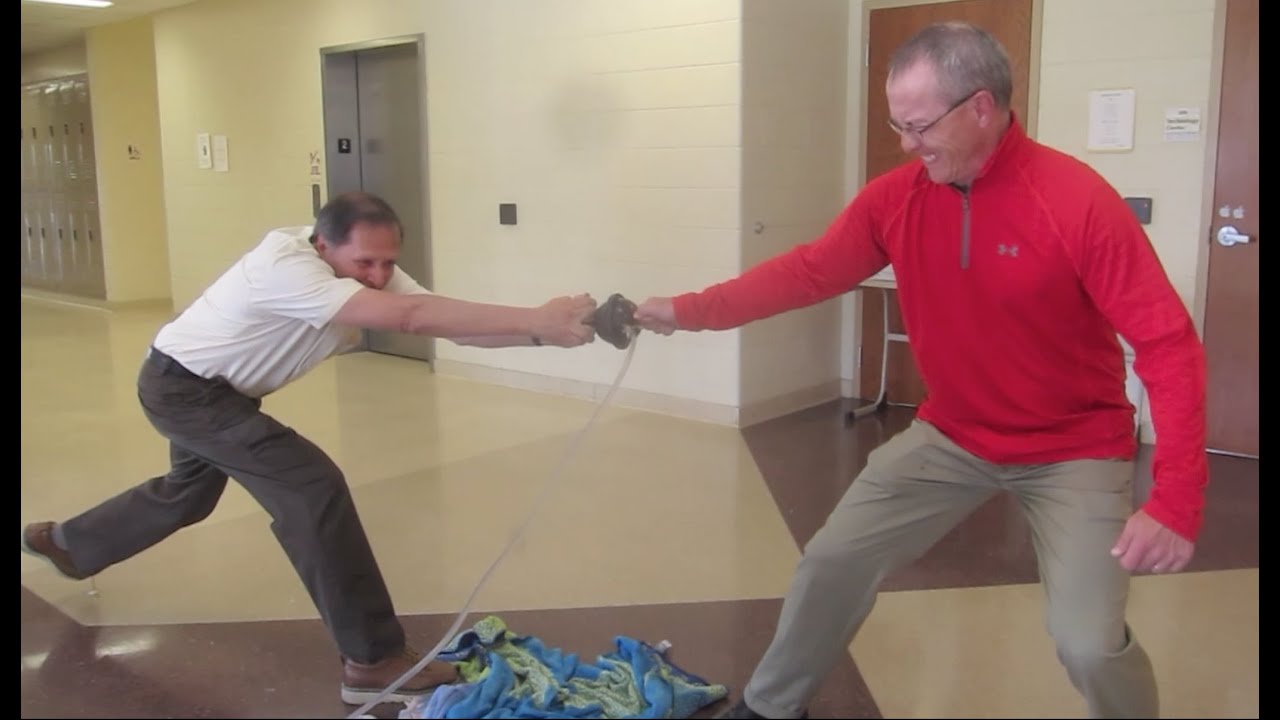
No vacuum pump needed: a long hose of water lowers the pressure inside the sphere so strong students cannot pull it apart.
Key ideas: atmospheric pressure, hydrostatic pressure, barometer, pressure and force, partial vacuum
Build it
Gather the equipment
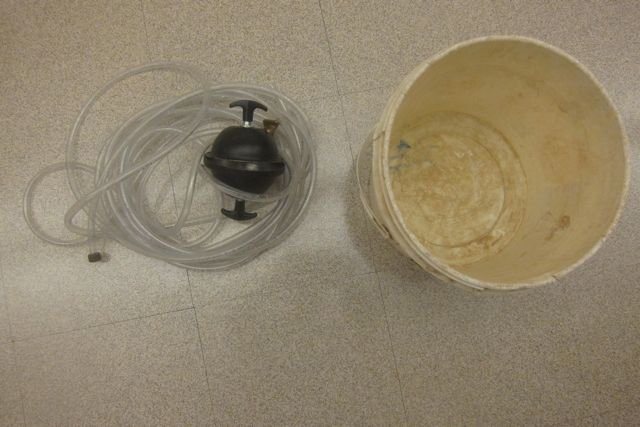
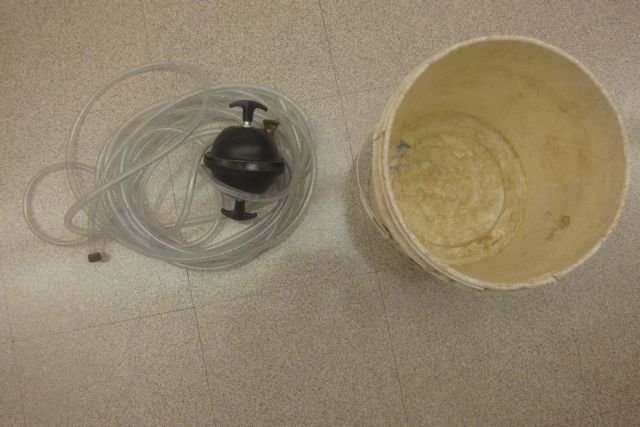
You need a set of Magdeburg hemispheres with a valve, about 38 feet of 3/8 in inside-diameter tubing, a bucket of water and a small weight. Pick a location where you can climb at least 15 to 17 feet above the floor, such as a stairwell with a railing.
Attach the hose
Push one end of the tubing onto the hemispheres' valve fitting. If your tubing is a different size, use a barb adapter and hose clamp to join them.
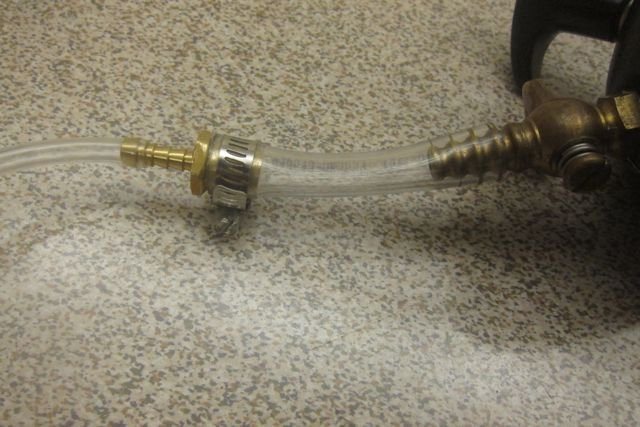
Fill the hemispheres with water
Hold the two halves together under water in the bucket so they fill completely, then close the valve. Keep holding them together until everything is ready.
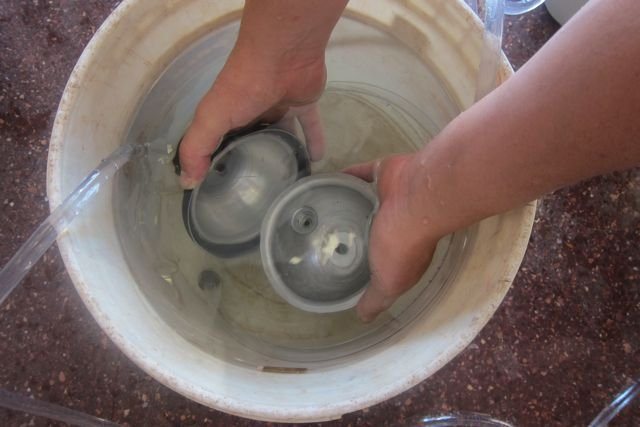
Fill the hose completely
Fill the whole hose with water so no air bubbles remain. Put its free end in the bucket with the small weight so it stays below the surface.
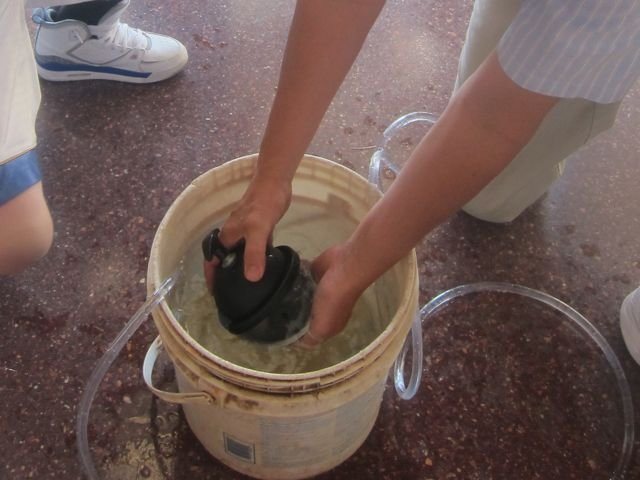
Carry the sphere up
Carry the water-filled sphere and the hose up as high as you can while a helper makes sure the bottom end never leaves the bucket. If it lifts out even briefly, an air bubble works up the tube and the water drains.
Open the valve
At the top, open the valve. The water in the hose is pulled down by gravity, but air cannot get in to replace it, so the pressure inside the sphere drops.
Try to pull it apart
Have volunteers grab the handles and pull. At about 17 feet up, the sphere is held together by roughly half the force of a full vacuum, more than strong students can usually manage.
Release the sphere
Bring the sphere back down near the bucket so the pressure inside rises again, and the halves will come apart easily. Do this over the bucket or towels to catch the water.
How it works
In the 1650s Otto von Guericke (1602-1686) of Magdeburg, Germany pumped the air out of two large metal hemispheres, and two teams of eight horses could not pull them apart. The air outside was pushing the halves together with nothing pushing back from inside.
The atmosphere presses with about 14.7 pounds per square inch. A column of water about 33.9 feet tall weighs the same per square inch, so every 2.3 feet of water corresponds to about 1 psi. When the water in the hose hangs below the sphere and cannot be replaced by air, it lowers the pressure inside by about 1 psi for every 2.3 feet of height.
With the sphere 17 feet above the bucket, the pressure inside drops by about 17 / 2.3 = 7.3 psi, about half an atmosphere. How hard the halves are to pull apart depends on the sphere's size: a 4 inch sphere (about 12.6 square inches across its middle) takes about 185 pounds with a full vacuum and about 93 pounds at 17 feet. Going higher than about 34 feet would not help, because the water column would break and leave an empty space at the top of the hose, just like the top of a water barometer.
Using it
- Before climbing, have students calculate the expected pressure drop from the height and estimate the pulling force using the sphere's cross-section area.
- Ask why the bottom end of the hose must stay under water.
- Compare this method with a vacuum pump. Which removes more air, and how could you get closer to a full vacuum?
- Connect it to a mercury or water barometer and to why a suction pump cannot lift water more than about 34 feet.
- Try different heights and see at what point the strongest volunteer can pull the sphere apart.
Variations
- Smaller hose: Bruce also tried 1/4 in outside-diameter aquarium tubing joined to the valve with an adapter and hose clamp. At 16 feet strong students pulled the sphere apart, but at about 30 feet they could not. He prefers the 3/8 in hose.
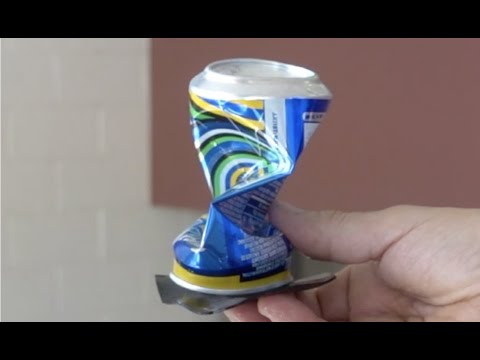
- Use the same setup to crush cans or plastic bottles instead of holding hemispheres.
- Replace the hemispheres with a vacuum gauge and watch the reading change as you climb the stairs.
Troubleshooting
More build plans
Air-Powered String Shooter
A loop of yarn shoots out of a PVC pipe and snakes through the air in a self-supporting arc, driven by nothing but a shop vac's exhaust.
Balloon in a Bottle
Blow up a balloon inside a bottle and it stays inflated with its mouth wide open.
Cartesian Diver Collection
Squeeze a sealed bottle and a little diver sinks on command; let go and it floats back up.
© Bruce Yeany · Homemade Science with Bruce Yeany · youtube.com/@YeanyScience
Free for personal and classroom use. Please don't resell or republish. Build and use at your own risk; follow the safety notes and supervise children.