Build plans / Pascal Bottle
Pascal Bottle
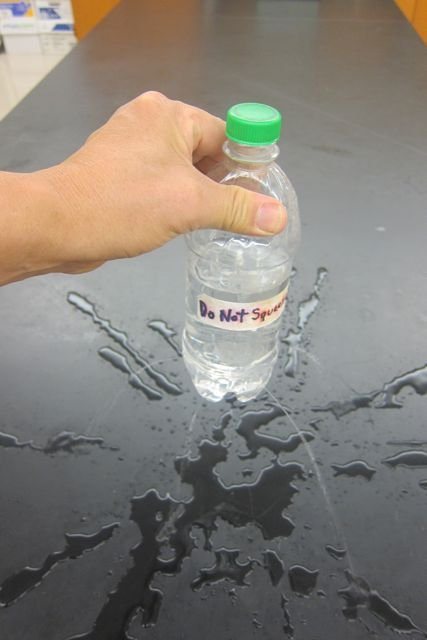
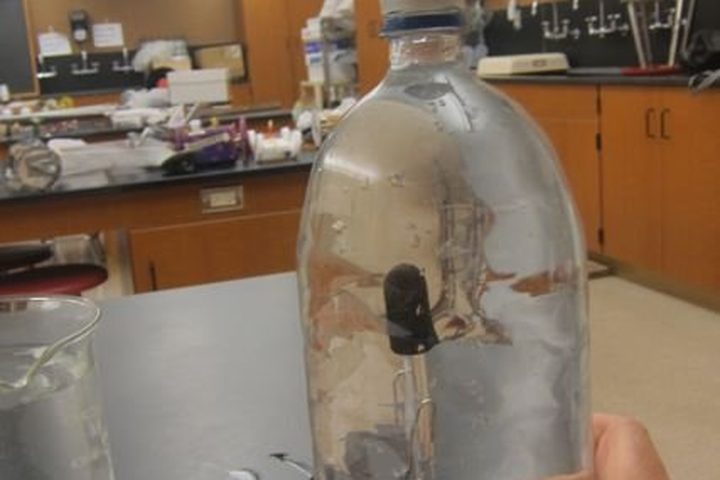
A 20 ounce bottle with five small, evenly sized holes drilled around its lower sides squirts five matching streams when it is squeezed, no matter where you squeeze or how you hold it. It shows Pascal's principle as clearly as a commercial version that costs around $60, and it costs nothing.
Written from Bruce's original workshop handout. Bruce's final review of this plan is in progress.
What it shows
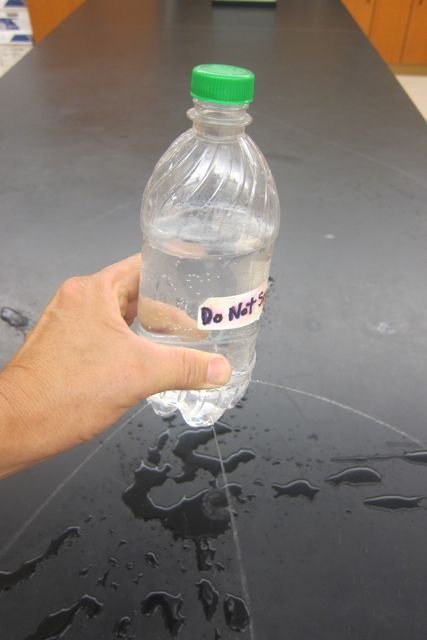
Label a water bottle 'Do Not Squeeze!' and wait for someone curious to find out why.
Key ideas: Pascal's principle, fluid pressure, pressure in all directions
Build it
Mark the holes
Mark five spots spaced evenly around the lower sides of the 20 ounce bottle, all at the same height near the base.
Drill the holes
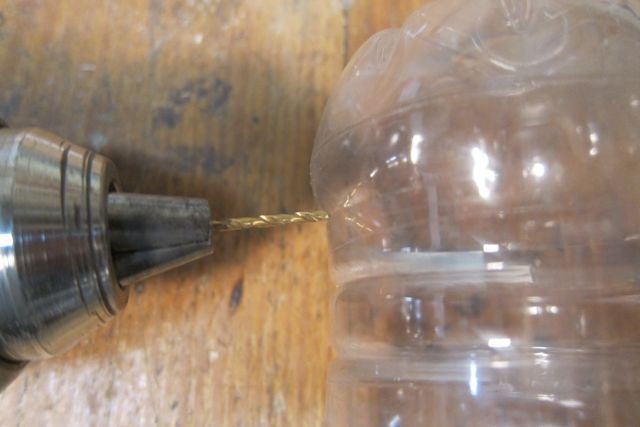
Drill a small hole at each mark, all with the same bit. A drill makes neat, uniform holes with clean edges, which gives matching streams.
Or poke them
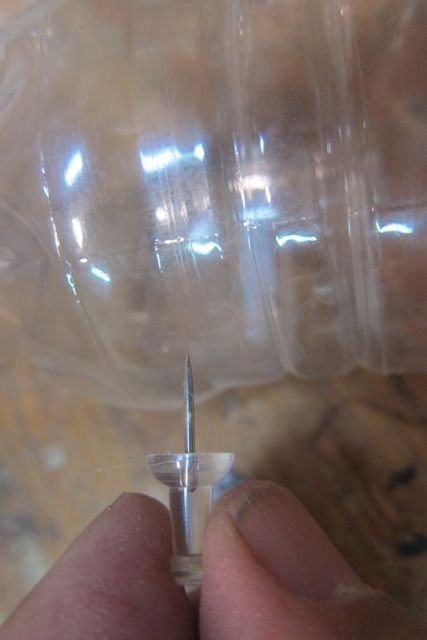
No drill? A push pin, ice pick or small nail also works, though the holes are not as neat. Use the same tool for every hole so they match.
Make a drip tray
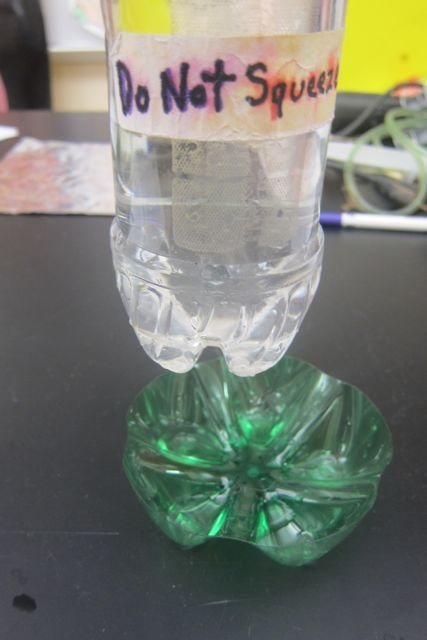
Cut the bottom off a 2 liter bottle. The 20 ounce bottle sits neatly in the grooves of its base, and the tray catches stray drips.
Fill and label it
Fill the bottle with water and screw on the cap. Add a label reading 'Do Not Squeeze!' and set it out on the tray.
Squeeze it
Squeeze the bottle and five even streams shoot out in every direction. Try squeezing near the top, the middle and the bottom.
Turn it sideways
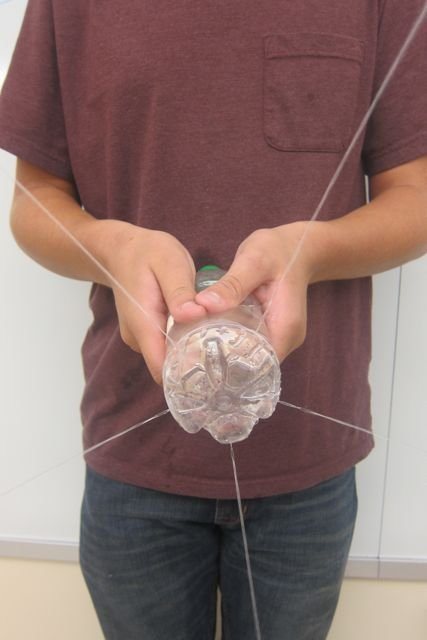
Hold the bottle on its side and squeeze again. The streams are still even, showing that the pressure rise is the same everywhere in the bottle.
How it works
Pascal's principle says that when pressure is applied to a fluid in a closed container, the increase is felt equally throughout the fluid. Squeezing the bottle raises the pressure of all the water inside by the same amount.
Since every hole is the same size and sits at the same depth, each one feels the same pressure, so the streams are the same size and travel the same distance. It does not matter where you squeeze or which way the bottle points.
Squeezing a toothpaste tube is the same idea: pressure on the outside is passed through the paste, and with the cap off the paste flows out to equalize the pressure.
Using it
- Leave the labeled bottle out before the pressure lesson and let curiosity do the rest.
- Ask: does it matter where you squeeze, top, middle or bottom? Have students predict and explain before trying it.
- Ask what would change if one hole were bigger, or one were higher up the side.
- Follow up with Cartesian divers, Diving Dan and hydraulic syringe pairs.
Variations
- Add more holes wherever you like; the commercial version has 10.
- Drill holes at different heights and compare the streams with the cap off (depth pressure) and with the bottle squeezed (applied pressure).
Troubleshooting
More build plans
Air-Powered String Shooter
A loop of yarn shoots out of a PVC pipe and snakes through the air in a self-supporting arc, driven by nothing but a shop vac's exhaust.
Balloon in a Bottle
Blow up a balloon inside a bottle and it stays inflated with its mouth wide open.
Cartesian Diver Collection
Squeeze a sealed bottle and a little diver sinks on command; let go and it floats back up.
© Bruce Yeany · Homemade Science with Bruce Yeany · youtube.com/@YeanyScience
Free for personal and classroom use. Please don't resell or republish. Build and use at your own risk; follow the safety notes and supervise children.