Build plans / Classroom Pulley System (Small-Load Version)
Classroom Pulley System (Small-Load Version)
A pair of hardware-store pulleys and some rope turn into a hands-on lesson on mechanical advantage. This is a small-load version of Bruce's classroom pulley set-up, using a bucket of sand and a spring scale so students can measure force and distance at each step.
Written from Bruce's original workshop handout. Bruce's final review of this plan is in progress.
What it shows
Lift the same bucket of sand with one pulley, then two, three and four, and feel the pull get easier while you measure exactly what it costs you in rope.
Key ideas: mechanical advantage, pulleys, work, force and distance
Build it
Install the anchor
An adult fastens a heavy-duty screw eye into a solid wooden beam or a structural support, or ties a strong strap around a ceiling joist or sturdy frame. Hang one pulley from it on its locking hook.
Weigh the load
Hang the bucket from the spring scale and record its weight. This is the force you would need to lift it straight up.
Single fixed pulley
Tie the rope to the bucket and run it up over the fixed pulley. Pull down with the spring scale and record the force. Then pull until the bucket rises 20 cm, and measure how much rope passed through your hands.
Mechanical advantage of 2
Hang the second pulley from the bucket. Tie the rope to the anchor, run it down around the bucket's pulley and back up over the fixed pulley. Measure the force and the rope pulled for a 20 cm lift.
Mechanical advantage of 3
Tie the rope to the bucket's pulley instead, run it up over the fixed pulley, down around the moving pulley and back up. Count the rope strands holding up the bucket; there should be three. Measure again.
Mechanical advantage of 4 and up
Swap in double pulleys to get four supporting strands (and more, if you have the rope). Each time, record the force, the lift and the rope pulled.
Compare the numbers
Make a table of strands, force and rope pulled. The force should drop roughly in proportion to the number of strands, while the length of rope pulled rises by the same factor.
How it works
A single fixed pulley only changes direction: you pull down to lift up, but the force and distance are the same as lifting by hand.
When a pulley moves with the load, the load hangs from several strands of rope, and each strand carries a share of the weight. With three strands holding the bucket, you only need to pull with about a third of the force.
There is no free lunch. To raise the bucket 20 cm with three supporting strands, each strand must shorten by 20 cm, so you pull 60 cm of rope. Force times distance, the work you do, stays about the same; friction in the pulleys makes it a bit more in practice.
Mechanical advantage is the ratio of the load to the effort force, and for an ideal pulley system it equals the number of strands supporting the moving pulley.
Using it
- Let students feel each setup before measuring, then predict the next force reading.
- Calculate the work in and work out for each setup and find the efficiency; where does the missing energy go?
- Ask: why do cranes, sailboats and tow trucks use block-and-tackle?
- Challenge teams to rig a given mechanical advantage using a set number of pulleys.
Variations
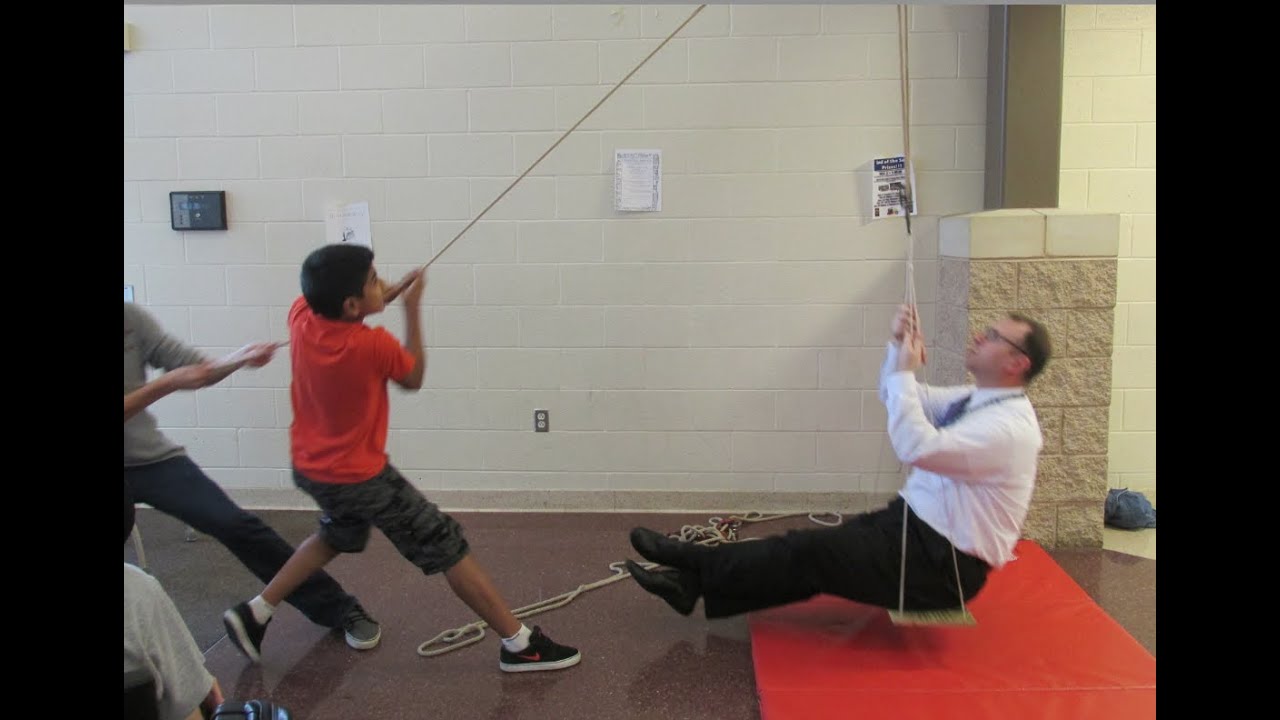
- Bruce's full-size classroom version hangs from a roof beam and uses a board seat so students feel mechanical advantage up to 6. That version involves lifting people and is not covered by this plan.
- For a tabletop version, use small pulleys, string and a can of coins hung from a sturdy crossbar.
Troubleshooting
More build plans
Cardboard Rubber Band Car
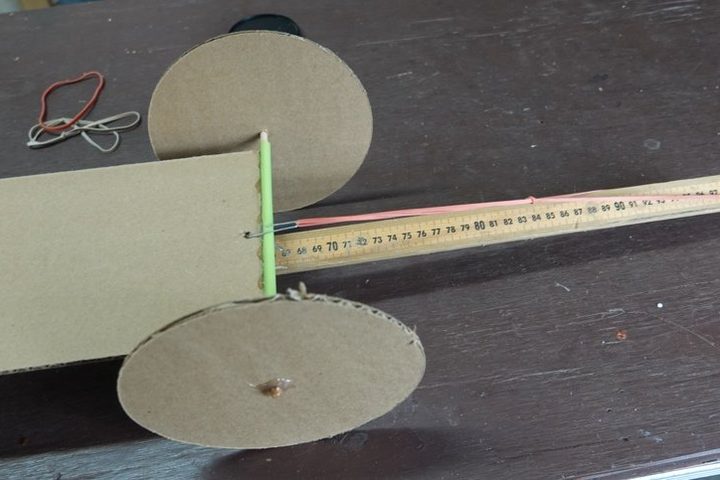
A shipping box, a few straws and a rubber band become a car that can roll more than 20 feet, and with giant wheels, more than 100.
Toy Dissection Lab and Display
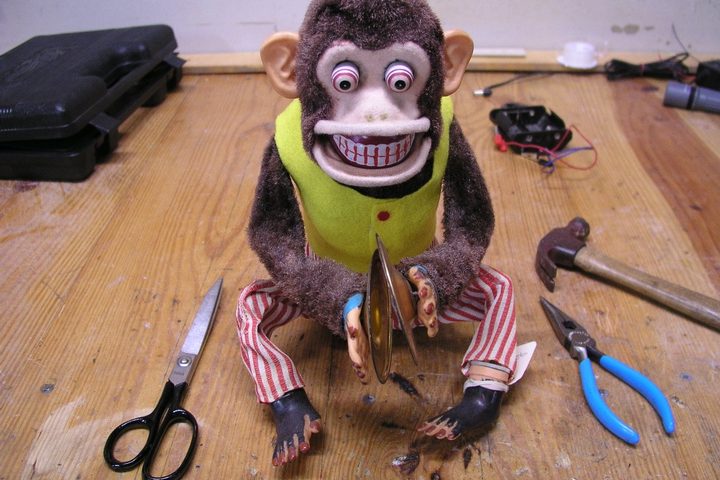
Take apart a broken toy to find the gears, levers and cams hiding inside, then put it back together as a see-through display.

Homemade Gears
With a compass, a ruler and a little arithmetic you can make working gears from cardboard or wood and see exactly how they trade speed for force.
© Bruce Yeany · Homemade Science with Bruce Yeany · youtube.com/@YeanyScience
Free for personal and classroom use. Please don't resell or republish. Build and use at your own risk; follow the safety notes and supervise children.