Build plans / Tin Can Telephone
Tin Can Telephone
Two large metal cans joined by a taut string carry a voice 100 feet or more. Talking into one can makes its bottom vibrate, the string carries those vibrations, and the far can turns them back into sound. It is an old project that still amazes students, and a good way to experiment with how sound travels through solids.
Written from Bruce's original workshop handout. Bruce's final review of this plan is in progress.

What it shows
No batteries, no bills, no signal bars: just two cans, a long string and vibrations.
Key ideas: sound, vibration, longitudinal waves, sound in solids

Build it
Prepare the cans
Wash and dry two one-gallon cans. Check the open rims for sharp edges and cover any rough spots with tape.
Punch the holes
An adult punches a small hole in the center of each can's bottom with a hammer and nail. The hole only needs to be big enough for the string.
Thread the first can
Push one end of the string through the bottom of the first can from the outside and tie a large knot on the inside so it cannot pull back through.
Thread the second can
Push the other end through the bottom of the second can from the outside and knot it on the inside.
Stretch it tight
Two people walk apart until the string is straight and taut. It must not touch anything or sag.
Talk and listen
One person talks into a can while the other holds the second can to an ear. Switch roles.
Experiment
Try different sizes of cans, plastic cups and other containers, different kinds of string, and different amounts of tension. Each type of container has its own best tension.
How it works
When you talk into the can, the sound waves in the air make the bottom of the can vibrate back and forth. Because the string is tied to the bottom, it is pulled back and forth too, in vibrations far too small to see.
Those vibrations travel along the tight string to the other can and make its bottom vibrate in the same pattern. The second can bottom pushes on the air inside, which carries the sound to the listener's ear.
The string has to be tight to pass the vibrations along. A slack string, or one touching a fence or a person, absorbs the vibrations and the sound dies out. Sound often travels better through solids like a taut string than through the open air over the same distance.
Using it
- Before explaining, ask students to figure out how it works. What is vibrating at each step?
- Ask what kind of wave travels along the string, and how the string moves.
- Pinch the string partway along while someone talks. What happens, and why?
- Compare cans, cups and other containers, and different strings, in a fair test.
- Try a party line: tie a third can's string onto the middle of the main line.
Variations
- Plastic or paper cups make a quick, safe version for younger children.
- Compare string telephones with open sound tubes made from hose or pipe.
Troubleshooting
More build plans
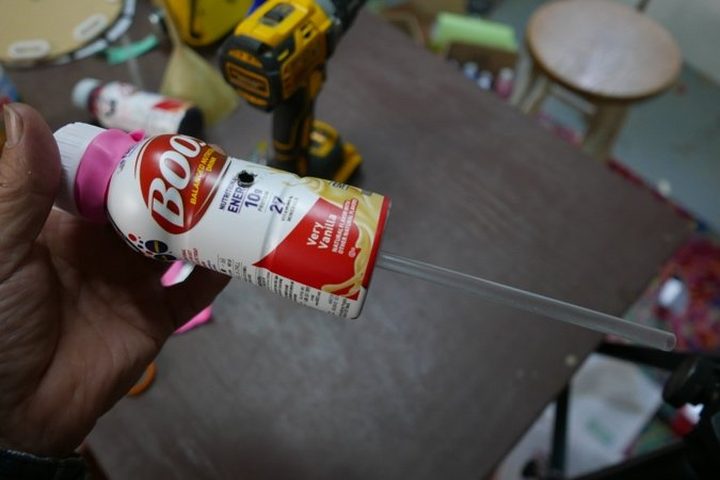
Balloon Fog Horn
Blow into a little plastic bottle and it lets out a deep, buzzing honk like a ship in the fog.
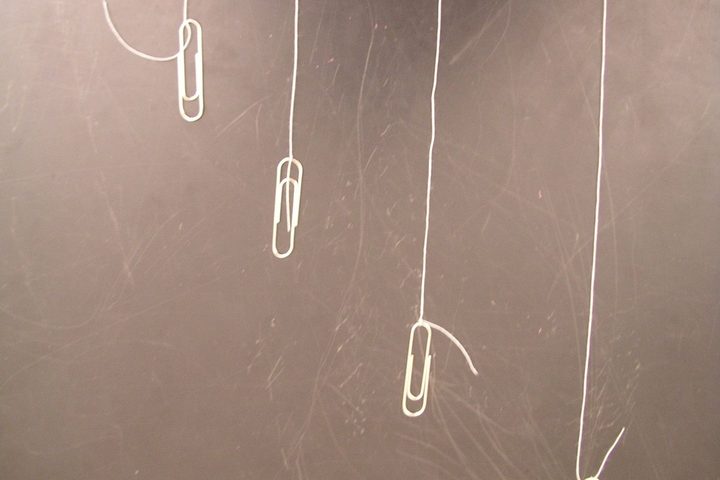
F.A.K.E.D. Resonance Pendulums
Ask the class to move just the orange ball with their minds, and watch it swing while the other three hang nearly still.
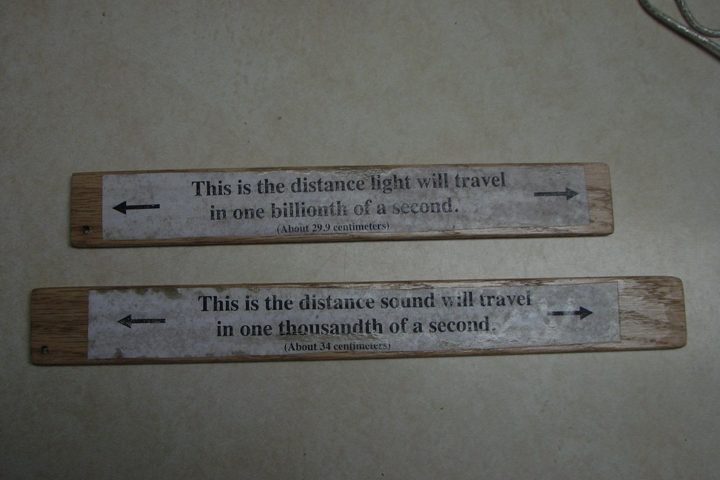
Nanosecond of Light and Millisecond of Sound Sticks
Two sticks of almost the same length: one shows a billionth of a second of light, the other a thousandth of a second of sound.
© Bruce Yeany · Homemade Science with Bruce Yeany · youtube.com/@YeanyScience
Free for personal and classroom use. Please don't resell or republish. Build and use at your own risk; follow the safety notes and supervise children.