Build plans / Water Lens Word Flip
Water Lens Word Flip
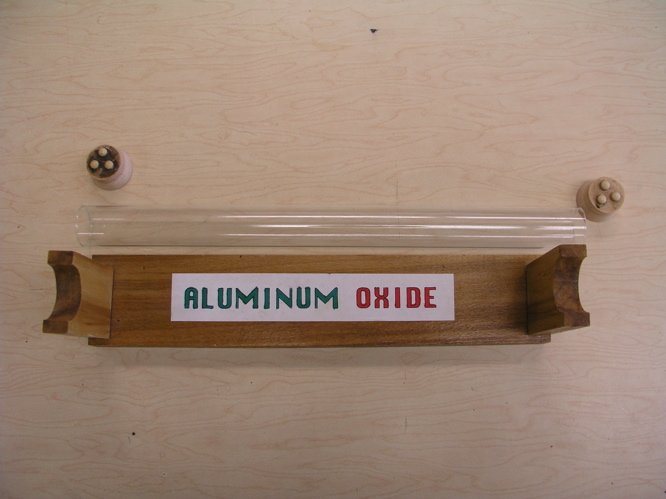
A clear plastic tube rests in a wooden cradle above a printed label reading ALUMINUM OXIDE. Empty, the tube changes nothing; filled with water, it becomes a cylindrical lens that flips both words top to bottom, but only one of them looks different. It is a quick, memorable discrepant event for any unit on lenses and images.
Written from Bruce's original workshop handout. Bruce's final review of this plan is in progress.
What it shows
Fill a clear tube with water and one word on the sign turns upside down while the word next to it stays perfectly readable.
Key ideas: converging lenses, inverted real images, refraction, symmetry
Build it
Choose the tube
Pick a clear plastic tube with smooth, undistorted walls and stoppers that fit both ends snugly. A clear 2-liter soda bottle with its cap is a no-build alternative for a first try.
Cut the base and cradles
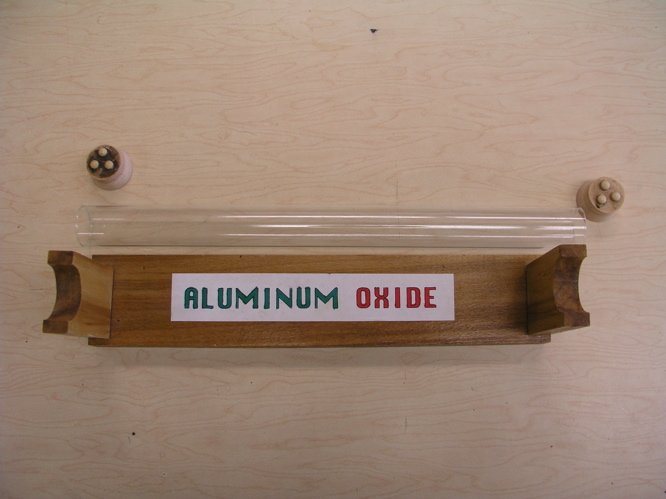
Cut a base board a little longer than the tube. Cut two end blocks and give each a curved notch so the tube rests securely across them.
Set the height
Fasten the end blocks to the base with glue or screws. Bruce's cradles hold the tube about 3 inches above the label; if your tube has a different diameter, adjust the block height so the words appear sharply flipped when viewed from normal standing distance.
Print the label
Print the words ALUMINUM OXIDE in large block capitals, with ALUMINUM in green and OXIDE in red. The two colors are a deliberate red herring.
Mount the label
Glue the label to the base board, centered under where the tube will lie, with the words running along the length of the tube.
Test it empty
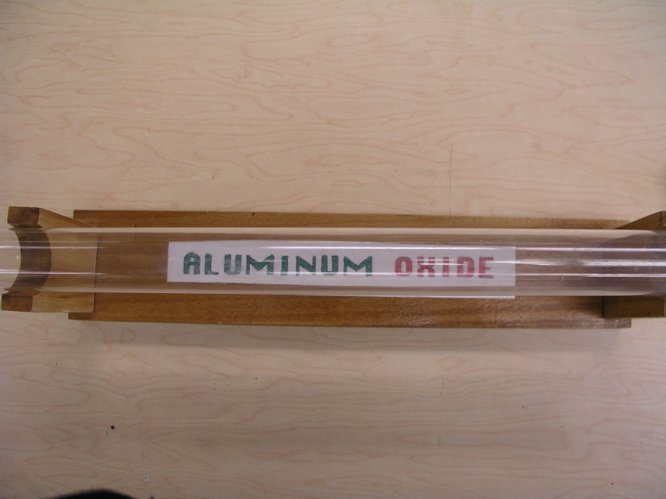
Lay the empty, capped tube in the cradle and look down through it. Both words should read normally; an empty tube does not bend the light much.
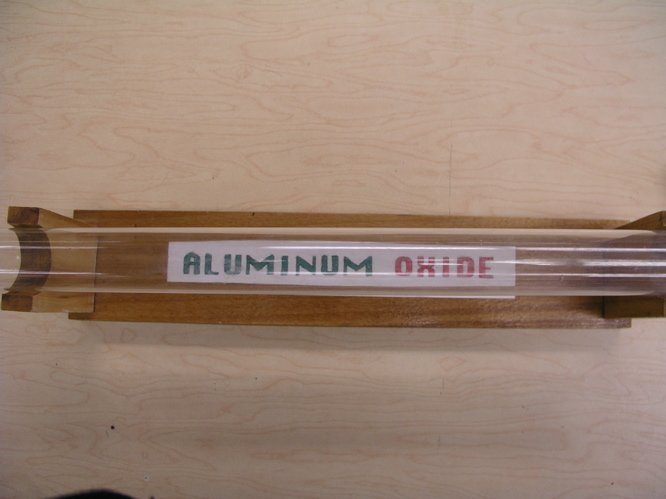
Fill the tube
Stopper one end and fill the tube with water at a sink. Top it off until the water bulges slightly at the open end, then push in the second stopper so no air bubble is trapped. It takes a little practice.
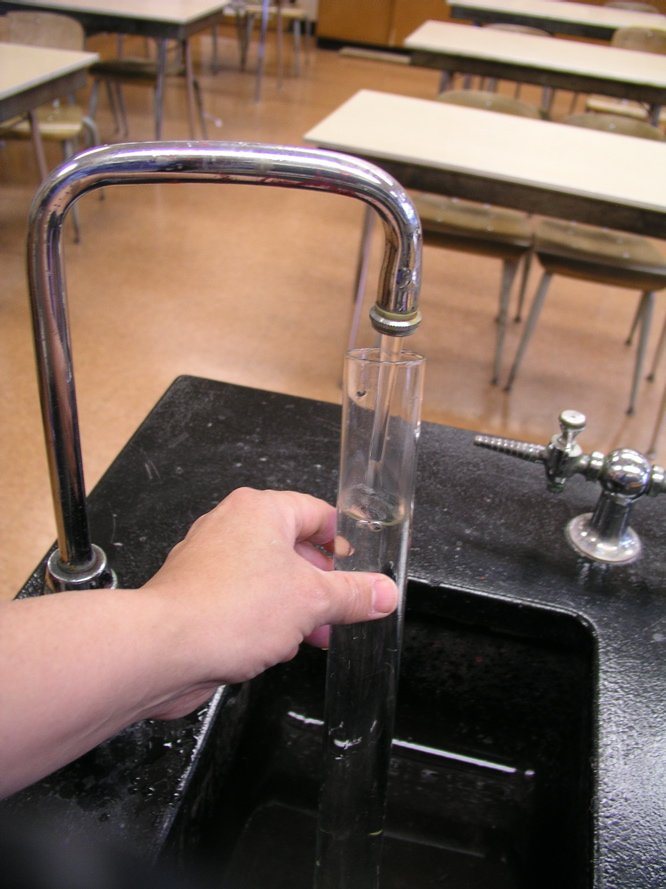
Run the demonstration
Set the filled tube back in the cradle. ALUMINUM now appears upside down while OXIDE still looks right side up. Let viewers guess why before explaining.
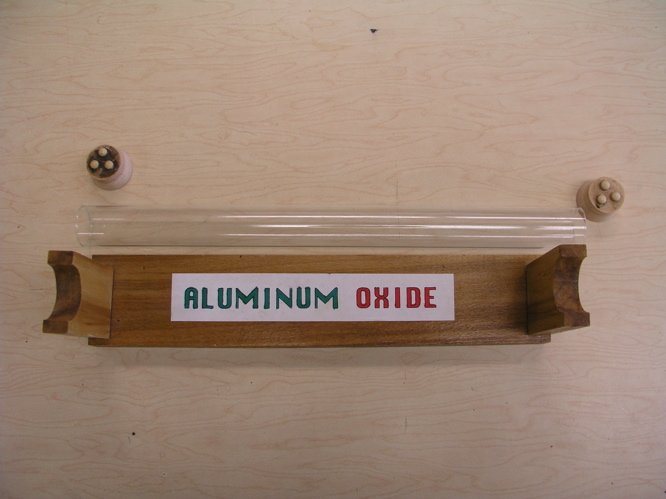
How it works
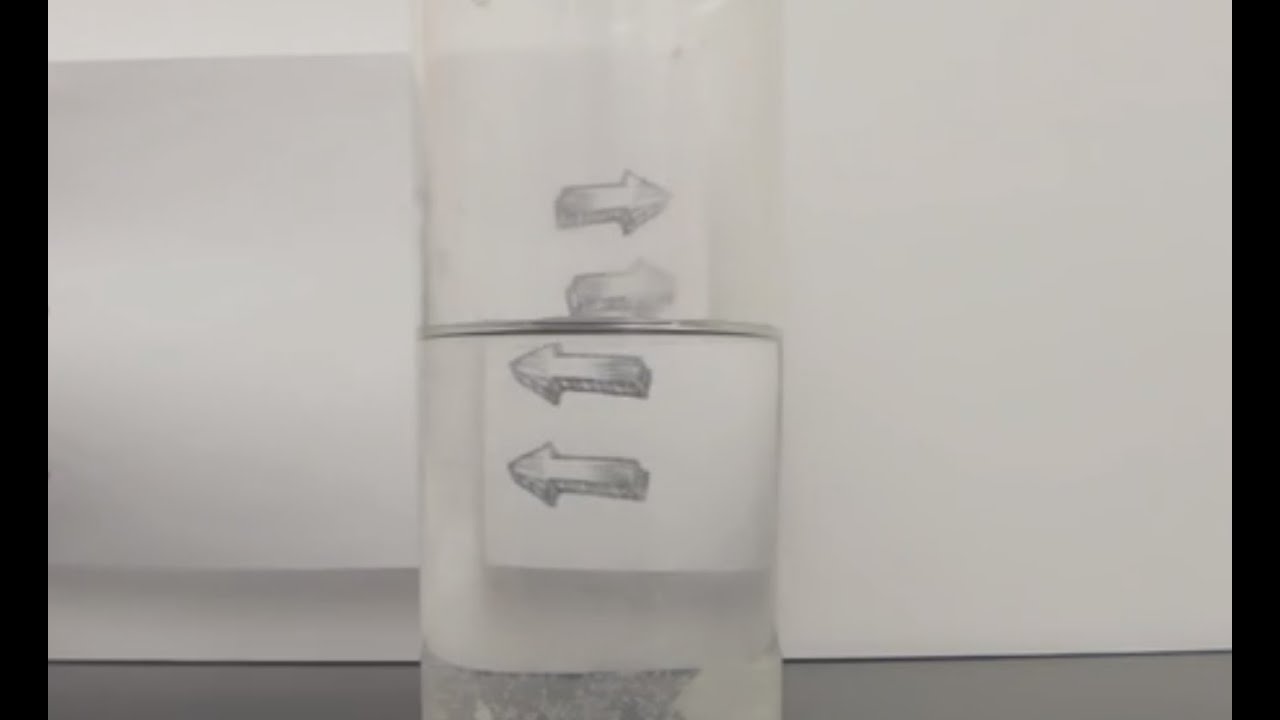
A tube full of water is a cylindrical converging lens. Light passing through it is bent toward the center of the tube, but only in the direction across the tube, not along it.
When the label sits farther from the tube than the lens's focal length and you look from a distance, you see a real, inverted image. Because the tube only focuses across its width, the image is flipped top to bottom, not left to right.
Both words are flipped. ALUMINUM looks wrong because letters such as A, L, U, M and N do not look the same upside down. Every letter in OXIDE is symmetric top to bottom, so its flipped image looks exactly like the original. The color of the ink has nothing to do with it.
The empty tube has thin walls with nearly parallel surfaces, so it barely bends the light, and the words pass through unchanged.
Using it
- Show the empty tube first, then fill it in front of the class. Ask: Why did one word flip and the other didn't? Does the color matter?
- Have students test the color idea by writing OXIDE in green and ALUMINUM in red.
- Challenge students to invent other words that survive the flip, using only top-to-bottom symmetric letters (B, C, D, E, H, I, K, O, X), such as CHECKBOOK or DECODE.
- Raise and lower the tube, or move your eye closer, to find where the image switches from upright to inverted. That point relates to the focal length.
- Compare the tube with a glass marble or a round flask, which focus in both directions and so flip the image both top to bottom and left to right.
Variations
- Instead of a glass or plastic tube, Bruce notes that a clear 2-liter soda bottle filled with water and capped works too.
- Make several labels with different word pairs and let students predict which words will appear to flip.
Troubleshooting
More build plans

Adjustable Angle Mirrors
Close the angle between two mirrors and one line on a card becomes three, five, seven, even eleven copies.

Classroom Wall Mirrors
Three mirrors on the wall, three different versions of you: magnified, shrunk, and repeated twenty-one times.
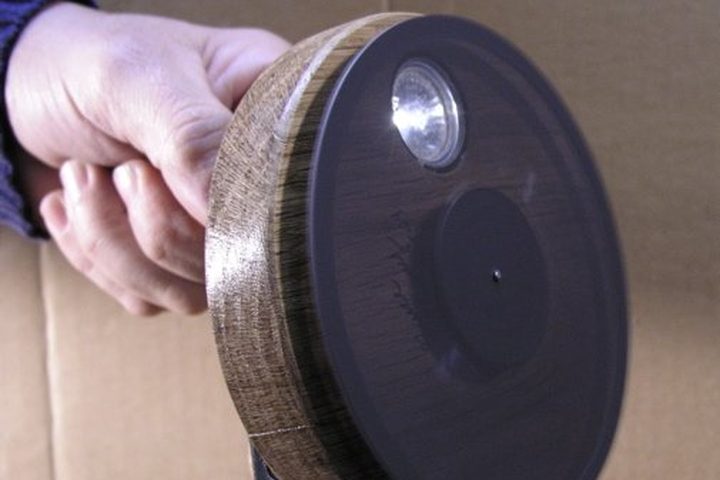
Hand-Held Strobe Light
A flashlight shining through a spinning slotted disk can freeze a dripping faucet, a vibrating string or a bouncing ball in mid-air.
© Bruce Yeany · Homemade Science with Bruce Yeany · youtube.com/@YeanyScience
Free for personal and classroom use. Please don't resell or republish. Build and use at your own risk; follow the safety notes and supervise children.