Build plans / Slinky Wilberforce Pendulum
Slinky Wilberforce Pendulum
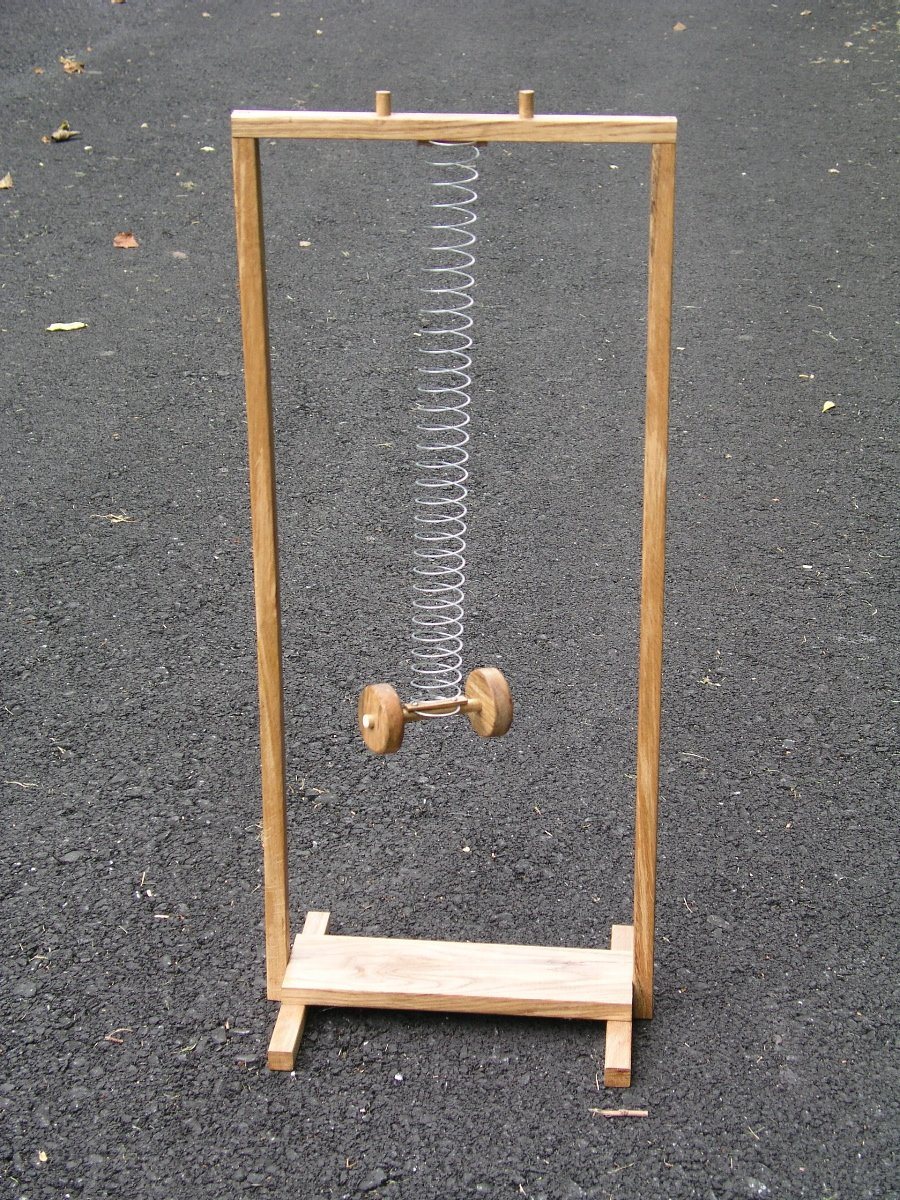
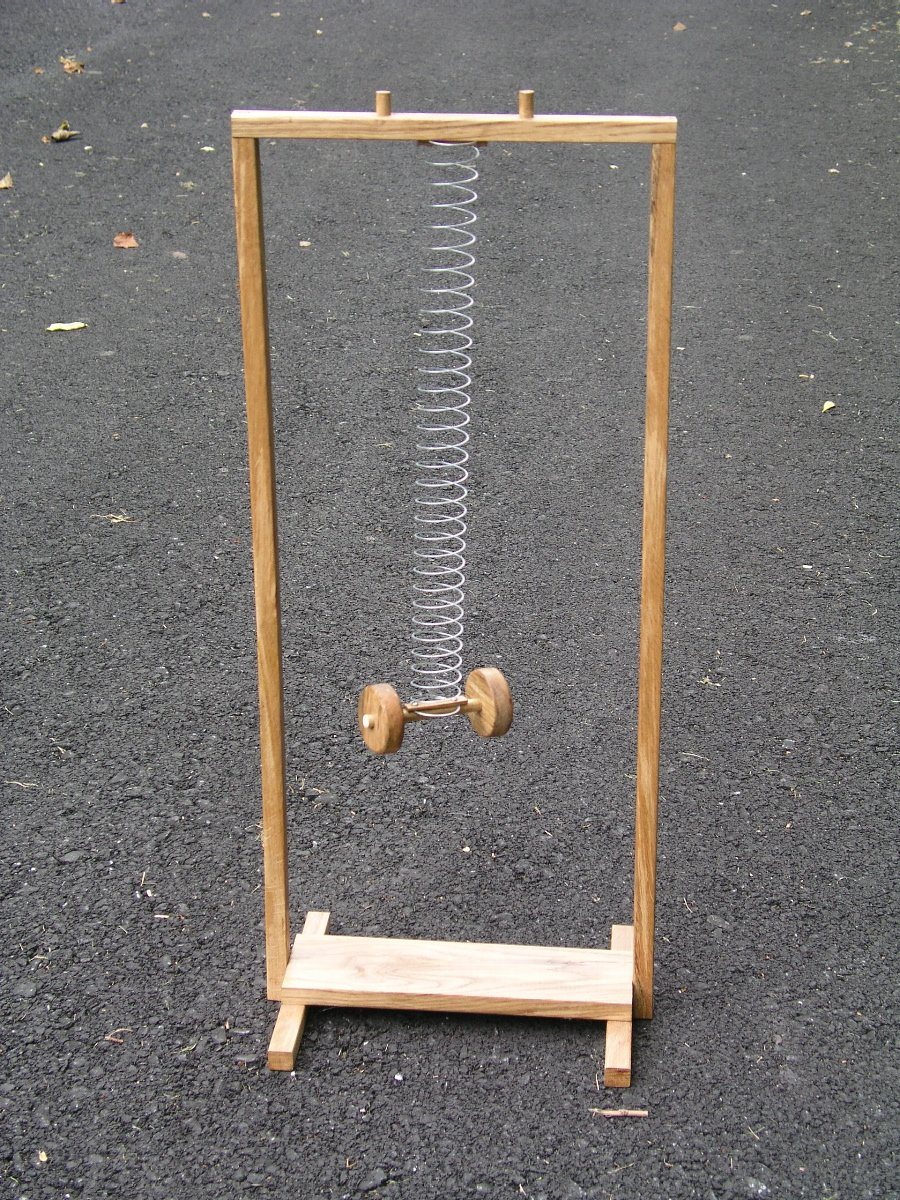
Half a Slinky hangs from a wooden frame with a dowel and two sliding wooden wheels as the bob. Once it is tuned, the energy trades back and forth between bouncing and twisting several times before the pendulum stops. It is a striking, nearly silent demonstration of resonance and coupled oscillations, and a quick tape-and-clay version can be made in minutes.
Written from Bruce's original workshop handout. Bruce's final review of this plan is in progress.
What it shows
Pull it down and let go: within a few bounces the up-and-down motion turns completely into twisting, then back again.
Key ideas: resonance, coupled oscillators, energy transfer, simple harmonic motion, moment of inertia
A version of this device appears in If You Build It, They Will Learn (NSTA Press).
About the bookBuild it
Build the frame
Make a tall rectangular frame from two uprights, a top beam and a base with feet. Size it to the spring: it must be tall enough for the spring and bob to bounce freely without hitting the base.
Add storage pegs
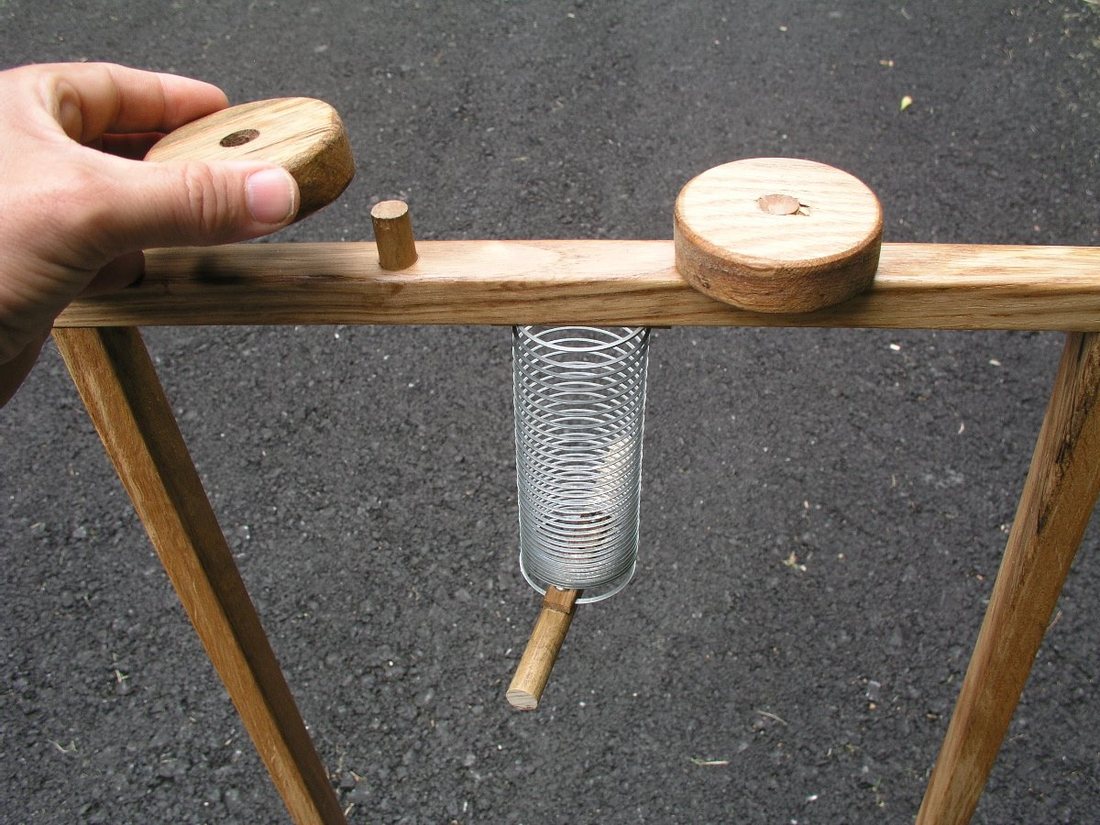
Glue two short dowel pegs into the top of the beam. The wooden wheels drop onto these when the pendulum is not in use.
Cut the spring
Cut the Slinky roughly in half. You will adjust the working length later.
Attach the spring to the beam
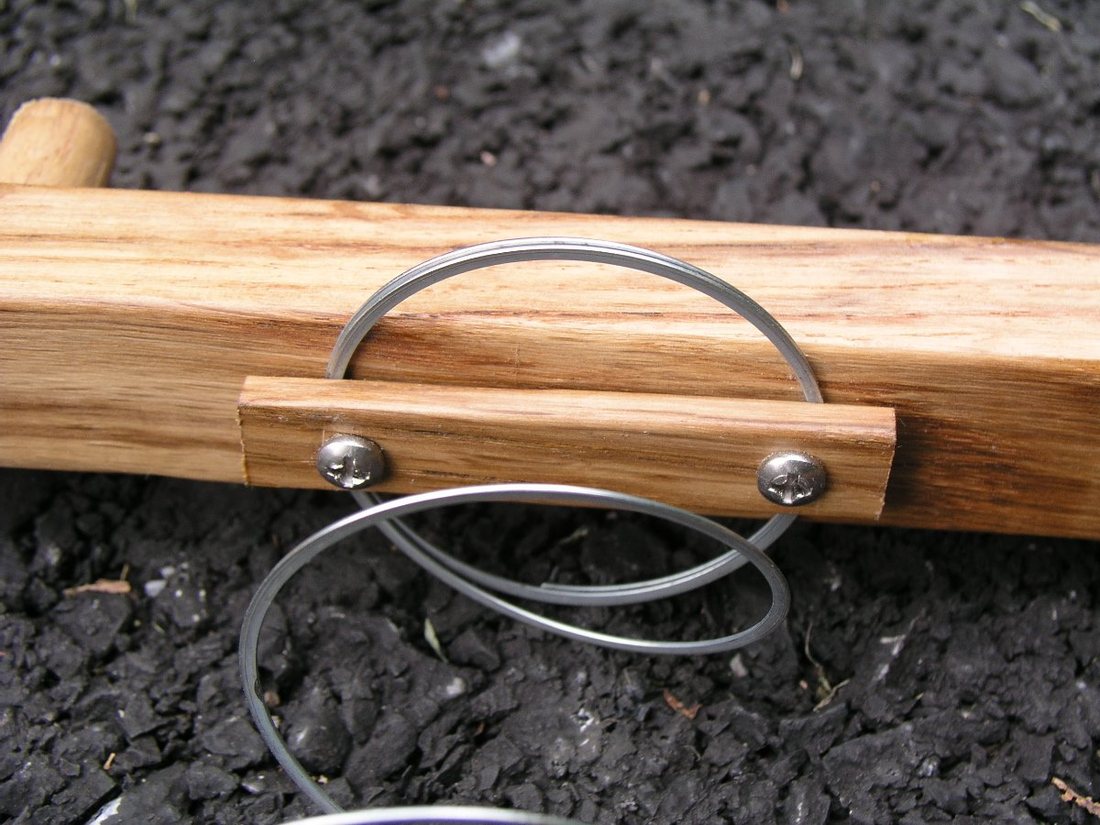
Lay a few coils of the top of the spring against the underside of the beam and clamp them with a wood strip and two screws. How many coils you gather under the strip sets the hanging length.
Attach the dowel
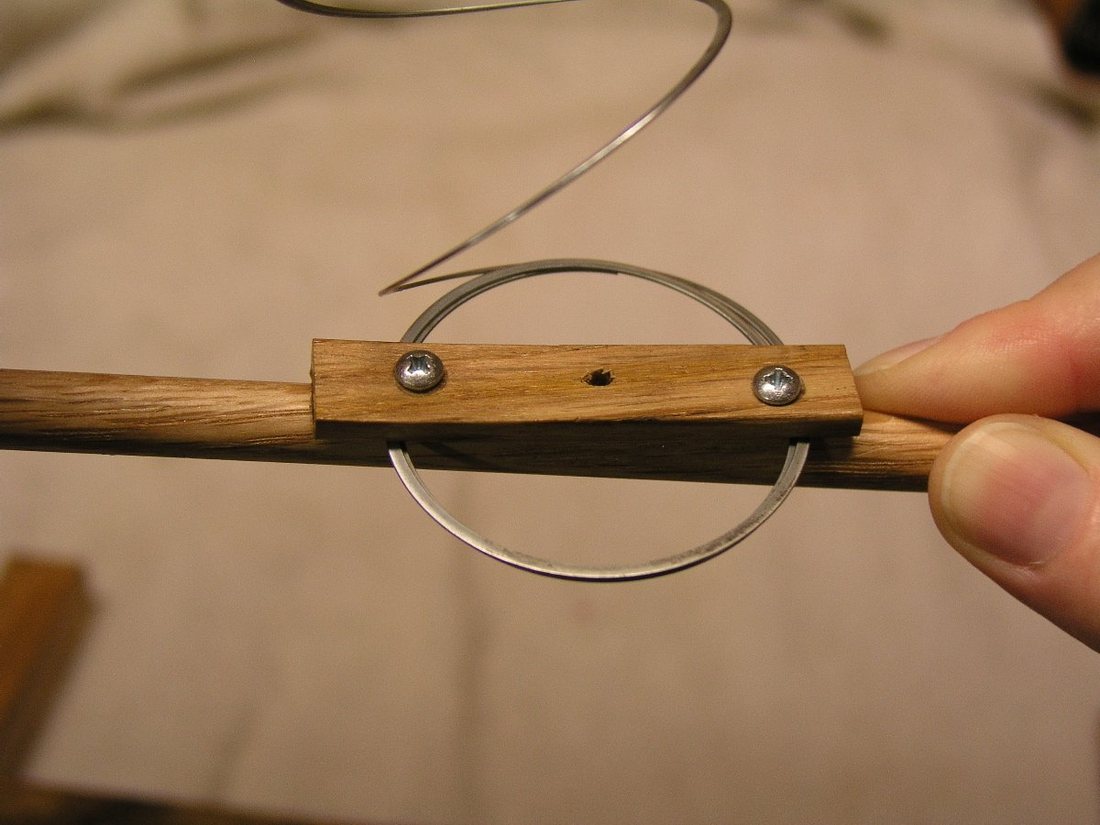
Fasten the bottom coils of the spring to the middle of the 10 in dowel the same way, with a wood strip and two screws (or tape the dowel across the bottom four coils).
Prepare the wheels
Drill a hole through the center of each wheel or block so it slides along the dowel with a little friction, then slide one onto each end.
Set the length
Hang the bob and adjust how much spring is clamped at the top until the bouncing motion fits comfortably inside the frame.
Tune it
Start with both wheels close to the spring. Pull the bob down a short way and release. Move the wheels outward in small, equal steps and test again until the bouncing changes completely into twisting and back.
Level the dowel
Check that the dowel hangs level. If it tilts, move one wheel slightly closer to the center than the other.
How it works
A weight on a spring can oscillate in two ways: bouncing up and down, and twisting back and forth. Each motion has its own natural frequency. Bouncing depends on the mass and the spring's stiffness; twisting depends on how spread out the mass is (its moment of inertia) and the spring's resistance to twisting.
A coil spring links the two motions: when it stretches it also untwists slightly, and when it twists it changes length slightly. So each bounce gives the twisting motion a tiny push.
When the two natural frequencies match, those tiny pushes always arrive at the right moment and add up, just like pushing a swing. The energy flows completely into twisting, then back into bouncing, again and again. Sliding the wheels outward increases the moment of inertia and slows the twisting until it matches the bounce. That is the tuning.
Using it
- Ask the class to predict what will happen after release, then watch for the moment the bouncing stops and the twisting takes over.
- Count how many bounces it takes to change over (typically 6-10), and how many times it switches back and forth before it stops.
- Mistune it on purpose by moving the wheels in or out. The transfer becomes partial and messy, which shows why the frequencies must match.
- Start it twisting instead of bouncing and see whether the energy flows the other way.
- Link it to other resonance examples: coupled pendulums, a child on a swing, a wine glass and a singer's note.
Variations
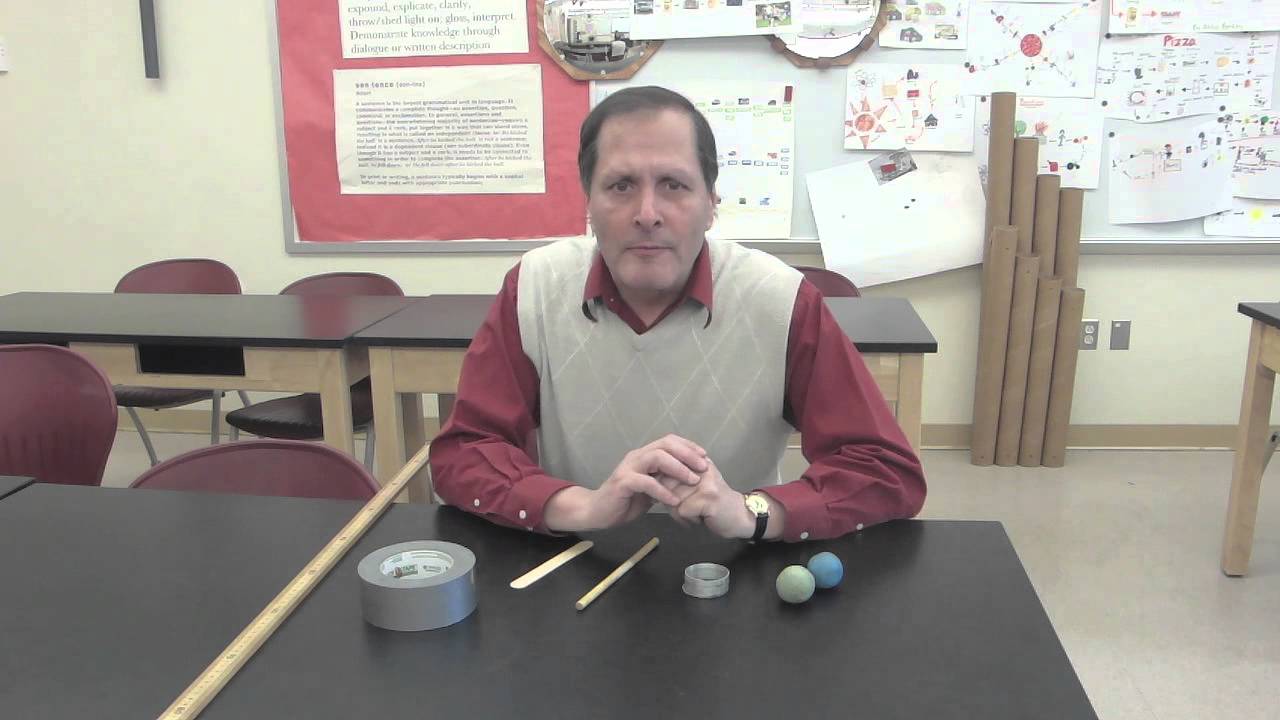
- Quick version: duct-tape a dowel to one end of a short piece of Slinky and a tongue depressor to the other, tape the tongue depressor to a meterstick, and hang the meterstick between two desks. Lumps of clay on the dowel ends replace the wooden wheels and are squeezed in or out to tune it.
- A larger version using a full-size Slinky and heavier blocks.
Troubleshooting
More build plans
Balloon Fog Horn
Blow into a little plastic bottle and it lets out a deep, buzzing honk like a ship in the fog.
F.A.K.E.D. Resonance Pendulums
Ask the class to move just the orange ball with their minds, and watch it swing while the other three hang nearly still.
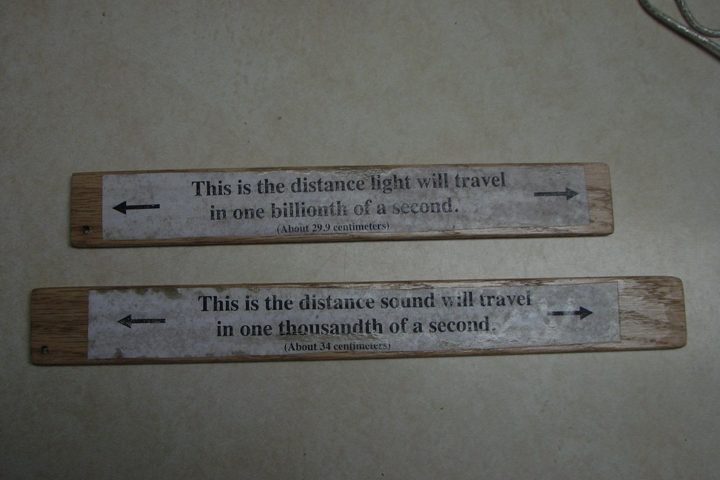
Nanosecond of Light and Millisecond of Sound Sticks
Two sticks of almost the same length: one shows a billionth of a second of light, the other a thousandth of a second of sound.
© Bruce Yeany · Homemade Science with Bruce Yeany · youtube.com/@YeanyScience
Free for personal and classroom use. Please don't resell or republish. Build and use at your own risk; follow the safety notes and supervise children.