Experiments / Cup Flyers
Cup Flyers
Why does a spinning cup fly up instead of falling down?
Tape two cups together, launch them with a rubber band, and watch them climb into the air like they forgot about gravity.
Based on Bruce's demonstration in the video below.
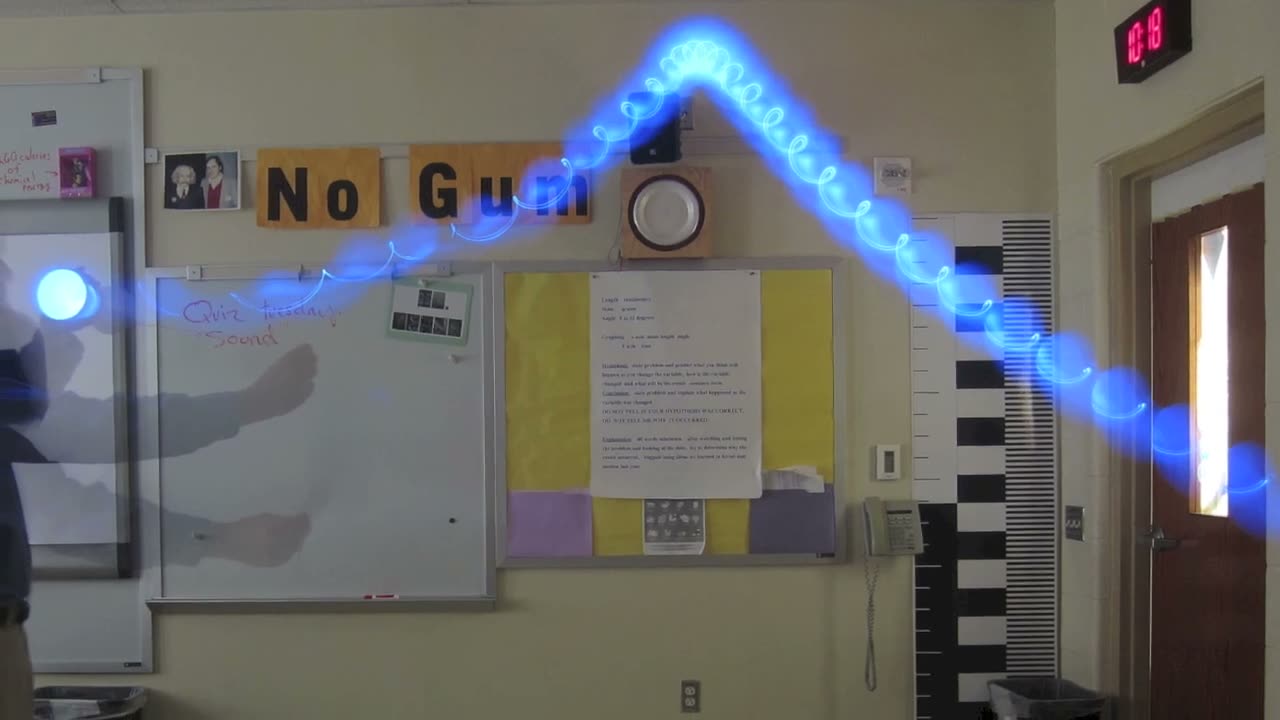
You'll make a cup flyer from two cups and a chain of rubber bands. When you launch it, the cups spin as they fly, and instead of dropping to the floor they swoop upward. Change the way it spins and you can make it dive or curve sideways instead.
“There's several variables that they can change and they will see how they affect its flight path.”
Build it
Choose two cups that are the same size. Foam cups are the easiest to start with.
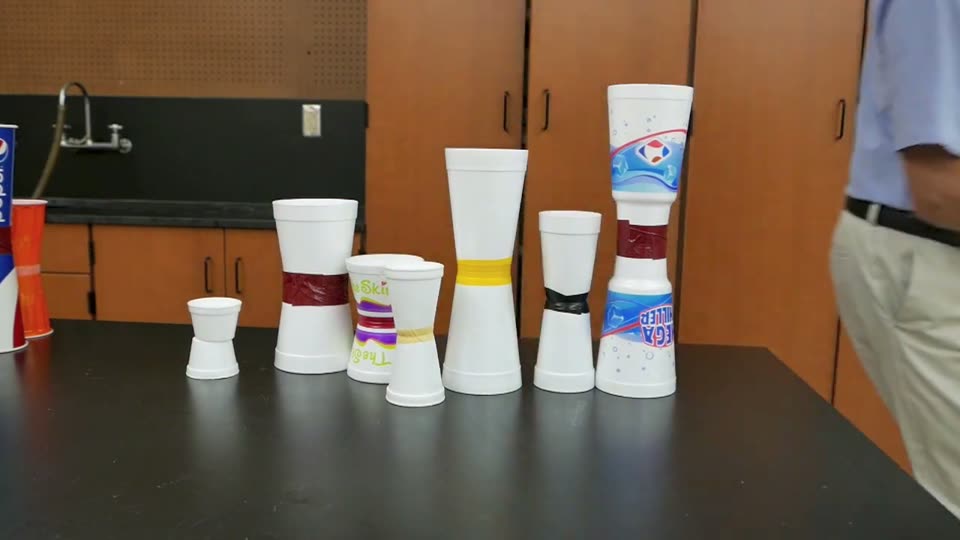
Hold the cups bottom to bottom and press them tightly together.
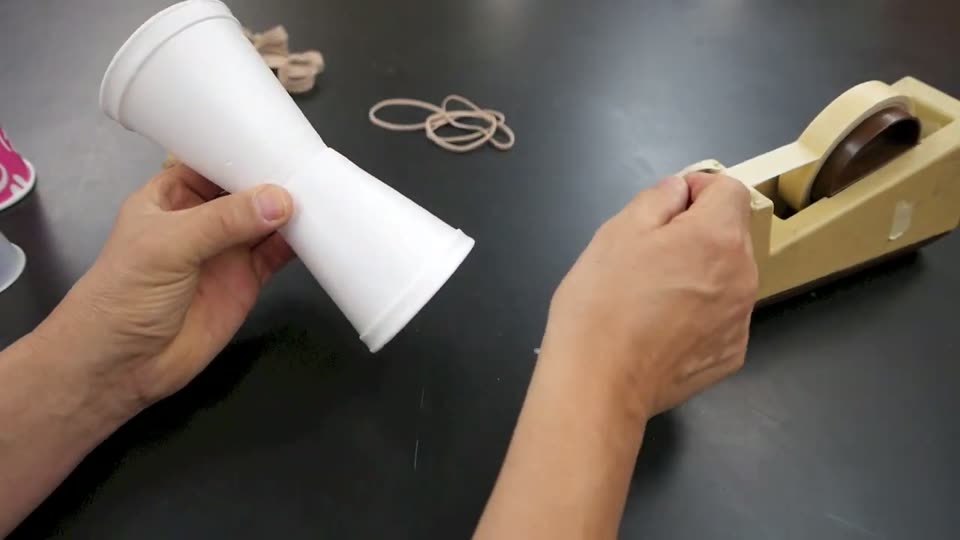
Wrap the strip of tape around the middle where the bottoms meet. Press it down tight so the cups can't wobble.
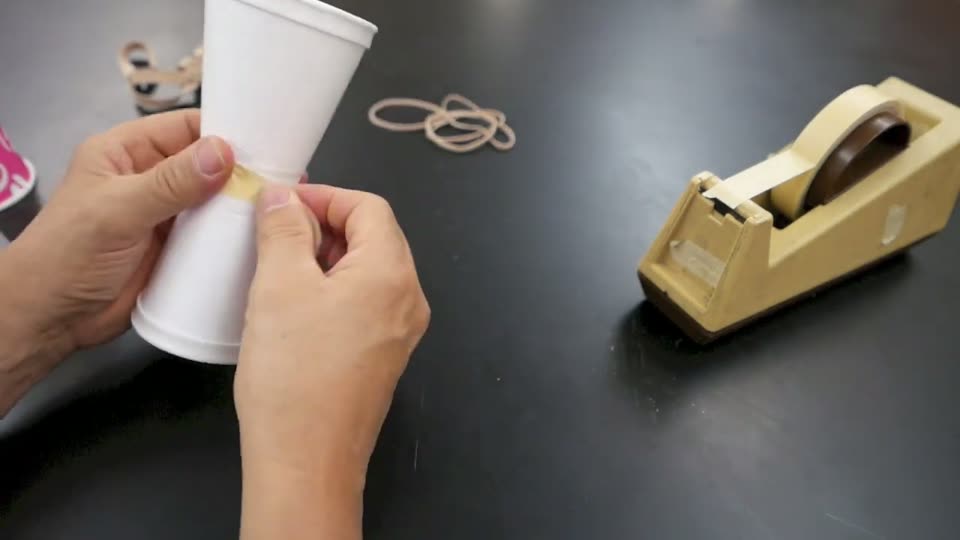
Loop four small rubber bands together, one through the next, to make one long rubber band chain.
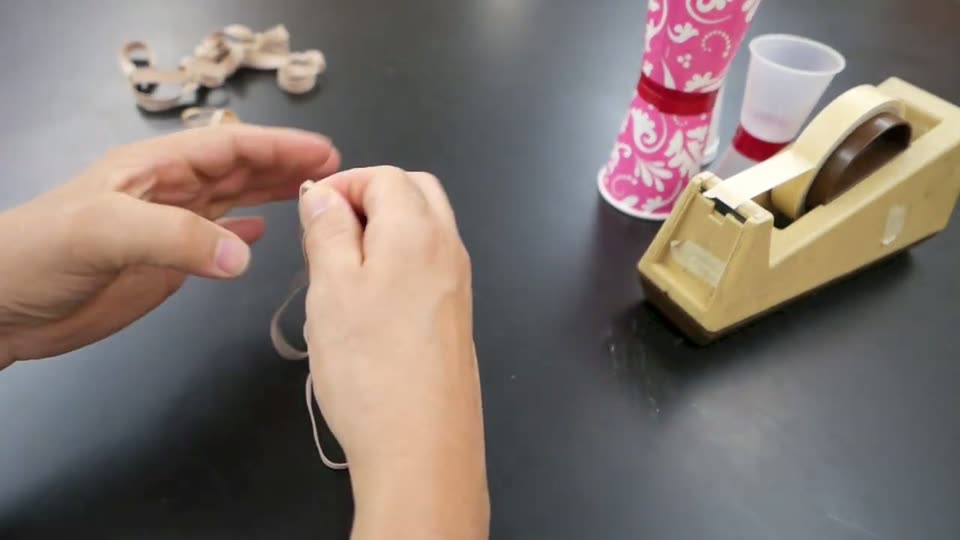
Hold one end of the chain against the tape in the middle of the cups.
Wind the chain around the middle three or four times, so the band comes off the underside of the cups. Leave the rest of the chain hanging free.
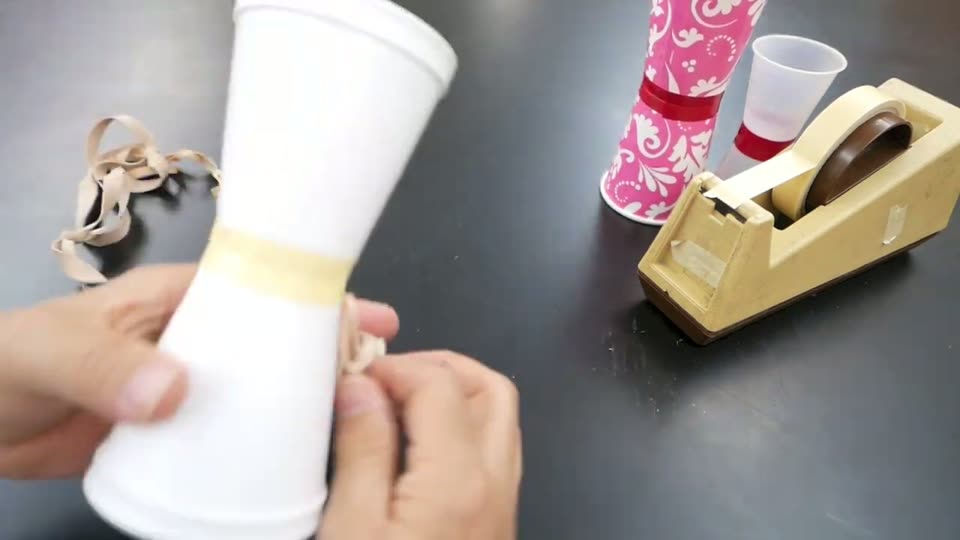
Stretch the band: hold the free end out in front of you with one hand, and pull the cups back toward you with the other.
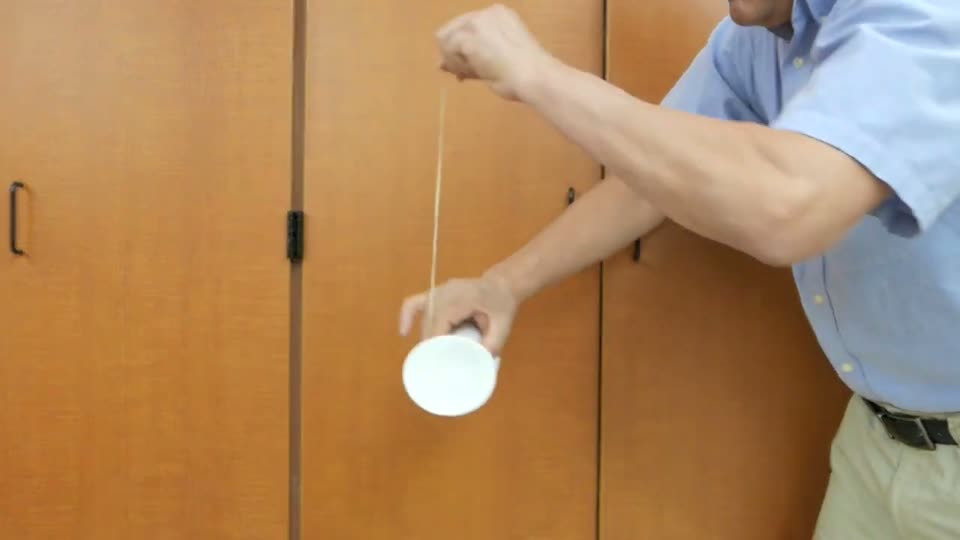
Let go of the cups. The band unwinds, sets the cups spinning, and flings them forward.
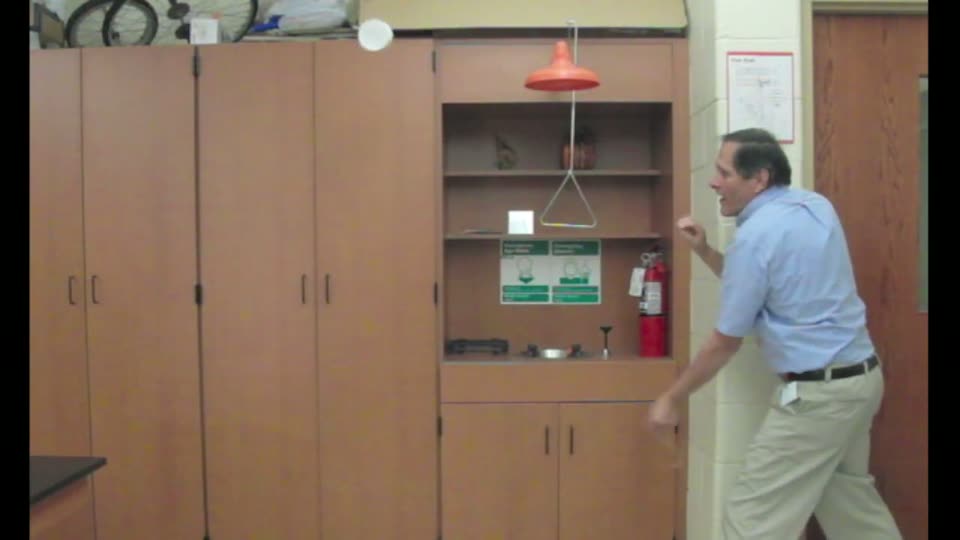
Try it & notice
What's going on?
For young scientists
When the rubber band unwinds, it makes your cups spin as they fly forward. A spinning object drags a thin layer of air around with it, a bit like a spinning wheel flicking water.
With the band coming off the bottom, the cups spin backward (the top moves back toward you). That spin throws air downward behind the cups. When the cups push air down, the air pushes the cups up. This push is called the Magnus effect. On light cups it can be stronger than gravity (the pull that makes things fall), so they climb.
Spin them the other way and the air gets thrown upward, so the cups get pushed down and dive. Stand the cups on end and the push goes sideways, so they curve left or right.
For grown-ups & teachers
This is the Magnus effect: a spinning object moving through air feels a sideways force perpendicular to both its direction of travel and its spin axis. The rubber band gives the cups backspin, so the force points up. Because the cups are very light, wide, and spinning fast compared with their forward speed, the Magnus force can exceed their weight, so the flyer rises and can even loop back on itself, as the LED long-exposure trail in the video shows.
In the video the effect is introduced as an application of Bernoulli's principle: on the side where the cup's surface moves with the oncoming air, the flow speeds up and pressure drops; on the other side the flow slows and pressure rises. An equally valid way to say it is Newton's third law: the spinning surface drags the boundary layer around and deflects the wake, so air is thrown one way and the cup is pushed the other. Both are descriptions of the same flow; neither is the whole story alone.
A common misconception is that the spin itself 'lifts' the cup like a propeller. A spinning cup sitting still feels no lift; the force only appears when the cup also moves through the air. Another is that the cup curves toward the high-pressure side; it is pushed toward the low-pressure side.
To extend it, treat it as a controlled experiment: change one variable at a time (number of wraps, cup size, cup material, launch stretch, spin direction, cup orientation) and record the path or how far the flyer travels. Connect it to sports: backspin keeps golf balls and basketball shots aloft longer, topspin makes tennis balls dip, and sideways spin makes a curveball curve.
NGSS performance expectations
- 3-PS2-1 Plan and conduct an investigation to provide evidence of the effects of balanced and unbalanced forces on the motion of an object.
- 3-PS2-2 Make observations and/or measurements of an object's motion to provide evidence that a pattern can be used to predict future motion.
- MS-PS2-2 Plan an investigation to provide evidence that the change in an object's motion depends on the sum of the forces on the object and the mass of the object.
Science words
Tips from 41 years of teaching it
Bruce's files don't include a write-up of the cup flyer itself, but his Bernoulli handout shows how he warmed students up to the idea that moving air changes pressure.
- Bruce starts with the simplest Bernoulli demo before anything that flies, and always has students predict first. Most are surprised by the answer.
- His one-line version of Bernoulli's principle: the faster a fluid (like air) flows across a surface, the less pressure it puts on that surface.
More to try
- Paper bridge: lay a sheet of paper across two books about 4 inches (10 cm) apart and blow under it through a straw. Does the paper lift or dip?
- Hanging bottles: hang two plastic bottles, each with about a cup of water in it, side by side on strings, then blow air between them with a hair dryer. Do they swing apart or together?
- Spool and card: push a thumbtack through the middle of a playing card, hold the card against a thread spool with the tack in the hole, and blow through the spool. The card stays on as long as you keep blowing.
Make it a challenge
Make it dive
Wind the rubber band in the opposite direction so the cups spin the other way. The flyer curves downward instead of up.
Sideways curve
Turn the cups so they stand vertical instead of lying sideways when you wind and launch. The flyer curves to one side.
Giant flyer
Tape two big cups or two popcorn tubs together and launch with larger rubber bands. Compare how far and how high each size goes.
Curve-ball flinger
Tape a cardboard stopper on one end of a tube (a paper towel roll or two snack cans taped mouth to mouth), drop in a light foam or ping pong ball, and fling it with a sweep of your arm. The ball rolls out spinning and curves, just like the cups. Leave a small gap or hole in the stopper so air can get in as the ball leaves.
Light trail
With a grown-up, tape a small battery LED inside one cup and photograph a launch in a dark room with a long-exposure or night camera setting to see the flyer's path and spin.