Build plans / Sound Tubes
Sound Tubes
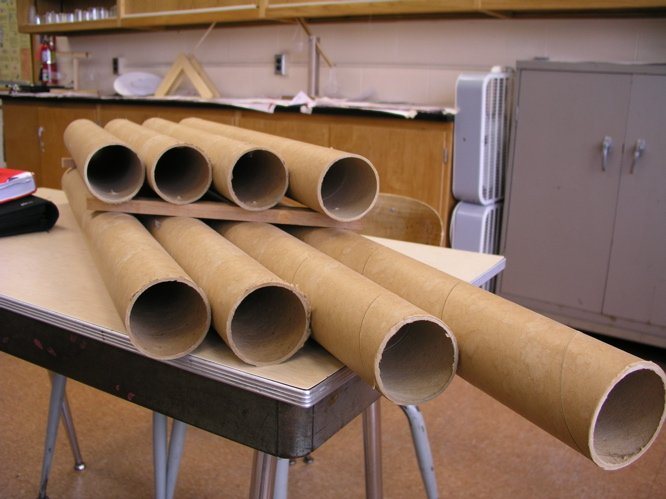
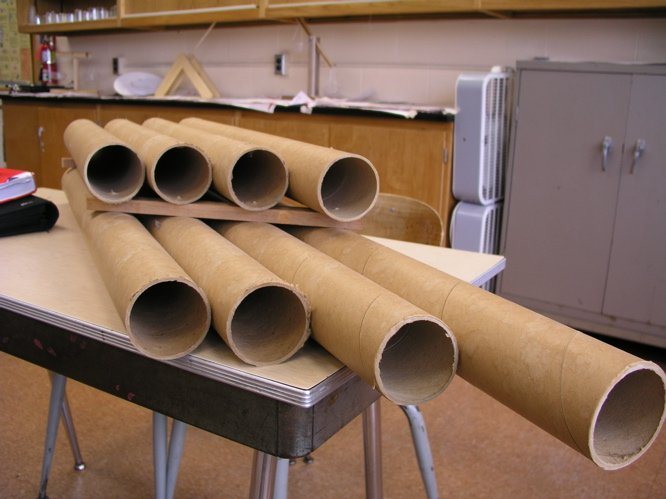
This is a set of open-ended tubes, each cut to a length that resonates at one note of a musical scale. No one plays them: each tube picks out and reinforces its own note from the ordinary noise in the room. Bruce built his from heavy cardboard carpet tubes, but PVC pipe or mailing tubes work too.
Written from Bruce's original workshop handout. Bruce's final review of this plan is in progress.
What it shows
Put your ear to the end of a long cardboard tube and the room's background noise turns into a soft, steady musical note.
Key ideas: resonance, wavelength, frequency, standing waves, musical scale

Build it
Choose the notes and lengths
Each tube resonates at a note whose wavelength is twice the tube's length. Bruce's lengths are: C (130.81 Hz) 1.32 m, D (146.83 Hz) 1.17 m, E (164.81 Hz) 1.04 m, F (174.61 Hz) 0.99 m, G (196 Hz) 0.88 m, A (220 Hz) 0.78 m, and high C (261.63 Hz) 0.66 m. To fill in the scale, B (246.94 Hz) is about 0.70 m.
Cut the tubes
Measure and mark each tube, then cut it square. Wide tubes sound slightly lower than the table predicts, so for tubes more than a couple of inches across, cut them a little shorter (see How it works) or cut long and trim to tune.
Plan the layout
Lay the tubes side by side from longest to shortest. Bruce's original layout was a single row; he later stacked them in two layers to save space. Neither sounds better than the other.
Drill screwdriver access holes
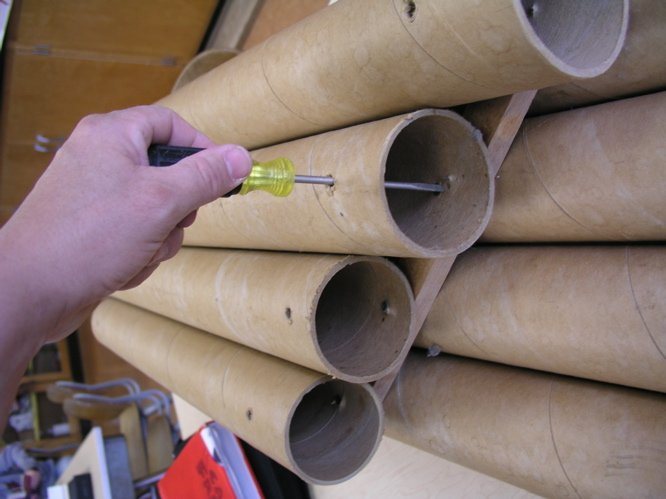
Drill small holes in the cardboard opposite where each screw will go, so a screwdriver can reach in through the tube wall.
Fasten the tubes to the wood strips
Screw or bolt each tube to the wood strips, working through the access holes. Keep both ends of every tube open.
Label and mount
Label each tube with its note. Add hooks if you want to hang the set on a wall.
Listen
Hold your ear close to (not against) the open end of a tube in a room with some background noise. Move from tube to tube and listen to the scale.
How it works
The background noise in any room contains a jumble of frequencies. A tube that is open at both ends traps sound waves bouncing back and forth along its length, and only waves that fit neatly, with a wavelength of twice the tube's length (and their multiples), reinforce themselves. That note grows louder while the others fade, so the tube seems to hum.
Frequency and wavelength are linked by the speed of sound: frequency = speed / wavelength. With sound traveling about 343 m/s at room temperature, a tube 1.32 m long has a fundamental wavelength of 2.64 m, giving about 130 Hz, the C an octave below middle C. Halve the length and the note goes up an octave.
The vibrating air column actually extends a little beyond each open end. For each open end, add about 0.3 times the tube's diameter to its length when calculating, so a wide tube sounds slightly lower than its length alone suggests. Cutting each tube about 0.6 diameters shorter than the table corrects for this.
Using it
- Have students listen to each tube and match its note on a keyboard or tuning app.
- Measure a tube, predict its note from the speed of sound, then check the prediction with a frequency app.
- Cover one end of a tube with your hand and listen again: a closed tube resonates about an octave lower, because its wavelength is four times its length.
- Compare with the musical bottles activity, where blowing across a bottle excites a similar resonance.
- Ask: why do the tubes still hum in a quiet room, and what happens when someone talks or claps nearby?
Variations
- Use PVC pipe for a sturdier, smaller-diameter set; tap the ends with a flip-flop to play it like a tube xylophone.
- Build a shorter set an octave higher; each tube is half the length.
Troubleshooting
More build plans
Balloon Fog Horn
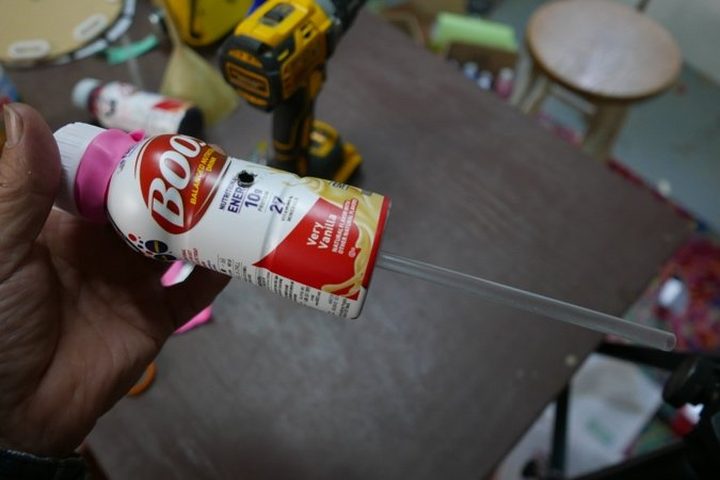
Blow into a little plastic bottle and it lets out a deep, buzzing honk like a ship in the fog.
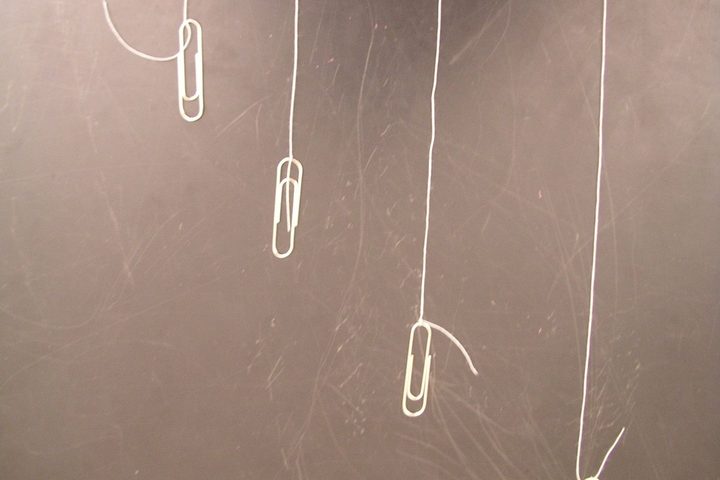
F.A.K.E.D. Resonance Pendulums
Ask the class to move just the orange ball with their minds, and watch it swing while the other three hang nearly still.
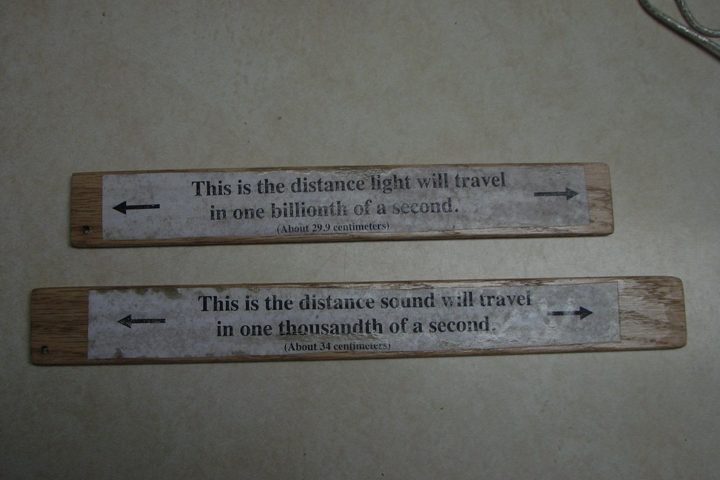
Nanosecond of Light and Millisecond of Sound Sticks
Two sticks of almost the same length: one shows a billionth of a second of light, the other a thousandth of a second of sound.
© Bruce Yeany · Homemade Science with Bruce Yeany · youtube.com/@YeanyScience
Free for personal and classroom use. Please don't resell or republish. Build and use at your own risk; follow the safety notes and supervise children.