Experiments / Siphons
Siphons
How can water climb up and out of a jar?
Fill a tube with water and it will empty a jar all by itself, climbing up and over the rim on the way.
Based on Bruce's demonstration in the video below.
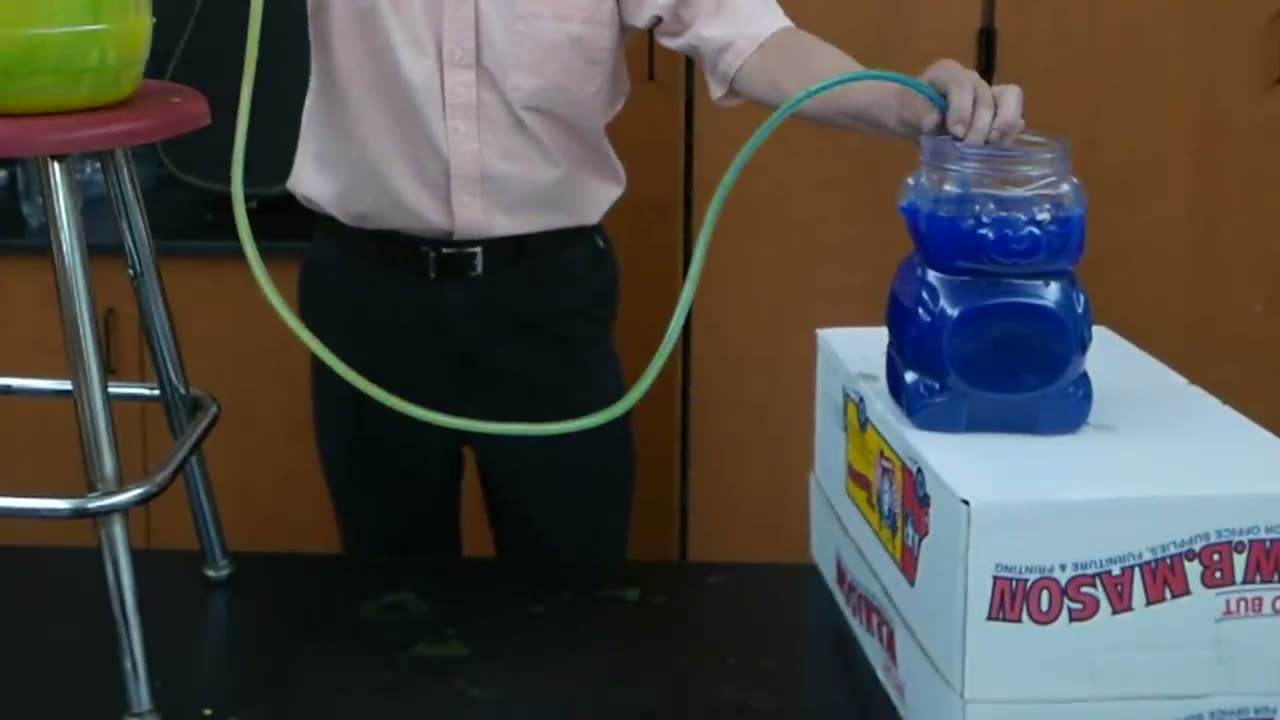
You'll use one long tube filled with water to move water from a high jar to a low one. The strange part is that the water has to travel up and over the rim of the jar before it can come down, and it keeps going by itself, always toward the lower water. Then you can build cups that empty themselves.
“A siphon works because gravity is pulling down on the taller column of liquid leaving reduced pressure at the top of that tube.”
Build it
Set up in a sink, a bathtub or on a big tray, with a towel nearby for drips.
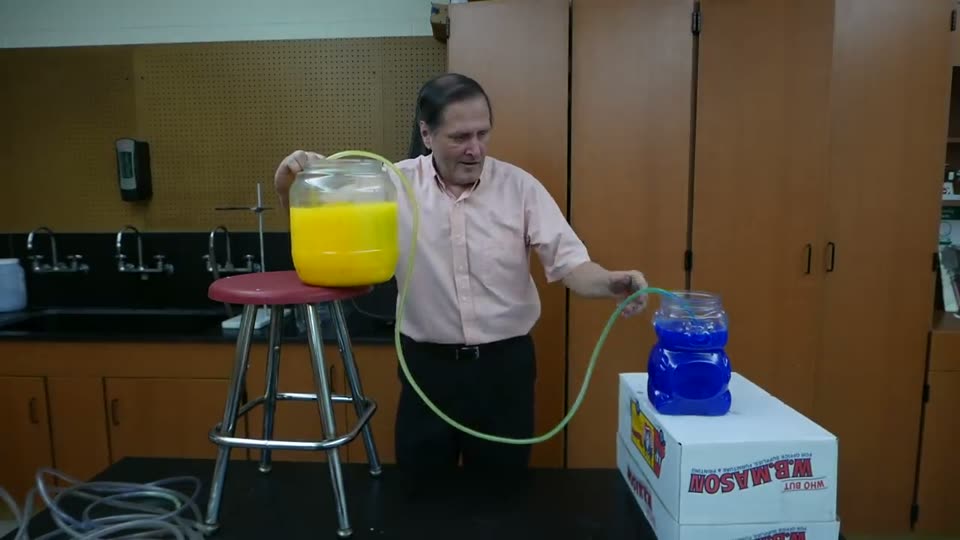
Put one jar up high on a box or a stack of books. Put the other jar, empty, down low next to it.
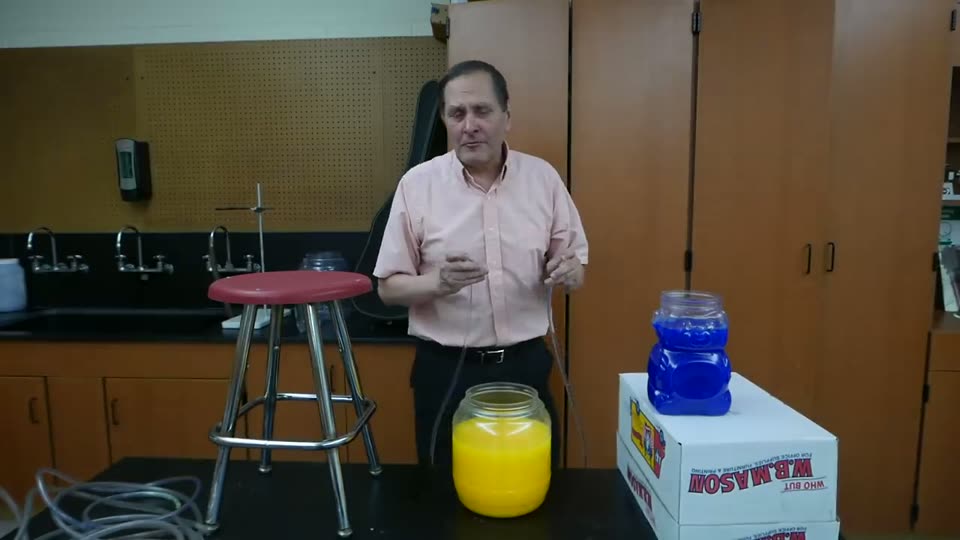
Fill the high jar most of the way with water and stir in a few drops of food coloring, so the moving water is easy to see.
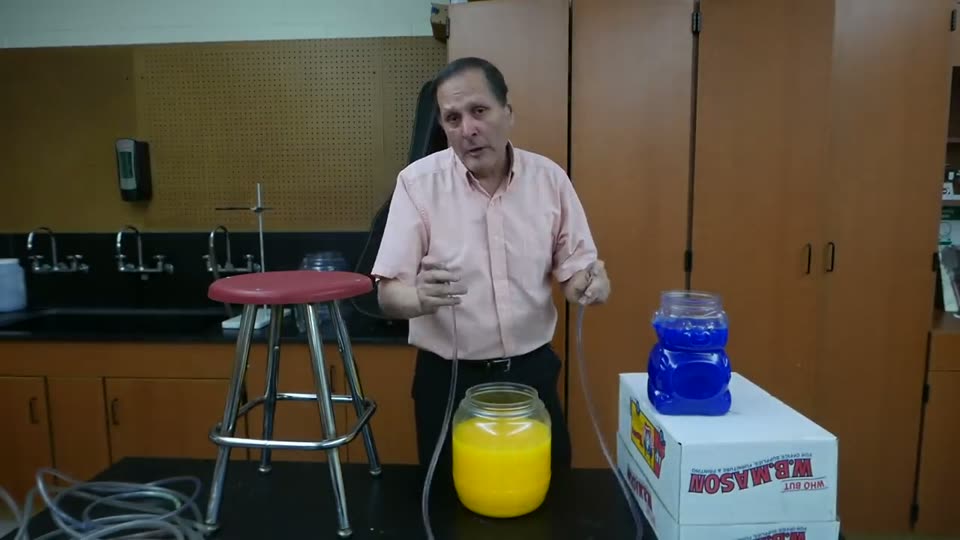
Fill the tube with water: coil the whole tube down under the water in the high jar until no air bubbles are left inside. (You can also fill it at the tap.)
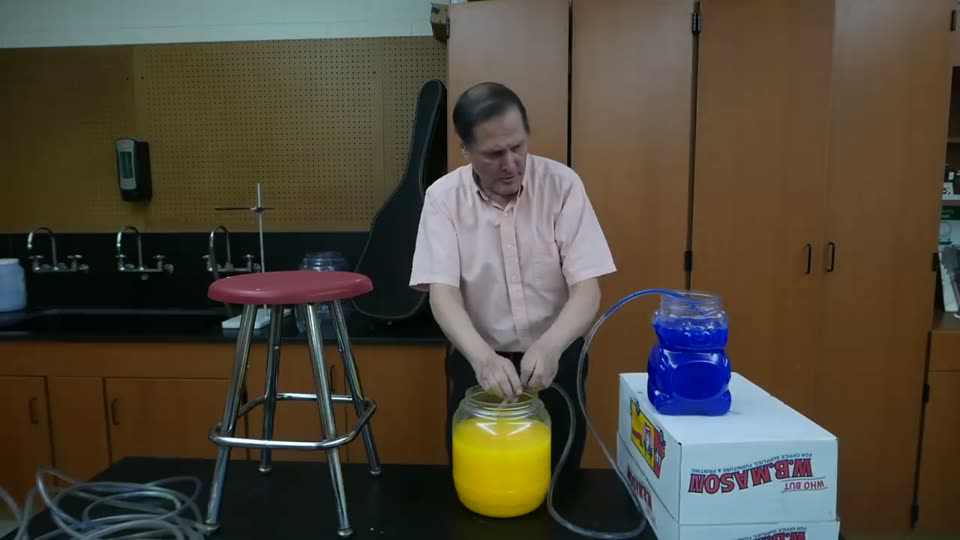
Press your thumb tightly over one end of the tube. Keep the other end under the water in the high jar.
Lift your thumb end out over the rim and down into the low jar, keeping your thumb pressed on.
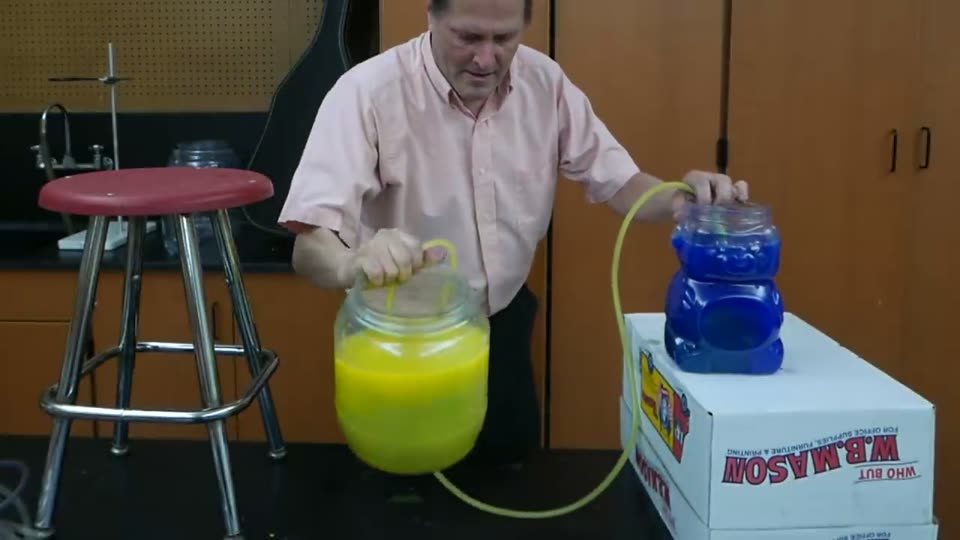
Take your thumb away. Watch the colored water climb up over the rim of the high jar and pour down into the low one.
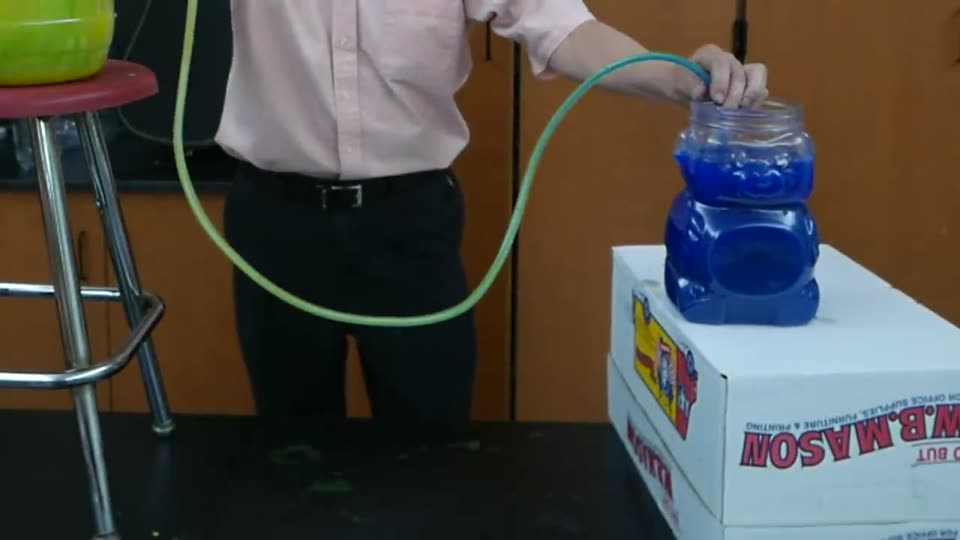
Grown-up: Lift the low jar (it's heavy now) up higher than the other jar, keeping both tube ends under water. Watch which way the water in the tube moves.
Try it & notice
What's going on?
For young scientists
A siphon only works when the end of the tube is lower than the water in the high jar. The water in the long side of the tube falls down and out, and that leaves the water at the top of the bend with less pressure (less push) than normal.
Meanwhile the air is pressing down on the water in the high jar all the time. With less push at the top of the tube, that air pressure shoves more water up into the tube to take the place of the water that left. So the water climbs up, over and down, again and again.
The tube has to start full of water, because a big air bubble at the top stops the trick. The flow keeps going until the two water levels are the same height, or until the high jar's water drops below the end of the tube. Raise one jar and it starts again, always heading toward the lower water.
For grown-ups & teachers
In the video, a siphon runs because gravity pulls the taller column of liquid down the outlet side, leaving reduced pressure at the top of the tube; atmospheric pressure on the reservoir then pushes liquid up to replace it. It always flows toward the lower potential: the outlet must be below the reservoir's surface, and swapping the heights reverses the flow. In energy terms, Bernoulli's equation gives an outlet speed of roughly the square root of 2gh (h = drop from reservoir surface to outlet), minus friction losses. The height of the bend decides whether it works, not how fast it runs.
A common model treats the water like a chain being pulled over a pulley, relying on cohesion between water particles. The video calls this flawed: a siphon still flows when there are gaps in the liquid (the flying drop siphon shows exactly that). It is the change in pressure inside the longer tube, not the weight of the liquid, that matters; if weight alone decided it, a setup with a wide, heavy reservoir-side tube could make liquid flow uphill, and it doesn't.
The bend can go surprisingly high: in the video a siphon lifted about 18 feet still flowed. The limit with ordinary water is about 10.3 m (33.9 ft), because the pressure inside drops by about 10% of atmospheric for every 100 cm of height. Near that height a near vacuum forms, dissolved gas comes out as bubbles (cavitation), and when the gap gets big enough the siphon stops. Removing dissolved gases first (degassing) can let a siphon go higher.
Siphons are used to clean aquariums, irrigate crops and flush toilets, and they even occur in nature. The Tantalus (Pythagorean) cup and the bell siphon are siphons that start themselves once the water rises above the top of the hidden tube. To extend it, use the investigations from the end of the video: how high can the tube be lifted above the reservoir, what happens as you increase the distance between reservoir and destination, and how do changes to the liquid or the tube's diameter affect the flow rate.
NGSS performance expectations
- 5-PS2-1 Support an argument that the gravitational force exerted by Earth on objects is directed down.
- MS-PS3-2 Develop a model to describe that when the arrangement of objects interacting at a distance changes, different amounts of potential energy are stored in the system.
- 5-PS1-1 Develop a model to describe that matter is made of particles too small to be seen.
Science words
Tips from 41 years of teaching it
Bruce wrote up the Tantalus cup as a way to sneak a siphon into a plain-looking cup. Here's what his notes add.
- For the Tantalus cup, drill the hole in the bottom a little smaller than the straw so the straw squeezes through tightly and doesn't leak. If it leaks, Bruce tries another cup with the next smaller hole, or seals around the straw with hot glue.
- Bruce lengthens the short end with a second bendy straw: cut a slit about 3/4 inch (2 cm) into one straw so it slides into the end of the other. A dot of hot glue or a rubber band keeps them together, and cutting the long end at a slant makes it easier to feed through the hole.
- Put the straw at the edge of the cup instead of the center. Then, when the cup is almost full, you can start the siphon just by tilting it.
- Paint a red line on the cup at the height of the top of the straw and add a sign: DO NOT FILL ABOVE THE RED LINE. Bruce found few kids can resist adding a little more.
- Below the bend the cup behaves like an ordinary cup you can drink from; only when the water rises over the top of the straw does it drain completely.
In Bruce's first classroom there was one tiny sink for the whole class, and students splashed water everywhere trying to pour out their wash buckets. He turned two 5-gallon buckets into giant Tantalus cups with PVC pipe, so after washing glassware students just started the siphon and let the bucket empty itself into the sink.
More to try
- Fill a Tantalus cup only halfway. How can you start the siphon without adding more water? Once it's running, how can you stop it?
- Will a siphon still work if the supply end of the tube goes into a sealed container? Predict, try it, and explain.
- Look up the myth of Tantalus and work out why the cup is named after him.
Make it a challenge
Make a Tantalus cup
Push the short end of a stretched-out bendy straw up through a hole in the bottom of a plastic cup so it hooks over inside, with a grown-up sealing it with hot glue. The cup holds water until you fill it above the top of the straw's bend (or tilt it to cover the straw), then the siphon drains it completely.
Bottle bell siphon
With a grown-up, cut the bottom off a plastic bottle and drill a hole in the cap slightly smaller than a straw, then push a straw snugly through the cap and screw it on. Cut small slits in the top of the straw, stand a test tube upside down over it so there's a slight gap at the bottom, and pour in water until it suddenly drains all at once.
See-through bell siphon
Shape an upside-down U of modeling clay around the top of a plastic tube, sandwich it between two clear plastic sheets and hold it with six binder clips. Leave a gap at the bottom and a small gap at the top, pour water in, and watch exactly when the siphon kicks in.
Flying drop siphon
Run a siphon tube into a plastic bottle, with a tube inside that carries the liquid upward and a second tube in the cap as the drain. Put a little water in the bottle, close it, put the hose end in the reservoir and turn the bottle over: a little water drains out, the pressure inside drops, and the siphon starts even though the water falls as drops inside.
Flow-rate races
Time how long it takes to fill one cup when the low jar sits on the floor, on a chair, then on a table. Then try a thinner or wider tube, or a squirt of dish soap in the water, and compare (fill-the-tube start only, never by mouth).